Cape May

Cape May
(RE BERG-ANDERSSON)

Sunday, March 11, 2012

Soiled, but Saved

This is a story about an act of stupidity, an act of kindness and some harlequin ducks. To protect the identity of the stupid, we'll call the protagonist ME.

After a winter waiting for the snow that never arrived ME decided she had to go to Barnegat Light, the northernmost point of Long Beach Island, down the Jersey shore.

It is a long ride down from where ME lives, but the back roads she and her husband take goes through the Pinelands, and the bracing air and bright light off the ocean makes it an enjoyable trip.

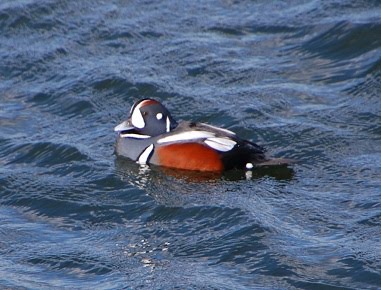
Harlequin ducks. Even the plainer
females are striking.
ME and her husband had never been to Barnegat in March, usually breaking up winter's monotony in January or February. The aim is to see what winter ducks and shorebirds will be on the sides of the jetty or in the inlet between Long Beach Island and Island Beach state park. This trip was also the first where the tide was low, so low the barnacles on the rocks were exposed and thousands of gulls were attacking them or each other, in the water and in the air.

Beyond the paved promenade was the jetty of huge, flattened rocks and several people were already walking on it toward the end where, in the past, eiders have hung out along with mergansers, longtailed ducks, purple sandpipers, ruddy turnstones and the ducks that make Barnegat famous, the harlequin.

The harlequin is, to me, the most beautiful duck around, particularly the male. But even the duller female is striking. (The only ducks that come close, in my view, are the male and female wood duck.) They are the reason why ME and her husband came.

So ME started to climb through the fence blocking the paved walkway from the jetty and her notebook fell out of her pocket, between two rocks.

What made this so incredibly stupid was ME's pockets could be snapped shut but she hadn't done it.

ME was very lucky. First, it was low tide - at high tide the notebook would've been soaked and useless. There was two years worth of data on its pages, which would mean little to anyone other than ME.

The jetty from the beach side. The ducks would be
on the other side.
Second, she was unable to think anything other than "I WILL get that notebook." Failure was not an option.

And so I - er, ME - shimmied down between the two rocks and managed to get the notebook between her feet. The problem was being able to pull up the legs enough to get the notebook. This was not easy.

Meanwhile, ME had drawn a crowd. Her husband was horrified. He was afraid ME would get stuck.

He was justified in that fear. Several years ago a man wrote a post on the NJ bird list detailing how he had been on the jetty rocks, heading toward the end, when he slipped and fell headfirst between the rocks, unable to get to his phone and call for help. It had been a particularly bad weather day and it took a long time for someone to happen along who could call for assistance.

So there was ME, remembering that story, trying to pull up that notebook.

Here's where the kindness comes in: A man asked if "a skinny guy like me" could help ME. ME hauled herself out from between the rocks - again, not easy - and he was able to get low enough to reach forward and pluck the notebook from the deep!

Oystercatcher
ME thanked him profusely, thanked his wife, thanked perfect strangers for their support.

Her husband handed ME her binoculars and camera - which she had smartly, for once, removed - and asked what they should do now. ME decided she'd had enough of the rocks, let's walk on the beach to the end and then try to get back up and find the harlequins.

ME secretly despaired of finding the pretty ducks with all the gulls attacking the side of the jetty. With each step on the sand her legs hurt, there was a stitch in her side, and the boots, camera and binoculars started to feel like 100 pounds each.

ME was thinking, the hell with it, let's go home.

There are many good things about birding including being outside, stimulating the mind to figure out what you're hearing or seeing and, if lucky, joining with others in mutual exploration.

But there are bad things about birding. One is that you quickly realize when you are out of shape, out of breath and aging rapidly. There is also a great feeling of inadequacy some of us feel when we are in the field and have no idea what we're seeing, or have seen nothing only to see from the bird lists that others have found 15 things, including something you've always wanted to see, at the same place that day.

Seal, pulled out with the tide.
Land birds are more my thing, warblers and tanagers and hawks and nightjars. At the shore I can't tell a second-year herring gull  from a first-year greater black-back gull. A semipalmated sandpiper and a least sandpiper would have to be standing still next to each other for me to tell them apart. I like ruddy turnstones, however, because their orange legs and breast coloring make them stand out, and I do like the ducks that come to Barnegat in winter and the two types of loons - common and redthroated - that visit as well.

So ME was walking with her husband down the beach, the enormity of what could've gone very wrong going after her notebook just hitting her, making her swear that was it, she was NEVER going birding again, when another woman with binoculars walked past them in the other direction. "See much?" ME asked. "Some harlequins, some turnstones," she said.

After thanking her ME caught up with her husband, who had kept going. "They're here, despite the gulls," ME said. So they carefully went back up on the rocks and almost immediately ME found an oystercatcher, its orange bill making it stand out amid the gulls. In the water were the loons, the longtailed ducks, some common mergansers and, on rocks that had no barnacles and so no gulls bothering them, the harlequins.
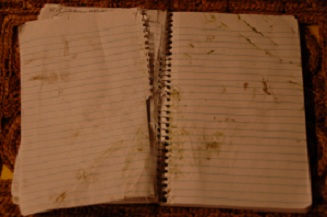
Soiled, but saved.

And something else. Something big and gray came up on the water and ME looked through her binoculars and shouted "Seal!" while somehow getting the camera up and shooting two pictures before the seal went under.

"Good eye, lady," a man on the beach yelled at ME.

Well, yes. Thank you. It is sometimes better to be lucky than good.
And this day proved there was nobody luckier than ME.

Sunday, March 4, 2012

(Early) Spring Cleaning

Meet the reason I have to
put up with fencing.
I don’t know about you but I am neither mentally or physically ready to start gardening.

Last year at this time, according to the garden diary I keep, we had just gotten rid of the last of the heavy pile of snow that had blanketed the yard all winter. I was newly unemployed and eager to get out and get the garden ready, to welcome spring and the warmth and pretend the snow had never happened, like a bad dream.

This year we haven’t had any sizable snow since Halloween. This has been good and bad. Good for me driving to work, bad for my plow guy having nothing to do. Good that I haven’t had to shovel. Bad that the lawn and yard plants did not get the moisture from any melting snow, just a few heavy rainstorms.

And yet, here are my crocuses in full bloom, several weeks early. Here are my daffodils coming up, a few even flowering, and here are the tulips and iris coming above ground. All were surrounded by last year's tree leaves and debris.

When I went outside this March morning, only planning on putting a now-spent snowdrop plant a friend had given me into the ground, I wound up, as usual, doing three more things I didn’t expect to do. The liriope, which blooms in the fall, had to be cut back or no one would be able to see the daffodils just coming up. There were swirls of early weeds that had to be removed so the snowdrop wouldn’t be overwhelmed. There were leaves to scoop up and put into compost.

And, of course, to get to these things I had to pull down the deer netting.

There is an art to gardening with deer netting, and someday I must think about what I have learned to do and not do and write it all down. I am sure I am not the only person who has had to garden this way in the suburbs. Had I known 15 years ago when I was putting in my garden what I know now, the garden would look very different. No azaleas. No tulips. No euonymous bushes. All are behind deer netting now as are the small yew bushes in back.

Little by little I put in “deer-resistant” plants but have learned from long and painful experience a hungry deer will take a bite out of just about anything. So almost everything is behind a net, except the large ornamental grasses, onions and daffodils that are unfenced in a plot in the back where I once had an apple tree.

The thin plastic poles I put in to hold up the doubled netting (because a deer can easily chew or put a hoof through one layer) have worked better than metal poles the deer could use to support its weight as it tried to get to the plants. But the plastic poles shred easily, catching the netting in the breaks. I discovered quite a few poles with this problem this particular morning, making a hard job harder.

Luckily, I was able to work in relative quiet. No dogs in the dog park at what was once Greystone. No neighbors’ dogs chained in the backyard barking to be let in or defending a territory five times bigger than you or I may think it should be. I could listen to the birds already singing their territorial songs including cardinals and chickadees and titmice.

I’m sorry but after a week in a noisy, crowded newsroom I enjoy quiet on the weekends. It is why I moved to the suburbs. (My husband likes to remind me the noise level in our old city apartment was far worse than anything the neighbor’s dog can do, and he‘s right. Car alarms and bullets are worse.)

Once I was done I felt a sense of accomplishment, as well as the pain in my knees and shoulders.

But I also saw there is so much more to do now that the mild winter has prompted premature growth.

My butterfly bush,
as it will look later
in Spring.
Soon the grow-through rings will have to be put around the plants that would otherwise flop over. Soon the butterfly bush will have to be cut back (half of it was already cut back in November after the Halloween storm when I anticipated another snowy winter - which didn’t happen this snow-free winter). Soon I’ll be fighting squirrels for the apples, putting up the house for the visiting wren and taking in the seed feeders.

There will be more daylight, more noise, more chores to do.

This is as it should be. I would rather be achy and active than one of those people whose idea of spending a weekend is in front of a videogame, or playing virtual sports rather than real ones. I also prefer landscaping that is creative and pretty and not just the same old ilex or barberry that can keep its shape and requires the homeowner to do nothing.

I see lots of that kind of landscaping in my town and when I drive through the streets of much wealthier Englewood Cliffs to get to work. The huge homes now there (where once there were smaller dwellings) take up almost all the lot and the front “yard” is cut through with a circular driveway, the better to park your Mercedes or Lexus or BMW and show everyone how well-off you are. The yard services show up every week, whether the little bits of lawn need it or not. Plants are replaced with the season and deer netting is not necessary.

Thus I can have a “care-free” and sterile garden where I never have to come outside or I can continue to plant my vegetables and different types of annuals and perennials, even if that means having to do so above, below or behind deer netting.

I guess you’ll be seeing me outside, achy knees and all.

Sunday, February 26, 2012

My Grail Bird

These are not Wilson's warblers.
They are goldfinches.
There are people who want to see every bird on earth. There are people who want to find the ivory-billed woodpecker.

I would like to see a Wilson's warbler.

It is a peculiar truth that what is a common bird for some is far from common for me.

In Chicago once, my husband (MH) and I were standing on the shore of Lake Michigan in a downpour made worse by one of the Windy City's patented gales. Trying to hold up my umbrella in one hand while focusing my binoculars with the other, a man in his rain slicker, shorts and sandals came bounding up and asked, "Have you seen the loon?"

We're all loons here, brother, I remember thinking. But he was looking for a common loon that had been reported, which while common on placid Lake Sunapee in New Hampshire when we visit is not so common on choppy Lake Michigan.

In Playa del Rey in California I was able to add 10 birds to my life list within 15 minutes on Ballona Creek because they were "common" to that area and not to New Jersey.

In Florida I saw two types of kites, a limpkin, a woodstork and an anhinga, plus a lot of prothonotary warblers. When one of these warblers appears in the New York area it always causes a stir among birders.

Wilson's warblers, however, are common to my area. Every year when the warblers move through Central Park there are Wilson's. Every year they are reported in New Jersey.

A prothonotary warbler I photographed
near the NY Public Library. You can't
see the big crowd this little guy drew.
One year one was reported - and photographed singing - in Bee Meadow Park in nearby Hanover. The next day I rushed out there but couldn't find anything in the area except a kid on a motorbike going round and round and pretty much killing any chance of finding anything else.

My good luck in finding a gray-cheeked thrush, a life bird for me, in another part of the park didn't sink in for quite some time because of my disappointment over that missed Wilson's.

Once I thought - maybe - I heard a Wilson's singing in a brushy area near a part of the Great Swamp wilderness area in Harding Township. MH was sure a Wilson's came to our feeder several years ago while I was at work because, he swore, it did not look like a goldfinch. Wilson's are yellow below with a green back and the males have a black cap. Neither sex have wingbars, unlike the goldfinchs.

It is likely the reason I want to see a Wilson's is just because it is such a common bird. It is a point of pride.

I doubt I'll ever see an ivory-billed woodpecker, if one is still around in that Arkansas swamp where it was allegedly found. I doubt I'll ever see any of the Siberian birds that get blown across the Bering Strait to Alaska. There are thousands of species of birds around the world that don't come anywhere near North America, much less New Jersey. I can accept this. But the Wilson's is another matter.

MH has never seen a redheaded woodpecker, but it doesn't bother him. He's more laid back about birding than I would be in his position.

This is not a redheaded woodpecker.
It is a pileated woodpecker.
You may think you've seen a redheaded woodpecker but chances are it was the more common redbellied woodpecker (whose red only goes down the back of the head) or the pileated (whose red is on the crest) . The redheaded woodpecker has an entirely red head, white breast and belly and a back that is solid black and white.

It is a striking bird. The first time I saw one was after a report that it was in a tree along the driveway to the old Great Swamp visitor center - practically in my backyard. I had to go. I almost missed it, too, but for the kindness of another birder who practically walked me to the tree where the woodpecker was preening for another birder's camera.

Several times we've tried seeing a redheaded woodpecker. For MH's own good, of course.

But we keep missing it, at Great Swamp where there's usually one every year; at Lord Stirling Park, which is Somerset County's part of the Swamp; and even at the New Jersey Audubon's Scherman Hoffman center, where one was at the feeders for several days the other month. When we got there a crowd in the driveway was watching the distant trees.  Something moved and I pointed it out to MH. Then I realized it had a solid black back...a pileated.

A good bird, but not THE bird.

MH calls these wild bird chases my hunt for the Grail Bird, which was the title of a book about the hunt for that ivory-billed woodpecker mentioned before. We always want what we haven't had, and in my case not seeing a "common" bird others have seen as regular as clockwork sticks in my craw. It reflects badly on my abilities as a birder, even as others tell me I'm pretty good at it.

It is a fine line between enjoying a day in the field and obsession, and I walk it every day.

But spring is nearly upon us, and with it will come birds heading north. Maybe this will be the year I see the Wilson's warbler.

Sunday, February 12, 2012

Geese on the Grass (Alas)


To paraphrase Paul Simon, the other day it was my birthday and I hung one more year on the line.

I got up that morning and went outside before getting ready for work. Two cardinals were battling it out musically. The songs signify “this is my territory” to other males and “I can sing louder and longer and be a better provider” to females. These songs should not be sung in mid-February but with this year’s unusual weather all bets are off.

Just before going inside I heard the honking of Canada geese. A small flock was taking off from the small stream behind my neighbors across the street on the county Greystone property.

How most people see Canada geese.
These were local geese, and they were heading someplace close such as one of the town ponds or the elementary school ballfield. They'd be back at dusk, like commuters.

We've all seen the long Vs of migratory geese heading north in spring and south before winter. Many times geese will fly south from the tundra to a lake in upstate New York or New Jersey, only to have to move on after that water freezes. You can tell they are migrants because the flock is very large and very high in the sky.

The local geese, despite being in New Jersey for generations, also get restless, that instinct that says “we must move” during migration times and “we must find more food” during the winter not quite extinguished.

All Canada geese look the same so when huge flocks gather in parks or office lawns, one can’t shoot them because they are protected by federal law. Some companies use dogs to scare the geese away, pushing the problem to another office park, or silhouettes of men or dogs on the lawns, the suburban equivalent of a scarecrow that works about as well when the geese realize nothing is moving.

Geese like short grass so they can see predators coming, making manicured lawns or decorative ponds perfect habitats.

There was a lot of screaming in New York City when scores of Canada geese were captured on a pond in Brooklyn’s Prospect Park and killed. As they do with the rampant deer herds, these people seem to have a romantic notion of "nature" and prefer blaming mankind and leaving the creatures alone or controlling their numbers with “birth control.” For geese, that means finding a nest, somehow getting the parents away from it (no easy task - a well-aimed swat of a wing can break your arm and geese also bite) and shaking the eggs to keep them from forming chicks (thus the parents sit on eggs that never hatch).

There aren’t enough people in the world to do this, and that doesn’t get rid of the geese already around, eating the grass and leaving behind long, green, cigarette-shaped souvenirs. And then there's always next year.

I am for balance, and more than agree it was man  - with his unchecked expansion into hundreds of acres of woods to create suburban sprawl - who created this problem. But  leaving hundreds of Canada geese to flock on - and mess up - hiking trails, business “campuses” and “office parks” is extremely unbalanced, not to mention a health hazard.

In the Bergen County, N.J., town where I work the neighboring company did nothing to discourage the four geese hanging around its fake pond, cropping the lawn and leaving their droppings on the grass. Geese mate for life and have large families.The population grew and the lawn service worked around them. When summer ended and the lawn service put its mowers away for the season, the undisturbed geese had no reason to leave. In fact, others joined them. Sometimes they wander onto my employer's property. It hasn't helped there's been no snow for force them to leave.

 
There are more geese behind me and to the left that you can't see in my picture.
I enjoyed walking the paths between that office and mine, but the picture shows why that has ended. When the geese finished cropping the grass near the pond they moved on. They crossed the footpaths and driveways, leaving their many calling cards. What used to be a long, pleasurable hike became an obstacle course. If I wasn’t shooing 35 geese out of my way I was stepping carefully around droppings everywhere, including bordering public sidewalks. I now stick to the concrete parking lots.

I do not understand why this company and others that go to a lot of expensive trouble to keep the lawns mowed, fed and watered in summer allow geese to literally make a big mess everywhere when the weather gets cold. Maybe it's because no executives walk on the paths, or those employees who do figure the crap literally comes with the territory. Maybe no one wants to be known as anti-goose.

Maybe they shouldn't have sought a perfectly manicured lawn in the first place.

Geese are out of control in recreational parks and fields, too, which means a lot of people are walking or playing in goose droppings. Worse, some people believe it is their civic duty to feed the geese, which only encourages them to stay and make more of a mess.

Canada geese are not the only pests, of course. The populations of a lot of creatures have exploded thanks to man's incursion into what had been untouched lands, usually at the detriment of other species. The deer herd is huge in my area, for instance. In other areas of the country alligators are showing up in people's pools or coyotes snatch little dogs out of backyards. Bears are killing chickens or breaking into homes and bird feeders or feeding from Dumpsters. Skunks and racoons have also discovered people are rather sloppy when it comes their garbage.

Don’t get me wrong, I do like Canada geese. Seeing wave after wave fly in at dusk over the only unfrozen water of Schwartzwood Lake one winter a few years ago was thrilling. Watching a very long skein of geese way up and calling as they fly in migration always stops me in my tracks.

But those are migrants and the others are local pests. As my husband likes to say, in the suburbs we call our rats deer and our pigeons Canada geese.

We created this situation. There aren't enough natural predators to make a dent in this population. We must do something to put nature back in balance, even if that means rounding the geese up and “harvesting“ (oh, the euphemisms!) the meat for homeless shelters. Alot of people are as emotionally - sometimes dangerously - against hunting geese, as they are against hunting deer or bear. But I see no other way around the issue.

In the meantime, watch where you walk.

Sunday, February 5, 2012

Birding With Disabilities

One takes so much for granted in this world. Walking, for example.

Towards the end of his life my father couldn’t get around very well because of Parkinson’s disease. He walked unsteadily but would use a wheelchair for longer distances or attending a family function. One day when I was visiting I decided I would wheel him over to the waterfront four long blocks away, to get him out of the house.

It was an eye-opener for me. The sidewalk cracks and ruts I could cross with nary a thought would get the wheels of the chair stuck, forcing me to strain to push the chair out and jostling him around in the process. Curbs - few were adjusted for wheelchairs as they are now - were another hurdle to be carefully surmounted.

He never complained - we eventually did get to Sheepshed Bay and later I rolled him back home in the street, which was more dangerous but smoother - but I know he would’ve preferred being driven. Even when he could walk better he preferred driving to walking, including to his medical office a block away.

I thought of my father recently when one of my friends happened to mention going up to New Jersey Audubon's Scherman Hoffman refuge in Bernardsville to get something from the store - seed, a feeder, I can’t remember - and had taken her uncle. He is another man who won’t go very far on foot (although he doesn’t have Parkinson’s) and so uses a wheelchair. My friend wanted to get him out of the house and away from the television. While she was inside shopping, she said, her uncle had stayed in the car.

If you enjoy birding or even just taking a long walk, anything that limits your independence can be terrible, and having a disability can be the worst thing to happen. But it can also be a challenge to spur you to overcome it - if you want to do so.

At Scherman Hoffman the handicapped have their own entrance to the education center, from the upper lot to the second floor. From there they go to a classroom or can take an elevator down to the store or up to the outside platform. My friend’s uncle could’ve gotten out of the car and gone, slowly, into the building. But he felt safer in the car.

I contrast him with a woman I’ve met in my birding travels who also can’t get around very well but has a completely different attitude - she birds from her car. She drives to an area and just sits with her binoculars and waits for the birds to come, sometimes for hours at a time. She told me she has seen quite a lot that way, and she is happy with that because otherwise she would not be able to go birding.

Considering the hilly area where it is located, going down the Scherman trails and into the woods is impossible for those who need wheels or are unsteady on their feet. There are no boardwalked trails as can be found in state or federal nature areas such as the Great Swamp or Cape May Point State Park. The older people I see using the trails at Scherman are steady on their feet and not in wheelchairs.

Luckily, a lot of organizations know that as those of us of the Baby Boom generation get older, we don’t want to be kept captive by our disabilities. If you go to a search engine such as Google and type in “birding tours for the handicapped” you will find a host of websites providing tours for those in wheelchairs, the disabled or the elderly. There is even a group, “Birding for All,” with chapters in the UK and the US, that seeks to “improve access for people with disabilities to reserves, facilities and services for birding.”

This is a wonderful thing. Since we can’t make ourselves younger (at least physically; mentally is another matter), if you can’t take yourself out to the woods for a quiet stroll the next best thing, I think, is to go on a tour with others like you who have good (birding) and bad (the pain, etc.) in common and are equally focused on retaining their independence.

I haven’t tried these services linked below, but I might have to once I get too old to get around much anymore. I put them out there for what you can learn from them.

Links:
http://www.birdingforall.com/

http://wildlifetourism.org.au/disabled_birding_tours/

http://www.myhandicap.com/travel-mobility-disabeld-people.html?gclid=CPetxcDnna0CFcfe4AodOF68OQ

http://www.guidedtour.com/?gclid=CJ3xhsXnna0CFQcQNAod6GZQoA

It is a scary thing to lose one’s independence and mobility. I guess that’s one reason people like to look at birds soaring aloft, defying gravity and so free. Icarus wanted to fly so he built wings held together by wax but got too close to the sun, the wax melted and he plummeted to Earth and died. The Wright brothers wanted to fly and created what has become a big silver bird that is such a hassle to get to and ride in that I’d rather drive or take the train.

There are times, like the other day, when I take a long hike with my binoculars and long-lensed camera around my neck and after a while feel very tired. Then something flies over - is that a redtail? - and I get my second wind.

I’d rather be tired on my feet walking than sitting inside at my desk staring into a computer.

Would my father have grown to share my interest in birds had I been a birder back then and driven him to the Bay and sat with him and my binoculars, pointing out gulls and other birds? I’d like to think he’d have at least tried to see and expand his horizons through learning something new, as I did when I pushed his wheelchair so long ago.

Saturday, January 21, 2012

Dum Spiro Sparrow

I was not surprised to draw back the kitchen curtains to find birds all over my four backyard feeders. We were having our first snowstorm of 2012 and the first since the freak Halloween storm in October.

January 2012

The birds were fighting each other as much as they were eating. Within sight were three pairs of cardinals jockeying for position at the house feeder; at least one redbelly, downy and hairy woodpecker each taking turns at the suet; and a host of house sparrows, whitethroats, house finches and juncos at these and the other two feeders, with mourning doves below and a quick hit occasionally by a family of jays.

When the house sparrows hogged the feeder and kept chickadees, nuthatches or titmice out for too long, I’d go on the porch to spook them off so the others could feed. Thanks to one neighbor no longer filling his feeder and another who is slow to refill when his empties, I get a lot of visitors in my yard. I don’t mind this - feeding birds is my way of saying thanks for all the pleasure I get seeing these and others in the wild.

But the birds could care less about my so-called generosity. They are just trying to survive.

When they chase each other or sit at the feeders and open their beaks and hiss or spread their wings in an attempt to look bigger, they are trying to get what they can before it‘s gone. The birds that can’t get to the seed directly will go down to the squirrel baffle or to the ground and peck at the bits of seed dropped by the sloppy ones above. Some have even started imitating the woodpeckers and hanging under the suet feeder, an unnatural feeding position for, say, a sparrow.

It is evolution in action. Those that can adapt will survive.

Birds have lived and died without human help for centuries. That I happen to put out feeders is a bit of luck for the birds that consider my yard their territory, or that have stopped briefly on the way to someplace else.

This storm is not very bad compared with last winter, when we had many more storms and so much snow that stayed unmelted for so long the birds were desperate and I could not keep the feeders filled fast enough. Cardinals, usually quite placid birds, were shrieking at others once they were on the house feeder, the one of the four that can accommodate them. If you don’t eat, you don’t live.

It is the same with people.

As I stand in my warm house after a hot breakfast I am more than aware there are people who do not have a roof over their heads and can only eat through the generosity of houses of worship or the community organizations, some to which I donate money, that feed them.

I am also more than aware that in this crazy world we are living in, I and my neighbors are only one disaster away from being homeless and hungry, too.


A rare moment of peace in a life of toil.
 Many of us who lost our jobs have been searching for months, trying to find anything that can use our talents, frequently losing out to those - usually younger and more mobile, without the same ties of house payments and kids in school - who are willing to work for far less in salary.

Some of us are lucky enough to get a job but it is only temporary, because many big employers have discovered it is cheaper to rent an employee through a staffing company and not pay benefits than it is to put someone on staff. There are always enough people searching for work to hire when the contracted worker is forced to leave.

Some of us work in jobs that are becoming more oppressive. We are being told that suddenly, after many years there, we don’t measure up, and if we don’t work harder and longer and change what we’re doing we will face disciplinary review. We are forced to have weekly meetings with supervisors monitoring our “progress,” and may be told if we don’t accept a buyout we will be fired and get nothing.

This was the reason why the message of that ragtag bunch of kids that became Occupy Wall Street resonated with so many of us in mainstream America.

We are told from birth to work hard and save and we will be wealthy and happy. So we work and we are then told we need this and must have that and so must spend and don’t save and don’t think about old age and retirement. We charge and get into debt. When our employers cut back benefits or end them altogether or fire us at a time of increasing prices for gas and basic foodstuffs like eggs and milk, we are on the edge of the precipice.

We think we were shafted because we followed the rules and the deck was stacked against us from the start.

The birds don’t care what goes on below them. As long as they can avoid predators and find a meal and a branch on which to roost through a cold night, they will live to fly another day and breed when spring comes.


Spring seems a long way off.

Today I learned something from my husband. Not only is the state bird of South Carolina one of my favorites - the carolina wren - but the state motto is Dum spiro spero - While I breathe, I hope. Spero is the root of the word despair - no hope.

Hope is the thing with feathers, wrote poet Emily Dickinson.

When MH told me this phrase I heard it as dum spiro sparrow.

That is another reason why I feed the birds - for a short time I can forget about this life of despair and concentrate on something with feathers.

Sunday, January 15, 2012

Winter Birding

To everything there is a season, and that is true for birding.

Spring and autumn get all the press because that is when the warblers and other tropical migrants pass through on their way north to their breeding areas of choice, or south to the warmer and buggier areas when it is cold up here. Summer is when a lot of birders go to the shore for relief and shorebirds.

I happen to like winter birding when the leaves are off the trees, the cold is bracing and the crowds are sparse. (A lot of birders follow the birds to South America to enjoy summer there.) That doesn’t make the birding any less interesting, especially this year when the unnaturally warm winter weather prompted a lot of migrant birds to hang around a lot longer than usual.

There are lot of birds that show up in New Jersey when the cold comes on. They consider New Jersey warm enough for them, a funny concept to remember when we are shivering from what we consider arctic winds!

Some of these are regular winter visitors. The junco, for instance. This slate-gray and white little guy - and in New Jersey it is always a guy because the browner females fly farther south for the winter (perhaps the males stay farther north so they can get to the breeding areas quicker) - is a pretty reliable indicator winter is coming on.

The white-throated sparrow below is another winter regular. The male’s white “eyebrows” and the yellow spot on either side of the bill and above the eyes get brighter as the winter goes on. Unlike the junco, males and females winter together, and you will hear the high whistling “O Sam Peabody, Peabody, Peabody” of the males as the territorial battles begin.

There are other winter birds not as common. The American tree sparrow, for instance, with its distinctive reddish cap and bi-colored bill, gray on top and yellow below.

The rough-legged hawk is a bird of the tundra, and when winter comes on it sometimes flies south to grassland areas, even urban landfills such as the one abutting the DeKorte Park in Lyndhurst, N.J., near the Meadowlands.

Snowy owl is another uncommon winter visitor and finding one is always a big occasion. This owl is, as the name implies, very white, hangs out in the open and hunts by day, unlike most other owls. This year, among the many recorded, a snowy has been at the Merrill Creek Reservoir in Warren County, NJ, for weeks.

Winter also means ducks. The common eider and the harlequin duck are standard winter ducks at the rocky jetty of Barnegat Light. If you look on a local pond before it freezes the chances are you will find all sorts of interesting ducks including one or more of the mergansers plus ruddy, canvasback and ring-necked duck.

But just about any waterfowl is likely to show up in any unfrozen water, even along the Hudson River shoreline between Hoboken and Manhattan, which is about as urban as it gets.

As I said, one big advantage of winter birding is the leaves are off the trees. Redtail hawks are easy to see from a great distance when they sit in a bare tree, and it makes it easier to find the white-breasted nuthatch calling from a limb over my head.


But perhaps the best thing about winter birding is you don’t have to even go outside if you don‘t feel like it. If you have a feeder out - better still, many feeders holding different types of seed and suet - the birds will come to YOU as you have your hot cup of coffee on a frosty morning.

Try it and you’ll be amazed by what you can see.