Cape May

Cape May
(RE BERG-ANDERSSON)
Showing posts with label carolina wren. Show all posts

Wednesday, August 20, 2025

Down the Shore on a Stakeout

When a bird is in an area where you don't expect it, it is considered an "accidental." If it hangs around an area long enough for birders to come from far and wide to see it, it is an "event."

But if it hangs around and only comes out into the open for very short periods during the day, and there are lots of people who still want to see it, that becomes a "stakeout."

Here is the difference between an event and a stakeout. Years ago I learned several northern lapwings, a bird usually found in Europe and Asia, showed up at a farm in New Egypt, New Jersey. These birds caused quite a stir. In their usual territory they like mudflats, open country and, notably, farm land. Based on what I read on the eBird lists, quite a lot of people came to the south Jersey farm to see these birds and had to be reminded to stay in the road and not to block the farm equipment.

Cormorant watching over the oyster reefs in Barnegat Bay
 (the lighthouse can be seen on the far right.)
(Margo D. Beller)

Also in New Egypt is a used bookstore my husband (MH) likes to visit, so it was not very hard to get him to agree to drive down there a few weeks after these birds had been reported. Amazingly, the three birds were still around and there were no people other than another couple and us. We saw, we noted, we left.

That was an event.

Meanwhile, in 2019 I was underemployed. I had a lot of time to go chasing after rarities, especially if they were close to home. So it was that a black-headed grosbeak, a western relative of the more common (to me) rose-breasted grosbeak, was coming to a feeder in the backyard of a house not far from Jockey Hollow in Morristown. The homeowners were nice enough to allow people to come to their driveway and watch for the bird at their feeder.

Sign explaining the Forked River Beach project (RE Berg-Andersson)

In hindsight, I should've brought a chair because this bird was nowhere to be seen, at first. A man who drove with his wife to NJ from Ohio, as I recall, was nice enough to let me sit in his chair. They'd been there for hours by the time I arrived. We were soon joined by others in chairs or standing behind tripods holding their long-lensed cameras, ready to "shoot" this rarity.

I was lucky. Besides the man letting me sit it was only 30 minutes in that I saw the bird, pointed it out and the cameras started clicking. The bird allowed me to see its handsome black head and orange breast (it was a male) and then I gave the man his chair, thanked him and left.

That was a stakeout.

This is a longwinded introduction to the second stakeout I've ever attended, this one with MH the other week down the New Jersey shore.

Green heron (RE Berg-Andersson)

I don't know if it was the weather pattern or global warming but recently there have been many roseate spoonbills found far from their usual breeding territory in the Florida Everglades and along the Gulf of Mexico. The bird, as the name implies, is pink and has a spoon-like bill to scoop up its meal. MH and I have seen one twice - a mature captive bird at Pittsburgh's National Aviary and a juvenile that in 2018 was found by the side of a rain-created pond at a quarry in northwestern New Jersey. More recently these birds have been found in Maine, Connecticut and Minnesota.

Three juveniles were found in Forked River Beach, NJ, earlier this month and that prompted a stakeout. Incredibly, MH was into the idea of traveling to a shore area in summer (on a weekday) to see these birds.

Semipalmated plover (RE Berg-Andersson)

It is a long drive from our town to Forked River Beach, especially taking the back roads MH prefers to drive rather than superhighways (me, too) and making pit stops. Once we got to the area we parked near a playground by Barnegat Bay. We could see the lighthouse across the water. In front of us were poles atop which were double-crested cormorants standing guard over oyster reefs.

If the insatiable desire for eating oysters at fashionable New York restaurants, as detailed by Mark Kurlansky in his book "The Big Oyster", didn't kill off the area's oysters, water pollution did. According to the New Jersey Department of Environmental Protection, oysters are a "keystone" species "meaning they are an integral part of a healthy marine ecosystem. Oyster reefs provide vital habitat for many of the commercial and recreational species that fishermen, boaters, and naturalists enjoy in New Jersey’s waters. Oyster reefs are home to a host of species including striped bass, blue crab, and summer flounder, among many others. Additionally, a single adult oyster can filter and clear significant volumes of water each day, helping to improve water quality by cycling excess nutrients."

At the same time the oysters were being depleted, coastlines were being eroded by the constant wave action intensified whenever a major storm or hurricane occurred. And we've had some major hurricanes affecting the shoreline in recent years. Beaches are big business in New Jersey. The Forked River Beach beds were an effort to help the shoreline in this area.

Great egret, as seen from behind the stakeout. The
roseate spoonbills would later be seen in this
area. (RE Berg-Andersson)

There was a paved path to walk past beach houses large and small with lovely gardens. There were benches, monarch butterflies at the flowers and even some birds but no spoonbills and, tellingly, no people looking for them. We were in the wrong place.

Luckily, someone had put a map on Facebook and by comparing that map to our map we found our way to another part of Forked River Beach. This time we found the stakeout. This time we had our chairs and sat a while. MH took pictures as I scanned the mudflats with my binoculars.

There were green herons. There were semipalmated sandpipers and semipalmated plovers. There were Forster's terns and a great egret. There were laughing gulls and herring gulls and very nice people who pointed out birds as they found them.

Sometimes it is a good thing to have a spotting scope, but I don't have one.
As best as I can tell the birds in this picture include semipalmated sandpiper (the 
small one), Forster's tern (the smaller blackheaded one), laughing gull (the larger
blackheaded one) and immature herring gull (the dark one in the back). I
can't identify the others. I've always been weak on shorebird IDs.
(RE Berg-Andersson)

What there weren't were roseate spoonbills.

That these birds were here at all was an amazing thing. This wetland along the bay was across the street from a massive development of expensive houses, many of which faced or were within walking distance of the water. (Hurricane Sandy's devastation of the Jersey shore in 2012 has not stopped housing development. If anything, it has gotten worse.) The main streets were named for Florida areas. Cross streets were named for birds. (As it happened, the closest cross street to the stakeout was Spoonbill Court.) Thankfully, this wetland had been left alone. 

We did not stay more than a half-hour. Seeing these birds would've been nice but they weren't my main reason for us to come here. It was very pleasant to get out of the house, sit by water on a sunny summer day, get a breeze in my face and look for birds. We left to explore areas nearby and eventually started the long trip back. As I later learned, the spoonbills briefly showed themselves about 30 minutes afterwards. The air must've been loud with camera clicks.

As of Aug. 15, they are still around, according to a Facebook post from the area.

Global warming has pushed many birds north. There was a time someone from New Jersey would be lucky to find a Carolina wren, a redbellied woodpecker or a northern cardinal. Now they are common. White ibis, another Everglades bird, has been coming to Ocean City, NJ, for years to breed and now white ibis are being seen in other northeastern areas. Mississippi kites have bred in New Hampshire for years.

There was a time you'd never see a Carolina wren in the north, especially
in winter. But that has changed. (Margo D. Beller)

I expect the ibises and the spoonbills to head south when winter comes. But what if winters remain so warm there is no cold and no snow to prompt them to leave? I would say there would be no migration but there would be a lot of competition for limited resources between birds that should've migrated south and those that remain all year or are only found in winter.

For the moment, the New Jersey spoonbills are an accidental that created an event that became a stakeout. But they could be a harbinger of things to come. 

Saturday, December 2, 2017

Two Ways of Looking at Global Warming

The Carolina wren flies to the porch and pokes around the overhang, looking for bugs. But this wren has flown to a porch in central New Hampshire. According to the owner of the property, this is the first Carolina wren he's ever seen in the state.

 As the name implies, Carolina wrens were once primarily found in the southeastern U.S. However, they are a common sight at all times of the year in my home state of New Jersey, which is north of the Carolinas and south of New Hampshire. These wrens, unlike the marsh and house wrens I see every summer, don't fly south for the winter. As long as there are feeders to provide suet and seed when the snows cover any insects, these wrens will survive.

Carolina wren at feeder in winter (Margo D. Beller)
Northern cardinals, despite their name, is another species once only found in the south, as were the northern mockingbird and the redbellied woodpecker. They are common backyard birds in my part of the country now. They have come north along with their food sources, managing to survive in northern areas in winter. I also happen to think that as global warming continues, as we are told more months of the year are the warmest ever, the birds can push north and stay, migrants no more.

If you've read my posts you know I am no fan of "development" and of the continued warming of the Earth, a process some call global warming but now has been dubbed climate change. Either way it means that average temperatures have been rising, weather has been getting more extreme, more 100-year disasters have been taking place more frequently and more carbon monoxide and greenhouse gases are being created, to the detriment of the atmosphere.

That's my usual glass-half-empty view because of what I see reported on the news, such as when the current U.S. administration thinks climate change is a Chinese hoax, wants to subsidize coal mining over cheaper and cleaner natural gas and puts in charge of the Environmental Protection Agency someone who wants to dismantle it.

Professor Chris D. Thomas of the University of York (UK) has another, more positive view. You could say he takes a much longer view than the mainstream press - several millennia, in fact. He believes that thanks to warming and other changes there is more species diversity in many areas.

"The world is one in which the specific combination of species and genes in any one place is new but the fundamental biological processes that are in operating are the same as before," he writes in his new book "Inheritors of the Earth: How Nature Is Thriving in an Age of Evolution."

Northern cardinal (Margo D. Beller)
Thomas is a realist. He knows there are areas of the world where species have become extinct. But he also knows that while climate change and excess pollution are things to fight, the long-term view is this is evolution, right out of Charles Darwin. Nature adapts, like the Carolina wren in New Hampshire. The state now has an additional species, adding to its diversity.

And it's not just birds. Many trees and plants have moved to other areas and thrived.

"Accepting that ecological and evolutionary change is how nature works means that we must contemplate life as a never-ending sequence of events, not as a single fixed image of how it looks today," he writes. "This dynamic perspective of life on Earth allows us to put aside most of our doom-laden rhetoric and recognize that the changes we see around us, including those that have been directly or indirectly engineered by people, are not necessarily fundamentally better or worse than the ones that went before. They are just different."

What is creating change is us, not just with more industry and suburban developments but by more subtle processes. The ships that brought Europeans to the new world brought with them diseases, and insects and vermin that stowed away. They brought plants and vegetables to remind them of home in this new world. Some of these plants thrived while others did not. Some had to "move" to other areas through mankind's movements to survive.

According to Thomas, those that do not evolve will die. At the same time, he disagrees with those who want to eradicate "foreign" species, such as the American trees brought over to Europe and now thriving. They want to bring things back to the way things were. Impossible, says Thomas.

Prothonotary warbler, increasingly found
in NYC, as this was
(Margo D. Beller)
"We are living in a fundamentally human-altered planet, and there is no longer any such thing as human-free nature," he says. "We cannot reverse time. Instead, we should appreciate changes that are positive as much as we regret any losses."

This is certainly a different way of looking at the changes we humans have created - inadvertently and intentionally - in this world. So in future I won't be overwhelmingly negative when another bird that normally lives farther south starts making regular appearances in my area, such as the southern yellow-throated and prothonotary warblers. It's evolution in action.

At the same time we must work hard to keep the losses of different birds and other species to a minimum and encourage the positive. Everyone can do something, however small. For instance, buy and put out feeders to keep the Carolina wrens and redbellied woodpeckers of the world thriving when they visit your yard this winter, wherever you might be.

Saturday, May 21, 2016

Another Year, Another House Wren

Welcome back, troglodytes aedon.

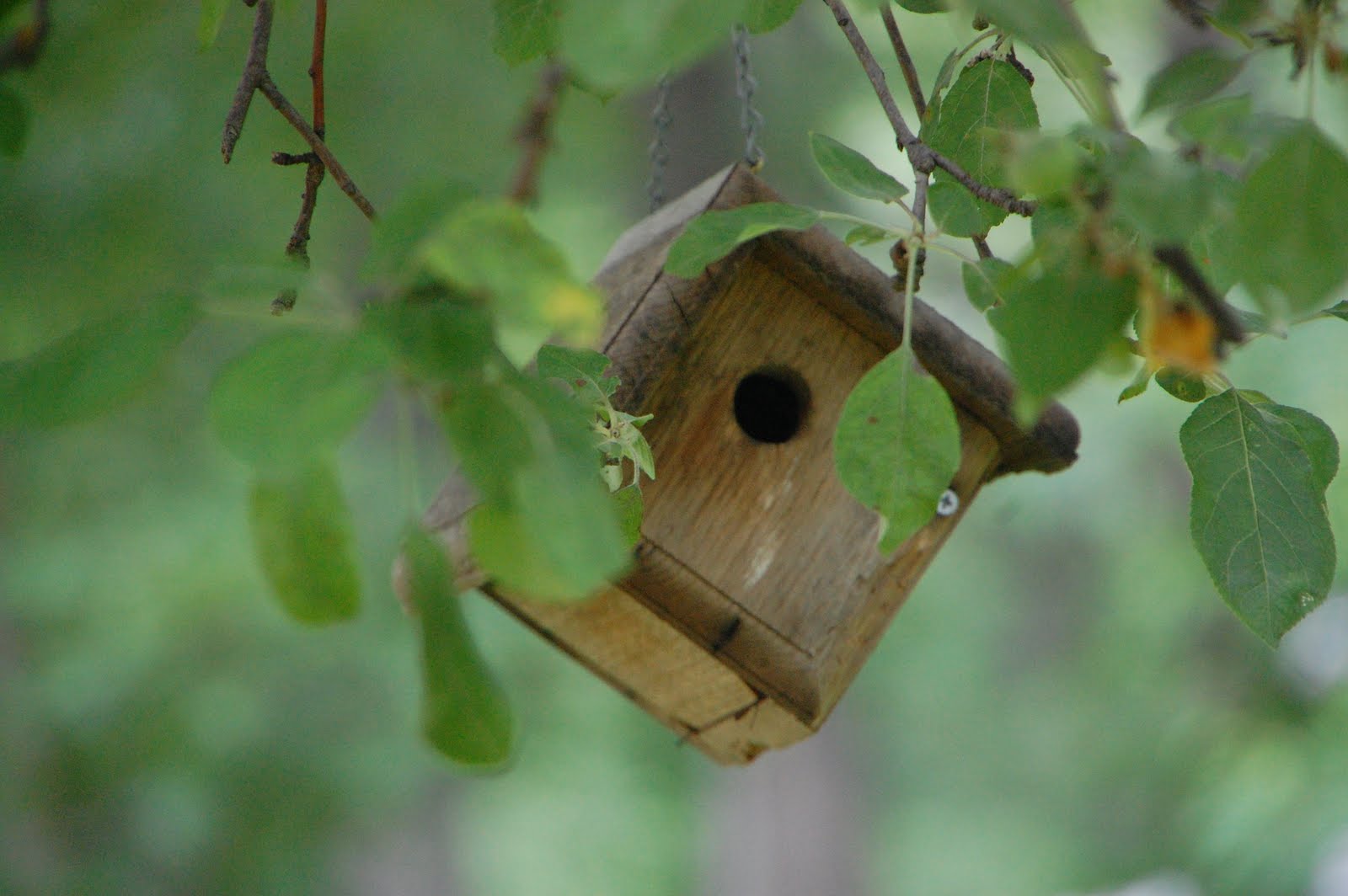
Every spring there comes a time when I either read a report of returning house wrens or hear one in an area not far from where I live. That afternoon or the next day I get out the wren box I've written about many times before and hang it from the same carefully selected branch in the apple tree, so chosen so I can see the box opening while the leaves keep the box shaded from the late afternoon sun. (Several past posts on house wrens were written in June 2011, and you'll have to go back to find them rather than click on a link. Apologies.)

Wren box (Margo D. Beller)
Usually it takes a week to 10 days for a house wren to find the box. This year was no exception, although it took the wren a day or two of scoping out the yard first - it went to the seed feeder, although house wrens don't usually go to feeders, and the water utensils, then flew back to the bushes.

I know when the box has been chosen because this is when this tiny bird proclaims its territory loud and continuously with its bubbly song. I have seen it high in a tree or in a branch above my head that allows it to face the box. Once you learn its song, you don't forget it.

Also, I know when he has found a mate. The song is the same but it becomes softer, more like a reassuring "I'm here, I'm just nearby looking for food." One of its song takes on a rising pattern, almost like a warbler. And there is that harsh scolding noise it makes if I or anything else come too close to the nest box.

It is not long before the female, if she agrees this is the right spot for the young, places twigs in the box. Every year I look for the tell-tale bit of twig coming out of the bottom of the box, a sign that this place is in use so stay away. Considering five to eight eggs are laid, I am continually amazed a nest and brooding female can fit. When the eggs hatch, both parents take turns getting food and sitting on the nest.

As the chicks grow, the parents stay outside the nest box but in close proximity. One parent flies to the opening with an insect and the peeping begins. It only gets louder as the young birds get bigger.

It takes about two weeks for these eggs to hatch and another two weeks before the birds learn to fly and leave the nest. At that point the box goes silent but I hear the brood following one parent or another around the hedges at the edge of my yard.

House wren, back yard apple tree (Margo D. Beller)
I learn new things about house wrens every year. The rising song I mentioned before was new to me this year. In past years I've learned a house wren has no hesitation in destroying the nest of another bird to take over the spot, in that particular case a black-capped chickadee that got to the box first. I have also learned jays will eat house wren chicks if one has the misfortune to get too close to the opening at the wrong time, or falls out to the ground when attempting to fledge.

Most times, only one wren family uses the box each year. That may be because when the apples start growing the squirrels start climbing everywhere and I start picking or, if out of reach, batting at the apples to bring them down with an extension pole. At that point the house wren may decide this is not his neighborhood.

But once in a long while, when apple season is done, another house wren comes by and checks out the establishment. It may remove some of the twigs or it may just use what's there, like renting a furnished flat.

House wrens got their common name because they will build a nest in anything - a flower pot, the pocket of a shirt on a hook, a tiny space inside or next to your shed. As long as it provides shelter from bad weather and is hidden from predators, it can be used.

(The larger Carolina wren, which stays in my area all year, will also build nests in anything and will sing loud and long to proclaim territory, draw a mate and warn if danger is near, even if it is only me. But it is too big for my nest box. The tiny winter wren prefers a different type of habitat than what my yard can provide.)

My wren house offers a distinct advantage by its very wooden sturdiness and its hanging from a tensile wire strung from a branch. I've had to make some repairs to it over the years, but the pleasure my yearly tenants bring me is more than worth the effort. Then, when the house wrens head south for the winter, the box is cleaned and brought inside to await another year and another house wren.

Monday, November 17, 2014

The Birds of War

In my last post, I noted my thoughts on war, inspired by our vacation visiting the battle sites at Gettysburg (plus a day trip to Antietam and the preserved town of Harpers Ferry).

I noted that it was humbling to stand and look at a wide open field and hear absolutely nothing, while seeing monuments that look like they were placed haphazardly but in reality connote where a regiment - cavalry, battery, infantry - was placed in readiness for battle.

However, there was something else I discovered. Bluebirds like battlefields.
Bluebird on monument. (Margo D. Beller)


Ok, maybe not battlefields per se, but farm fields where there are lots of insects. I saw more bluebirds at the various areas of the three-day Pennsylvania battle than I have at my local Great Swamp.

And it wasn't just bluebirds. At the edges, in the brush near battle monuments, were white-throated sparrows and juncos. At the edges of forests were cardinals and tufted titmouse. In the trees over the tourists climbing over Little Round Top and looking down on the Devil's Den and the Slaughter Pen were white-breasted nuthatch and song sparrow. In the long shadows of late afternoon, two pairs of Carolina wrens had their own civil war in the trees near a monument to Gen. Slocum on Culp's Hill. A northern harrier flew over the Peach Orchard. In the pine trees of the military cemetery, where Lincoln made his famous address, Carolina chickadees chittered and fed. In a tree near another field, a Cooper's hawk allowed me to take its picture.

Most fittingly, squadrons of black and turkey vultures used the warm air rising off the field where Pickett's forces charged the Union position on the ridge on the other side. The Confederacy was repulsed on this, the final day of battle, July 3, 1863. Gen. Lee and his forces slipped away down the Hagerstown Road on July 4 - Independence Day - not followed by his opposite number, Gen. Meade. The war would last until April 1865.
Wooly bear (photo by Margo D. Beller)
The birds have adapted to the conditions of the farm field thanks to its preservation by the U.S. government. The town of Gettysburg, just beyond the battlefield, by comparison, is rife with house sparrows, starlings and pigeons.

There were more than birds. There was the whir of insects, the wooly bear in the road and, at the base of the statue to the 11th Pennsylvania regiment, its mascot Sallie. This dog protected the dead for several days until the bodies could be retrieved. I visualize the dog charging the vultures no doubt drawn by the blood and stench of human and horse bodies decaying in the July heat.

Sallie (photo by Margo D. Beller)
It is ironic that this bronze statue of Sallie - who was killed in the later battle of The Wilderness - placed at the bottom of a granite monument and facing the battlefield rather than the road should somehow humanize the battle, and the sacrifice of soldiers in this pivotal battle of the war to save the union. (My thanks to "Hallowed Ground" by James McPherson, who mentions Sallie and where to find her in his tour of Gettysburg.)

The birds and insects I'm hearing and seeing around me also send a message: Life goes on.


Sunday, September 29, 2013

In Praise of Carolina Wrens

Dawn, Cape May. As the first light appears at Higbee Beach, I am walking quickly up the road to where I know others will be awaiting the morning flight, that strange phenomenon when southbound birds find themselves over Delaware Bay at dawn and so turn and head north to land, in this case Higbee.

As I walk along I hear the pleasant song of the Carolina wren. In fact, I hear several.
Carolina wren, Cape May, NJ  (Margo D. Beller)

In fact, during the full day of birding my husband and I had in Cape May a couple of weeks ago, the bird we heard the most was the Carolina wren. Every single place we stopped had at least one singing, and the songs were usually different. These wrens are loud for such little birds, and after minutes of singing one song, they switch to another.

9 a.m., Morris Plains. I am walking along a street in my NJ town to the convenience store where I buy the morning paper. It is a cool morning, color beginning to appear in the maples, the first sign that summer is over and autumn is here. As I walk I listen for what birds might be around. I hear chips and cheeps and some of the familiar contact calls of the titmice and white-breasted nuthatches but the only song I hear is the Carolina wren's.

When people ask me what is my favorite bird, I always say the black-capped chickadee and the cardinal are tied for first, with the Carolina wren a close second.

The chickadee likes to poke around, isn't put off by people and has an appealing "Hey, sweetie" song. It is rambunctious and flies in small flocks, or in ones and twos. The cardinal, by contrast, is a much bigger bird, the male a bright red, the female brown with red in the crest, bill and tail. Once the young are gone you usually see pairs. They call to each other. They mate for life and in spring the male will feed the female a seed and it looks like they are kissing.

But the Carolina wren is a close second because no matter what season, it will sing. Unlike its smaller cousin the house wren, it does not leave when summer ends. Like a lot of birds formerly considered "southern" - the mockingbird, cardinal and redbellied woodpecker immediately come to mind - the Carolina wren is now a fixture of New Jersey, even northern New Jersey where I live. In fact, one year, in the west-central part of rural New Hampshire where my brother-in-law lives with his family, I found a Carolina wren investigating the overhang of his roof, perhaps looking for bugs or a possible nest site. These birds will nest just about anywhere.
Carolina wren at my feeder. (Margo D. Beller)
Other birds sing in the spring when they are asserting themselves, trying to draw a mate and setting up territories. But once nesting starts, the birds go silent and then it is soon autumn and most of them fly south for the winter. The Carolina wren also goes silent at nesting time, but once the young are out the singing resumes, and I've heard these little brown birds with the yellowish breast in the middle of winter.

As long as there aren't too many freezing days or too much snow, or as long as I provide seed and suet in my feeders, this bird will survive to breed another day. I don't see them as often as I hear them, but it is always a treat when I do and I am always honored when they come to the feeders.


Tuesday, April 24, 2012

Suddenly...

Suddenly, the wind is blowing out of the south.

Suddenly, bare trees have foliage, sprouting bright new red flowers or yellow skeins of seeds or green leaves. Even the larches, the only conifer that sheds its needles and goes bare in fall, look alive again as I hike through Greystone.

Carolina wrens will sing just about any time of the
day or year.
Suddenly, there is bird song, usually in the early morning but frequently all day. The carolina wren likes to sing anytime, and so do the titmouse, the white-breasted nuthatch and the cardinal. I go on my early morning walks into Greystone and find these birds plus robins, chipping sparrows, bluebirds, white-throated sparrows, mockingbirds and redwinged blackbirds. Even the fish crows are doing their croaking song. Vultures circle over my head and rise as the sun warms the air.

This is the most wonderful time of year for me. Every day there’s something new. One day the phoebes show up to build their nest under the bridge over a brook. Another day a female hooded merganser comes to a Greystone pond, joining the wood ducks and mallards. A lovely, trilling and unfamiliar song turns out to be a rubycrowned kinglet.

Suddenly, there are birds on nests. Harold and Maud, the redtails, are taking turns sitting on their eggs as the trees leaf out and make it harder to see the nest. A robin is suddenly seen sitting snugly on her little nest on a lower branch of a tree. A Canada goose is sits still on her nest on the side of a pond, a good place, undisturbed by people (although vulnerable to animal predators) but easy for someone who knows where it is to see her.

The other morning I watched a Cooper’s hawk break branches and take them to the top of a spruce over a busy street. Cooper's are agile flyers, able to hunt birds in deep woods, so this one could easily make its way through the branches to its nest and disappear into the evergreen foliage.  When the young are born and need feeding the other birds will have to watch out.

Suddenly, just as the trees are covered in seeds and the leaves obscure the branches, the warblers show up.


This pine warbler was singing, making it easy to find
despite the bad light and how high it sat.
Of course they do. If there is anything more aggravating than a warbler WAY UP THERE in the leafy treetops with the sun behind it, making a silhouette of its identifying pattern, I don't know it. They can literally be a pain in the neck.

I don’t know why it is many birders tend to go nuts when it comes to warblers. Maybe it is because when they come through seeking them among the leaves makes it almost a game. Maybe it is because there are so many different types to find. Maybe it's the sheer joy of suddenly realizing by that certain leaf movement that something is up there, something new and different that you don't see every day.

For me it is because in spring the warbler males are in their bright breeding colors and singing, so even if you can’t see it, you can identify it if you know the song.

It took until early April before my husband and I found palm and pine warblers - the early ones - along with some myrtle warblers that didn't mind New Jersey's relatively warm winter and cold, windy spring. They were all looking for insects in trees along the Passaic River. It was weeks later that I heard a prairie warbler and saw a black and white warbler - one of the few with no yellow in it - in a Bergen County park. I feel as though I'm way behind on my warblers.

At Garrett Mountain, which towers over the gritty city of Paterson, warbler seekers have already found hooded warbler and Louisiana waterthrush along with the myrtles, pines and palms. Garrett is one of those places known as a migrant “trap,” an area of natural habitat surrounded by an urban area. Birds tired after a night of flying with the south tailwind need a place to feed and rest, and that bit of green in a built-up area looks very appealing.

Central Park in New York City is probably the best known migrant trap, but anywhere you have a park or at least some greenery you will find a migrant. Even the enclosed courtyard of my office building, in the middle of a glass box, has had birds fly in for a day or two.

You never know what you’ll see, and it’s the prospect of something new that makes one willing to get out of bed in the dark and walk for miles hoping to see a bit of movement, hear a tiny chip call, something that will draw you to a bird you’ve never seen before or haven’t seen for years

It’s nuts, but it’s a lot of fun and it’s why you’ll see me out there absurdly early in the morning at this time of year.

Saturday, January 21, 2012

Dum Spiro Sparrow

I was not surprised to draw back the kitchen curtains to find birds all over my four backyard feeders. We were having our first snowstorm of 2012 and the first since the freak Halloween storm in October.

January 2012

The birds were fighting each other as much as they were eating. Within sight were three pairs of cardinals jockeying for position at the house feeder; at least one redbelly, downy and hairy woodpecker each taking turns at the suet; and a host of house sparrows, whitethroats, house finches and juncos at these and the other two feeders, with mourning doves below and a quick hit occasionally by a family of jays.

When the house sparrows hogged the feeder and kept chickadees, nuthatches or titmice out for too long, I’d go on the porch to spook them off so the others could feed. Thanks to one neighbor no longer filling his feeder and another who is slow to refill when his empties, I get a lot of visitors in my yard. I don’t mind this - feeding birds is my way of saying thanks for all the pleasure I get seeing these and others in the wild.

But the birds could care less about my so-called generosity. They are just trying to survive.

When they chase each other or sit at the feeders and open their beaks and hiss or spread their wings in an attempt to look bigger, they are trying to get what they can before it‘s gone. The birds that can’t get to the seed directly will go down to the squirrel baffle or to the ground and peck at the bits of seed dropped by the sloppy ones above. Some have even started imitating the woodpeckers and hanging under the suet feeder, an unnatural feeding position for, say, a sparrow.

It is evolution in action. Those that can adapt will survive.

Birds have lived and died without human help for centuries. That I happen to put out feeders is a bit of luck for the birds that consider my yard their territory, or that have stopped briefly on the way to someplace else.

This storm is not very bad compared with last winter, when we had many more storms and so much snow that stayed unmelted for so long the birds were desperate and I could not keep the feeders filled fast enough. Cardinals, usually quite placid birds, were shrieking at others once they were on the house feeder, the one of the four that can accommodate them. If you don’t eat, you don’t live.

It is the same with people.

As I stand in my warm house after a hot breakfast I am more than aware there are people who do not have a roof over their heads and can only eat through the generosity of houses of worship or the community organizations, some to which I donate money, that feed them.

I am also more than aware that in this crazy world we are living in, I and my neighbors are only one disaster away from being homeless and hungry, too.


A rare moment of peace in a life of toil.
 Many of us who lost our jobs have been searching for months, trying to find anything that can use our talents, frequently losing out to those - usually younger and more mobile, without the same ties of house payments and kids in school - who are willing to work for far less in salary.

Some of us are lucky enough to get a job but it is only temporary, because many big employers have discovered it is cheaper to rent an employee through a staffing company and not pay benefits than it is to put someone on staff. There are always enough people searching for work to hire when the contracted worker is forced to leave.

Some of us work in jobs that are becoming more oppressive. We are being told that suddenly, after many years there, we don’t measure up, and if we don’t work harder and longer and change what we’re doing we will face disciplinary review. We are forced to have weekly meetings with supervisors monitoring our “progress,” and may be told if we don’t accept a buyout we will be fired and get nothing.

This was the reason why the message of that ragtag bunch of kids that became Occupy Wall Street resonated with so many of us in mainstream America.

We are told from birth to work hard and save and we will be wealthy and happy. So we work and we are then told we need this and must have that and so must spend and don’t save and don’t think about old age and retirement. We charge and get into debt. When our employers cut back benefits or end them altogether or fire us at a time of increasing prices for gas and basic foodstuffs like eggs and milk, we are on the edge of the precipice.

We think we were shafted because we followed the rules and the deck was stacked against us from the start.

The birds don’t care what goes on below them. As long as they can avoid predators and find a meal and a branch on which to roost through a cold night, they will live to fly another day and breed when spring comes.


Spring seems a long way off.

Today I learned something from my husband. Not only is the state bird of South Carolina one of my favorites - the carolina wren - but the state motto is Dum spiro spero - While I breathe, I hope. Spero is the root of the word despair - no hope.

Hope is the thing with feathers, wrote poet Emily Dickinson.

When MH told me this phrase I heard it as dum spiro sparrow.

That is another reason why I feed the birds - for a short time I can forget about this life of despair and concentrate on something with feathers.

Sunday, November 20, 2011

Communing with the Cardinals

When my friends ask me which of the many birds I’ve seen is my favorite, I know exactly what to answer.

I have three.

The carolina wren: It sings its lovely songs - it knows a lot of them - all year, even in the coldest, snowiest winter. It flits around the edges of my yard, is wonderfully colored and easy to identify and I always feel honored when it makes an unexpected appearance at my seed and suet feeders.

The black-capped chickadee: This one will explore just about anything, isn’t afraid to hang upside down while gleaning for seeds and has a lovely song that starts up high and comes down. To me it sounds like “Hey, sweetie.” It will come to the feeder, grab a sunflower seed and fly to a nearby bush to eat. It is inquisitive and isn’t afraid to fly close. Even the “dee-dee-dee” call is calming.

But I have to admit the first among equals is the cardinal. The red of the male or the warm brown (red at the crest and bill and tail) of the female look pretty in a green bush or pine tree. The crested bird is big and easy to identify. It is monogamous (like the wren but unlike the chickadee) and when courting its mate he will give her a seed in a way that looks like a kiss. Both birds sing but the male is more obvious, loudly proclaiming from the top of a tree in spring.

What I like best about the cardinal is it is reliable, coming every day at dawn and at dusk.

We all know the phrase about the early bird getting the worm. I think it refers to the robin, which gets up in the dark to call and then to eat. But robins don’t come to seed feeders. When I am up at dawn I can look out at the feeder and know one of the cardinals will be the first bird to visit. If I am lucky enough to be home at dusk I know it will be the last bird to visit.

At these times I like to stand at the kitchen window and watch the cardinals, communing with them, if you will.

They seem so calm and comfortable with each other, like my husband and myself and other long-married couples I know. The gentle “kiss” could be MH greeting me when he first comes downstairs in the morning. The pair fly together, calling with hard “teeks” as if to say, “I am here, where are you?” “I’m right here, where are YOU?”
In winter I’ve had as many as four cardinal pairs jockeying for feeding position. Like all birds there is a pecking order, with the most inferior and his mate forced to wait off to the side until the others eat - these birds will sit at the feeder a long time cracking the seeds with their large finch bills - before they can have their meal. (I keep a lot of seed on hand.)

It is easy to put human traits to birds but cardinals aren’t people.

I keep four feeders going in winter but the cardinals, being bigger, can only come to the one that looks like a house. Last winter, when the snows were deep and the neighbors didn’t fill their feeders we had so many finches, sparrows and other birds at ours the cardinals would scream at them and attack. It was a horrifying reminder that Nature isn’t always placid and winter can be much harder on the birds.

Remember that the next time you complain about 4 inches of snow on a weekday morning. At least you know where you’ll get your next warm meal.

Winter aside, there are other hazards like cowbirds (which frequently drop their eggs in cardinal nests), hungry hawks and people who chop down a tree or bush with no thought as to what might be nesting inside.

Cardinals are in no danger of becoming extinct - at least not yet.

Give man the time to think of ways to jar Nature’s delicate balance and perhaps the cardinal, along with the rest of us, won’t be around much longer.

In the meantime I’ll watch for the cardinals to make their regular visits at dawn and dusk, a bit of certainty - for now - in an uncertain world.

Saturday, July 9, 2011

This brood has flown

It was bound to happen sometime.

Things were getting loud and rambunctious at the wren box. The parents were shuttling back and forth so fast and so often I doubt they ate anything themselves. The young got so big the parents had stopped going into the box to feed them unless it was to feed one in the back, crowded out by more dominant siblings.

And the parents would not stop scolding me. All I had to do was walk out the back door and one or the other would be chittering. Much of that was to tell the young to be quiet so they wouldn't give away their position. That's instinct, although considering they were in a box I had put up in an apple tree, rather silly.

But I put up with it.

The apples in the tree where the feeder is hung were getting riper with the hot weather, and the squirrels were increasing their visits and dropping more chewed apples. This required me to go out more often to pick up the remains or pick apples I could reach before the deer came along...although based on what is under the tree my actions are also pretty silly.

Then MH and I went away for the July 4 weekend.

We came back on the 4th, a Monday this year. There were no apples on the ground when we came home but there were the next morning. The wren scolded me as usual. But on Wednesday there was silence as I picked up the apples. I reached up and shifted the box and it was as light in weight as the day I put it up.

But while out of the box the wrens have not left my yard. The male house wren will sing in the morning, particularly if the carolina wren on the next block is singing - which he does quite loudly for a small bird, to my delight.

Lately I have heard the brood but not seen them as they move among the dense shrubery. Momma wren chitters when I first come out, as if to say to her family "Be careful." But she does not come to the tree as I work. (This was a good thing because I wanted to come out and pick as many apples as I could reach or knock down with a stick, which I wouldn't do if the box was in use.)

And who knows, the male may start a second brood in the house. Wrens are not monogamous - when the young can take care of themselves, the party's over.

Whether there's one brood or two, at some point the young will start feeding themselves and will, at the right time, feel the need to head south as the air cools. With any luck one of them will remember my yard and come back.

When he returns and starts singing he will find the box - clean and empty - waiting for that year's brood.

Sunday, June 12, 2011

Love is Blind

I do not like cowbirds.

They are ugly birds. The male is black with a brown head that looks all black in dim light. The female looks like an oversized, gray house sparrow.

I do not like the female because she also has an ugly habit of dropping eggs in the nests of other birds. This is known as parasitizing.

The cowbird isn't the only bird to do this. Some cuckoos drop eggs into the nests of other cuckoos, for instance.

But parasitizing is the only way the cowbird can continue the species. Cowbirds don't build nests. Nor do they kick out other birds to take the nests, as owls do. It is not known why they must use the nests of songbirds.

That is why at this time of year, when I am hearing the first broods of chipping sparrows, starlings, robins and titmice making a ruckus as they chase their parents begging to be fed, I expect my annual sighting of some pair of adult birds being harried by a particularly large, aggressively hungry chick.

One year I was walking to the train and saw a pair of carolina wrens feverishly trying to fill the mouth of a cowbird chick that was double their size. Cardinal nests are also prone to parasitization and, like the sun rising in the east, I will soon hear the very loud screeching of the cowbird chick in my bushes following an adult cardinal that is desperately looking for something to feed it.

You would think the wren, for instance, would recognize the intruder in its midst. Some types of bird do. The yellow warbler will build an entirely new nest over an existing nest if it spies the larger cowbird egg, neglecting its own eggs in the process of starting over.

But most birds, like the carolina wren and the cardinal, are not programmed that way. If there is an egg, the adult sits on it. And if that slightly larger egg hatches first, as cowbird eggs do, and the chick manages to push some or all of the other eggs or hatchlings out of the nest in order to hog the food, it isn't noticed by the parents. In their minds, they are raising the next generation.

But it's the wrong generation.

In Michigan, where the population of Bachman's warbler was practically wiped out thanks to a nasty combination of habitat destruction and parasitization, it is policy to catch and kill cowbirds within the designated Bachman warbler jack-pine habitat.

It may seem cruel but that has helped the Bachman's population slowly re-grow.

This isn't a problem for the cowbird. This is one bird where the destruction of its usual habitat has helped it.

Cowbirds were farm birds, picking bugs off the cows and the fields. But with "progress" has come suburban developments built on farm fields. There may be fewer farms but the cowbirds adapted and thrived. Too well, in fact.

One thing that amazes me is that after being raised by a pair of cardinals, for example, the cowbird chick will grow up and somehow intuitively know it is not a cardinal. Then it will find other cowbirds and at the correct, programmed time mate and start the parasitation process all over again.

To me this makes the cowbird, literally and figuratively, the dark side of nature.

Sunday, June 5, 2011

The Wren Days of Summer

There comes a time when you have to acknowledge spring migration is over.

No more blackpoll warbler, whose squeaky-brake call was heard for two weeks in the backyard. No more large flocks of goldfinches jockeying for position at the thistle feeder.

Far fewer birds are singing at dawn. The other day as I was hiking in the neighborhood I heard a strange song, then spotted a goldfinch. He wasn't singing but the male indigo bunting at the top of the spruce was.

But that's the exception. At this time of year birders leave the woods and head to the shore to look at the peeps and waders. The birds sit in the open and, if you can put up with the biting flies and mosquitoes, you don't have to work as hard at seeing something.

This is the season of the breeders. In my brother-in-law's New Hampshire woods, the black-throated green and blackburnian warblers still call to protect their nesting territory, the wood thrush and veery sing all day and the yellow-bellied sapsucker drums loudly on branches.

In my area, we have cardinals, catbirds, chipping and song sparrows and loads of robins. The chickadees, titmice and nuthatches sing every so often but they are more concerned with feeding young behind the thick tree canopy. If I didn't have suet out I might not be seeing downy, hairy or redbelly woodpecker.

Thankfully, there are wrens.

The carolina wren, such as this one from last winter, has a very loud song for such a little bird. If fed during the worst of winter, it will hang around all year. In the last week I have heard a carolina wren singing from the next street. One of the reasons why I love carolina wren is it sings all the time - in winter's cold, in summer, in breeding season. So this one is singing and is likely proclaiming his territory.

The other breeding wren is the house wren, which comes up in spring after wintering far to the south. (This year's current singer is at the top.) Years ago a friend gave me a small decorative bird house and for the hell of it I hung it in one of my apple trees. To my delight a house wren and mate raised a family in it. It was not meant to be a real birdhouse so it was not a surprise that it broke apart after a few years.

At that point I went to the local Audubon office and bought this wren house.

I wait for "house wren" to show up on area birding lists and then put the house up. Usually within a few days there is activity and later a brood or two. (The opening is too small for the carolina wren.)

This year, as with everything else during a cold and wet spring, things were different. It seemed to take a long time for a house wren to discover the box and then after a few days it was silent. A week would go by and then there would be early morning wren song.

If you look at the house above you'll see a bit of stuff coming out the bottom - nesting material. I see a pair of wrens going in and out of the box but I don't hear any cheeping. At this point I am just glad to have them at all. It is nice to be awakened by a house wren's bubbly song rather than the alarm clock. It is nicer to hear the house wren nearby and the carolina wren a block or so away.

As I get ready to take the feeders in for the season the wrens will be my summer solace.