Cape May

Cape May
(RE BERG-ANDERSSON)
Showing posts with label climate change. Show all posts

Sunday, March 1, 2026

Spruce Loses His Winter Coat

I was in the backyard the other morning, checking to make sure the woodpeckers had not finished all the suet in the feeder, when Spruce Bringsgreen called to me.

"Look, Margo, my winter coat is gone!"

Sure enough, Spruce, whose boughs were heavily laden with snow for what seemed like forever, now showed their usual blue-greenness. 

After our late January foot of snow, followed a period of intense cold, the slowly warming temperatures started working to melt the white stuff until I could not only see a good swath of the front and back lawns, I could carefully walk in the two inches or so of remaining snow to get to my compost pile and find just enough thawed area to dump several weeks of coffee grounds and other worm food.

Then, a month later, we had another foot of snow. This time, however, there was no deep freeze to follow but very warm (for February) temperatures.

Spruce in the winter coat he has finally shed.
(Margo D. Beller)

As Bernd Heinrich points out in his book "The Trees in My Forest," conifers including firs and spruces have boughs that point downward. When covered with snow the boughs are pushed against the trunk and the snow slides off ... eventually.

"I am so glad to be rid of that coat," Spruce said. "Yes," I replied, "I am getting tired of all the snow, too. It gets depressing after a while to always have to put on my boots to take out or take in feeders. The sun never gets to the area behind the enclosed back porch that I have to walk, and with all the recent melting by day and freezing by night it can get rather slippery."

"Didn't I see you putting down some gray stuff before?"

"Yes, that was some old cat litter. It helped after the first storm when there was ice, but when the melting started it became mud and left quite a mess on my boots. This time I am leaving that area alone and walking very carefully so I don't fall again."

"I will be glad to get rid of those juncos," he said. "They've been hiding out in my branches but they seem to be anxious to leave, and there are so many they are annoying some of the other birds I've hosted such as the red-breasted nuthatches and chickadees."

Over the past week there has been an increase in the number of birds singing territorial songs or drumming on trees to warn potential rivals away from a preferred nest site. A Carolina wren showed up in the yard for the first time in weeks. Canada geese have been getting restless to move now that lakes and rivers are nearly free of ice. Daffodils have started growing. So have the weeds.

"Don't worry," I said, "the juncos will be gone soon and they'll be replaced by catbirds like the one that screamed at me when I got too close last summer. There must've been a nest nearby, perhaps in you."

"Not me," he said, "tho' I don't mind catbirds or even the robins that build nests in my upper branches they don't always use. What I do mind is when a hawk that goes after your feeder birds hides in my branches."

He meant the accipiters, specifically the small sharp-shinned hawk. Accipiters are accomplished fliers. If they aren't strafing the ground looking to pick off a bird or squirrel they are diving into bushes or trees to catch a meal. The larger accipiter called the Cooper's hawk is another hazard to the feeder birds.

"Well, Spruce, considering the number of birds that are in decline because of climate change, pollution, the destruction of forests for more residential houses and agriculture, I can put up with the occasional hawk in the yard. I'll just make sure one doesn't set up housekeeping in your branches."

"That would be fine," he said. "Is the snow done for the year?"

"Gosh, I hope so," I said. "Maybe the occasional snow shower. But the forecasts I see are mainly for higher temperatures. Anything from the sky would be rain."

"That means when the snow is all gone you'll soon be cleaning up the winter mess in your garden, right?"

Alas, yes.

Saturday, February 14, 2026

Opinion: Donald Trump Is (Not) For The Birds

In the last few days there has been a seismic change in the way the United States deals with climate change.

It is ignoring it.

Here is the reporting of the New York Times:

President Trump announced [Thursday] afternoon that he was officially erasing the scientific finding that greenhouse gases threaten human life by warming the planet. The move largely cuts off the federal government’s legal authority to address climate change through regulation.

Following the lead of a president who refers to climate change as a “hoax,” the administration is directly challenging the overwhelming scientific consensus. Presidents of both parties have warned of the dangers of climate change for decades.

At issue is a 2009 determination called the endangerment finding, which the government has used to justify regulations on greenhouse gases. Lee Zeldin, who leads the [Environmental Protection Agency], called today’s move “the single largest deregulatory action in the history of the United States.”

The administration claimed it would save auto manufacturers and other businesses an estimated $1 trillion, although it has declined to explain how it arrived at that figure. The Environmental Defense Fund estimated the rollback could lead to as many as 58,000 premature deaths.

(Alen Hunjet, StockPhotoBoard.com)

What Trump did, according to the BBC, was revoke the Obama-era "endangerment finding" that held that pollution harms public health and the environment. For almost 17 years, the U.S. has used that scientific finding as the legal basis to establish policies to reduce emissions from cars, power plants and other sources of planet-warming gases.

"This radical rule became the legal foundation for the Green New Scam," Trump said, using a term popular with Republicans for describing Democratic environmental and climate policies.

So 58,000 early human deaths caused by an increasingly warmer planet where we've been having hotter summers, more widespread drought and more destructive hurricanes is a "green new scam." 

As an American who loves her country, I hate this radical change by a man who has no regard for anything except his own ego and making a few million bucks for his companies while in office. But as a birder, I am extremely saddened and worried about what will happen to the environment, especially the birds, now that fighting climate change is no longer an American imperative. 

As the oceans warm, the creatures that need to live in cold water have been moving north. So have the birds, whales and fish that feed on them. As icebergs melt, the oceans will continue to rise and threaten coastal communities. That includes my hometown of New York City.

Spring will come earlier. According to Roger F. Pasquier, in his book "Birds in Winter": "While short-distance migrants are leaving their wintering site sooner and returning there later, long-distance migrants, affected by day length, have not shifted their schedule as much. On arrival in spring, however, they find the season more advanced, often to the point where the food they give their young is no longer widely available. Resident birds in the same habitat have begun nesting weeks earlier, remaining in sync with the emergence of the prey they feed their young. The migrants least able to accelerate their schedule are the species most declining."

This was written in 2019.

Birds and animals that once lived in southern regions, such as the red-bellied woodpecker and the northern mockingbird, have been living in the north for years. Armadillos native to Central and South America are now moving beyond the American south, where they could be warm and find lots of insects to eat, to the warming midwest.

Says Pasquier: "The most visible impact of climate change in wintering birds has been the shift in their range. Many species of middle latitudes are migrating less far, if at all, and their range in both winter and summer has moved poleward. Ground foragers can now survive the winter in places where snow cover used to make feeding difficult. Waterbirds are not limited by areas that once froze for months of winter..."

President Trump has done many things to harm many people since he was re-elected in 2024, and he is not much better when it comes to Nature. He wants oil drilling in the arctic. He wants oil drilling off America's coasts. He tried to scuttle wind power projects. He ordered the Defense Department to use more coal-based electricity. He has ordered the Energy Department to pay coal plants to stay online. He has proposed major changes to the Endangered Species Act to eliminate many protections. Once he was re-elected he again pulled the U.S. out of the Paris Accords on climate change. (He did this during his first term, in 2017, but President Biden reinstated the U.S. in 2021.)

His way to "Make America Great Again" seems to be all about making America a sick place where businesses can operate unregulated and with impunity and Nature is a profit center, the rest of the world and all that live in it be damned. 

Even NASA, a part of the U.S. government, recognizes the seriousness of climate change.

There is unequivocal evidence that Earth is warming at an unprecedented rate. Human activity is the principal cause.

Earth-orbiting satellites and new technologies have helped scientists see the big picture, collecting many different types of information about our planet and its climate all over the world. These data, collected over many years, reveal the signs and patterns of a changing climate.

Europe has been taking climate change seriously, because it is the fastest-warming area on Earth. But the relationship between Europe and the U.S. has been changing under Trump. Besides pulling the U.S. out of the climate accord he has threatened to take the U.S. out of NATO and has been obsessed with controlling Greenland, a protectorate of NATO member Denmark.

Ironically, climate change is causing Greenland's ice sheet to melt at an accelerated rate, leading to rising sea levels and having an impact on local ecosystems and communities. The warming temperatures also threaten traditional livelihoods, particularly for the Inuit population, as fish stocks decline.

Trump does not care about any of that. He does not care about ecosystems and communities. He does not care about Inuits or fish. He claims he needs Greenland to protect the U.S. from potential threats from China and Russia. What he really wants, I believe, are the rare earth metals needed for technology, which Greenland has in abundance and the U.S. is no longer getting from China.

In a word, sad.

I Don't Count (Don't Ask Me)

Lately, I have found I can no longer do on my computer the things I was doing just fine before. This is not so much because of any infirmity on my part but because these websites have tech people and I am convinced these tech people must change things in order to keep their jobs.

So now instead of signing into one of my emails with a password I have to click more buttons in order to do so. The way I used to print was changed after the last alleged upgrade. When I downloaded a document as a pdf recently I got a pdf.aspx I couldn't open without a "third-party program." I had to look up how to change it back to a pdf so I could print it.

None of this has saved me any time or made my use of the computer any easier. I didn't ask for these changes, they were foisted upon me.

Not using eBird. (RE Berg-Andersson)

In the name of security, several sites I've signed into for years recently asked me to create a new password. I get it, people can hack into your computer if they get your password, although some disagree how often these passwords have to be changed. I disagree, too, considering the several data breaches that affected me within the last year that did not involve these websites forcing the new password.

So I am more than a little disappointed the good people behind the Great Backyard Bird Count, held every year during the Presidents' Day weekend, have made filing my bird lists more high-tech and less user-friendly. The organizations involved include the Cornell Ornithology Lab (creator of the Merlin app I use), Birds Canada and the national Audubon Society.

In the past I could go to a dedicated site, sign in and then attempt to go through the steps to post the number of birds I saw, where, under what conditions, what day and what time. 

That has changed. 

There is still a dedicated site, www.birdcount.org. But now to report you must use either the Merlin app, the eBird Mobile app or send the information to the eBird website. For this I would have to create an account.

I have no interest in creating an eBird account because I don't care to use eBird to list my sightings. Sure, I look at the eBird lists to see what others have found in particular areas, including my home county. But when you file to eBird it is expected you will keep a COUNT of how many birds you've seen every time you go out birding.

Still not using eBird. (RE Berg-Andersson)

When I am out in the field, with binoculars around my neck, a stick in one hand and the Merlin recording app in the other, it is hard enough just finding a bird by eye or ear without taking the extra step and counting.

Say I see a couple of titmice as I walk in one direction and I then see a couple of titmice on the way back - have I seen the same two or four?

Say I am by a frozen pond where the one bit of open water contains what looks like hundreds of Canada geese (plus others - as I saw several winters ago). These geese aren't sitting still waiting to be counted. Most people reporting huge numbers are estimating, and while they are counting and estimating they are missing other birds flying or swimming around.

I support what Cornell and the others are doing. The Great Backyard Bird Count helps scientists understand bird populations and their health by collecting data on bird sightings from participants around the world. This information is very important for monitoring changes in bird species and their habitats, especially as the environmental changes - the climate change the Trump administration considers a hoax. (More on that in a separate blog post.)

And I can understand why you have to post with Merlin and eBird. Cornell runs Merlin and eBird. It built the infrastructure. Why create a separate site when you have already spent a lot of time and money on a technology platform that can entice more birders into creating more accounts to post their findings?

A cardinal, one of the many nice birds I've seen in the last few days 
without reporting to eBird. (Margo D. Beller)

Why? Because some of us would rather concentrate on birding than keeping count and filing electronic paperwork. 

Obviously, I'm no "citizen scientist." I'm just a backyard birder.

So, for what it is worth, here is what I saw or heard in the area of my backyard between Feb. 12 and today, Feb. 14, 2026, with help from Merlin:

Fish crow, American crows, mourning doves, a ton of juncos, downy woodpeckers, hairy woodpecker, a red-bellied woodpecker, jay, too many house finches, two female and one male purple finch, male red-breasted nuthatch, titmice, starlings, grackle, robins, mockingbird, two white-breasted nuthatches, a pair of cardinals. 

Not bad, for winter.

Wednesday, July 2, 2025

Saving the Apple Tree

I hope she forgives me.

The apple tree and I go way back to when we moved into this house. I've been here over 30 years and I estimate that, based on the size of the tree, it was planted about decade before. So it is an old tree.

The apple tree now. You can see where
the cut was made on the right. (Margo D. Beller)

A few days ago the boss of the lawn service I use came over with his chainsaw and cut off the rotting branch of the apple tree. He also, on his own, took off two smaller dead branches, saving me climbing up my ladder with my handsaw.

The result does not look so bad ... from afar. Once I paid the man and he left, I went out to look at the cut. I was horrified to see a large hole, and carpenter ants coming to investigate - or scurrying around after being disturbed. If carpenter ants were in the tree it wouldn't have much of a chance. If the ants didn't dig it out from within a hungry pileated woodpecker would start excavating from the outside to get at the ants. Either way, the tree would soon die.

I immediately drove to the local big-box store and bought limb sealant to cover the wound. 

Once I cleared the sawdust I sprayed the cut and into the hole.
(Margo D. Beller)

When half the dogwood died a few years ago, I had it cut back. The cut was clean, there was no rot in the center of the wood. But I wrapped the bottom of the trunk where pieces were starting to fall off. I must've done the right thing because the tree has survived, leafed out and even blossomed. I have gotten used to the way it looks when I am sitting on the porch. It is only when you go out and look at what was cut that you can get an idea of how much more there used to be.

The apple tree situation is different in several ways. For one, there was that big hole. So I sprayed into that hole to protect what I could reach. 

Another difference - I had the dogwood planted in 2007 at the same time as Spruce Bringsgreen, the blue spruce. So both trees are teenagers compared with the apple tree. 

The apple has survived my cutting down three overgrown, deer-attracting apple trees on the property, and one small apple tree that was killed by too many young bucks rubbing the velvet off their antlers. This remaining apple tree has survived sapsucker drill holes, a gall at the bottom and a hole in the trunk big enough for a chipmunk to hide in. It has produced apples every year, especially after it has been pruned. It has abided the squirrels and the house wren nest box that hung there for 10 years until it was moved to the dogwood. It has forgiven me for walking around with my long pole to whack the branches and bring down enough apples to use.

But I'm not sure it will forgive me this time.

The apple tree in 2023. 
(Margo D. Beller)

Last year, thanks to climate change, we had a severe drought starting in the summer and lasting into spring of this year, at which point we were inundated with an overabundance of rain. The apple blossoms appeared as usual, and then suddenly one-third of the tree went black. The squirrels and I had apples but they tended to be smaller. The apples were done by June 30 and the rotting branch was cut off that day. I should not have been surprised by that hole in the tree, but I was.

"I felt her pain, even though I do not have the problems an apple tree can have," Spruce told me after it was done. "But it was hard to watch."

The apple tree has been stoic. Her leaves are still green and, even with one-third of her gone, she doesn't look misshapen. But she isn't talking to me at the moment.

I hope she lives.

Monday, June 16, 2025

Another Tree Problem

“Trees are poems that the earth writes upon the sky.”
 Khalil Gibran, "Sand and Foam"

At this time of year things have settled somewhat in the yard. Catbirds fly around looking for food to feed their young. I am serenaded by one singing from my hedge, where I'm sure there is a nest. Less than 24 hours after the wren young left the box, a male wren, possibly a different bird, started singing its territorial song. It was not the only one. On my street alone I've heard three others, one of them two yards over. The male hasn't drawn a mate yet but he is fierce in protecting the nest box.

The dead part of the tree against the living rest
of the apple tree. (Margo D. Beller)

The fledged wren young were noisily following their parents in and around shrubs at the periphery of my yard for a couple of days but lately I have not heard them.

The gnats continue in ones and twos rather than a bagful, and I am still not sure how they are getting inside the enclosed porch. Every day I play whack-a-gnat. There is no longer anything on the porch that would allow them to eat or breed. If they are coming in through small spaces around the windows, I may have to turn to chemical warfare again.

Currently, however, my main attention is on the apple tree.

We had a lot of rain this spring, and the tree was full of blossoms, which meant it would be full of apples. Then, suddenly, one third of the tree died. This is an old tree. It has a hole in its trunk big enough for a chipmunk to hide in. It has a ring of little holes from a yellow-bellied sapsucker that visited a few years ago. And yet, the tree continued to bloom and produce apples.

Dogwood blossoms in 2016. (Margo D. Beller)

When half the dogwood tree died in 2023, I asked the yard man I was using at the time to bring his chainsaw. He cut the dead parts into stackable pieces. I waited to see what would happen. The next spring the dogwood not only lived, it put out flowers.

Last year, the problem was the tree-like house plant that was getting too unwieldy to transport in and out of the house. I agonized over whether to kill the plant, but when it began growing from the bottom my decision was made and I chopped down the top. The two parts growing from the bottom are healthy (see below) and, I hope, won't grow too much.

These are a little bigger now. (Margo D. Beller)

Now it is the apple tree's turn. 

There are no lack of sites on the internet explaining what can happen to an apple tree. Here's what Tree Fluent has to say: "Environmental changes can significantly impact apple trees. Temperature fluctuations, excessive rainfall, or drought conditions can lead to stress."

Well, that sums up life in my area in a nutshell. This week alone we started 20 degrees colder than average and expect to jump to 20 degrees hotter than average by the weekend. A major fire in the New Jersey Pine Barrens in April was finally put out with help from a series of heavy rain storms. But last summer was so dry we had drought emergencies that didn't end until last month.

What else could've affected the apple tree?

Couch to Homestead lists a variety of causes including over- or under-watering, the wrong growing environment, a lack of nutrients, pests and diseases. The diseases have such charming names as apple scab and fire blight. There are also various parts of the tree that can be prone to rot, starting with the roots.

Apples growing on the living two-thirds of the tree.
(Margo D. Beller)

I did not plant this tree. It is the last of five apple trees standing, four of which I've taken down and one taken down by stags rubbing velvet from their antlers too many times. I left this one tree because its apples taste good as apple sauce. (Unfortunately, the squirrels and the deer also like them.) These apples usually have more bad than good parts, requiring a lot of cutting to use. In summer the apple leaves seem to be the first to yellow and fall. I thought this was a natural thing. Now I am not so sure.

My remedy for this problem is to rent a chainsaw, cut down the dead wood and hope that allows the tree to recover and grow next spring. It worked for the dogwood. It worked for the big plant.

I haven't gotten around to doing it yet because it has been too wet, yet again. If this remedy doesn't work the tree, like the diseased ash tree we had to cut down years ago, is history. 

Friday, November 22, 2024

A Change in the Weather

 Climate is what you expect. Weather is what you get. -- Robert A. Heinlein

I am fascinated by weather, how one day can be picture perfect and the next cloudy and gray; 20 degrees higher than "average" one day and 20 degrees below the next.

When the local news is on I always pay particular attention to the weather segment.

Shearwater blown close to shore. (Margo D. Beller)

When I first contemplated this post, we had not gotten any significant rain since August. The ground was dry, brown and rock-hard, an amazing change from earlier in the year when we got a lot of rain. There was no forecast of rain for the following weeks, including the week my husband (MH) and I were to be away. Fires were raging throughout my home state of New Jersey and I feared some neighbor's stupidity in running a lawn mower or lighting a backyard fire pit despite a state burn ban would set the neighborhood ablaze, leaving us homeless.

So before traveling I gathered important papers, my laptop, prescription drugs and small artifacts I wanted to keep and packed them to bring with us. We left and I hoped for the best.

We drove to Cape Cod, which is the only area of Massachusetts that was not in significant or extreme drought - it is only down about 2 inches, as opposed to more than double that elsewhere in the state. Its geographical location - sticking out into the ocean - helps. The warmer ocean currents that may be a factor in New Jersey's strange weather kept Cape Cod warm and moist enough for flowers - mums and snapdragons among others at the motel - to be blooming long after my flowers became a memory.

Sheltered savannah sparrows (Margo D. Beller)

But being out in the ocean is not good when the winds start blowing hard from the north, as they did when we were on vacation. It became wintry in a hurry, although the winds that nearly knocked me down several times also blew ocean birds closer to shore where I could see them. It also forced the land birds I was seeking to gather in numbers in more sheltered areas.

When we returned home most of the backyard trees were bare, their leaves blown in clumps around the lawn. I had cut back and stored the cannas before we left but the coleus in the one pot I'd left outside was dead. The earlier darkness and the later morning light depressed me. 

Hard, dry ground at Greystone (Margo D. Beller)

This is when I contemplated this post, to try and make sense of this annual change that I find doesn't get any easier to live through. But then, a week after returning, something good happened - it rained. And when the temperature started falling it snowed, lightly.

It has been raining or snowing for two days now. After the initial runoff because the ground was so hard the soil has softened and is drinking in the moisture. The snow showers have prompted the birds to flock to the feeders in droves. When I contemplate Thanksgiving I do not fear my house will burn if we go away. The forecast is for two or three more soakings, including more snow, in the coming week. 

New Jersey is still in a drought, however, even with the current and forecast precipitation. Much of the northeast is also in a drought. We would need two weeks of rain like today's to make up the deficit. With climate change it is no longer predictable if we'll get enough rain, too much rain or no rain.

And during the time the northeast was drying up, the southeast was flooding, the west was burning and parts of the southwest had heavy snow

As I sat writing this post I wondered, why this wacky New Jersey weather?  Climate change, of course.

From the New York Times:

New Jersey is heating up faster than any other state in the Northeast, pacing a region with rapidly rising temperatures, according to data gathered by a nonprofit research organization

The cause of New Jersey’s dubious distinction is most likely a combination of factors, including the warming of the ocean bordering the coastal state and overdevelopment in some areas, experts say.

But what is certain, they added, is that the state — and the Northeast in general — will continue to see more heat waves like the one last month, as well as worsening storms and floods.

“New Jersey is ground zero for some of the worst impacts of climate change, including extreme heat and considerable increases in flood risk,” said Shawn M. LaTourette, the commissioner of New Jersey’s Department of Environmental Protection.


While average annual temperatures across the country have increased by about 2.5 degrees since 1970, annual temperatures in New Jersey have increased by roughly 3.5 degrees, said Lauren Casey, a meteorologist with Climate Central, the nonprofit organization that gathered the temperature data.

According to the group’s findings, New Jersey is the third fastest warming state in the country.

When we had less than half an inch of rain in early
November I took this picture of my back patio.
(Margo D. Beller)
What does this mean? More heat, more rain (when there is rain), more humidity in summer and less snow in winter. According to my state's climatologist, 80% of New Jersey’s warmest months have occurred since 1990. And there has not been a top-five coldest month in New Jersey since 1989.

In years past, during the worst summer heat, there would usually be one day when the humidity was low, the sun was out and the breeze was cool and pleasant. I would say to MH, I wish all the summer days could be like this.

Be careful what you wish for. After this year's long string of "perfect" days sucking us dry, I don't think this anymore.

Sunday, August 4, 2024

My Evolving Garden

"Gardening is an instrument of grace." —May Sarton

I went outside one morning between rain storms to cut some flowers for the kitchen. At the time what was blooming were white Shasta daisies, yellow daisy-like flowers that have spread beyond the two plants my sister-in-law gave me, purple salvia, some zinnias and purple coneflowers. The early spring flowers were long gone and the fall flowers - rose of Sharon, sedum - were still in bud. 

Garden flowers - zinnias, yellow daisies, goldenrod, coleus, coneflower.
(Margo D. Beller)
As I was preparing the flowers for the vase I thought about how my garden has changed over many years .

When we bought our house decades ago, the area in front of the bay window was flanked by two large rhododendrons and three azalea shrubs between them. At the side of the house were drifts of daffodils. In the back was a plot of the ground cover pachysandra. There was no patio, no paving-stone walkway. In the front, the dirt path had large flat stones for walking to the front door. I don't remember if anything was growing along that walkway.

Then we had to have major work done on the foundation. All those plants I mentioned above - gone. I regretted losing those daffodils and the rhododendrons.

The rhododendron I planted. (Margo D. Beller)

So when the work was done and it was time to plant a new garden I had to take into consideration zoning rules (a "park-like" lawn on the 35-foot setback that came nearly to the house), whether the plants needed sun or shade and, especially important for me, what kind of pretty flowers would they produce.

I planted a rhododendron where one of the previous owner's plants had been. I flanked the area with two rose of Sharons. In between were a row of yellow and green euonymous shrubs and purple asters at the front. I was not thinking in terms of perennials vs. annuals or how fall-blooming plants like asters would look in the spring. Like the plants, my thinking would eventually change.

Along the now-bricked front walkway I put in azaleas. In back, small yew shrubs. Where the daffodils had been, some andromeda bushes.

It didn't take long before I started learning about the animals that roamed the property, especially rabbits and deer.

After too many mornings when I discovered a rabbit nibbling on the asters, I bought a small fence to keep them away. That sorta worked (and thanks to the increase in the fox population I haven't seen a rabbit in the yard in years). But then I'd see damage to the asters and the euonymous shrubs and figured out something bigger was stepping over the low fence and helping itself. 

I can't remember how long it took to figure out I had a deer problem. I started reading about deer and what they are likely to eat, and quickly realized I had created a veritable White Castle for Odocoileus virginianus.

Columbine (with seedheads) that sprung up between euonymous shrubs.
(Margo D. Beller)

There are ways to deter deer. You can continually spray foul-tasting stuff on your plants, you can get a dog to patrol the property and pee in the garden so the deer smell it and stay away from a potential predator, you can put up barriers such as a fence or you can plant things that a deer is generally presumed not to like (but I've found will try anyway).

I eschewed the spray and I don't have a dog, so I went with fencing and plants - such as ornamental grasses and onions - in areas where I didn't put up a fence. 

After the azaleas stopped blooming I realized having just these plants looked boring, So I planted low juniper bushes between each azalea to make it more interesting. I discovered the joy of daffodils when a now-former neighbor insisted I fill a bucket with them after her son-in-law rescued hundreds from a garden crew that had dug them up from an office park. I bought more daffodils and got even more from a friend who said she didn't want them in her garden. Eventually daffodils were planted with ferns between the andromedas as well as in the spaces when the junipers eventually died.

The asters eventually died, too. I planted hyacinths, crocus and glory-of-the-snow and lilies. A friend gave me some goldenrod and snowdrops. A charity mailed me a packet of Shasta daisy seeds, most of which have sprouted. These are all behind deer fencing.

Fencing protecting yews. Behind them are the hostas.
(Margo D. Beller)

From an annual plant fair I bought butterfly bush, butterfly weed and hellebore. After several attempts to grow black-eyed susans failed I succeeded with purple coneflowers. I found columbine that had produced seedheads in a vacant lot about to be built over. These seeds have produced daughter plants everywhere I've spread them and beyond. I did not, to my regret, rescue a peony so I bought one that has flowered beautifully each spring. 

I bought a hydrangea bush to remind me of my parents' garden, but between the deer trying to eat it and the chipmunks tunneling underneath it didn't last. 

I planted joe-pye weed that grew 10-feet tall and threatened to overwhelm the bay window plot so I had to move them. They did ok after the move but they are now gone. The ornamental grasses I planted did much better than the Scotch brooms and lavenders I tried in the backyard.

Joe-pye in the wild. My experiment with them did
not turn out as well. (Margo D. Beller)

When a friend was breaking up her garden she begged me to take some of her plants, so I took irises, lily of the valley, astilbe, perennial geranium, fringed bleeding heart, yarrow, bishop's weed, monarda, vinca and several hostas. These plants have since been moved several times or have died, either because they reached their mortal limits or because they became so invasive I had to pull them out. Some of those that died I replaced with the same type of plant. 

In the case of the hostas I tried to get rid of as many as possible after the time deer ripped through the netting and nearly destroyed the potted plants, which I'd foolishly put in front. I now have two hostas hidden behind other plants. The others I gave away. 

And, of course, there are always weeds.

For my fencing I started with heavy metal poles I could never get fully in the ground. Then I discovered thin metal poles coated in green plastic that had no hooks. These don't last as long but I can hammer them into the ground. I developed a way of attaching the netting with green plastic garden ties, looping the top of the netting around the top of the poles. I also moved the low fence, putting it around my compost pile.

May Sarton wrote about her garden in her journals. She had vast drifts of flowers at her place in York, Maine. I don't remember her complaining about deer or about overdevelopment or climate change making the Earth too hot and changing when those flowers bloomed and when bees, birds and other pollenators would be stopping by to feed. 

Perennial geranium I bought and potted, and a hosta I kept that is not
yet hidden by the yew. (Margo D. Beller) 

But all that is happening now. With so-called development wiping out natural areas for residential and commercial lots the increasing deer populations gather and eat in small garden plots and suburban yards because there are no woods anymore (or predators that have been wiped out, or fear of being shot where people are now living).  

Meanwhile, the planet is getting hotter and plants are blooming before insects and birds can pollenate them. In years of massive insect populations the leaves of many plants are turned into lace. In other years, like this one, there has been so much rain my dogwood bloomed and the red spider mites were kept away from the flowers. Our recent heatwaves have been punctuated with massive downpours turning the street into a river and our driveway into a tributary.

The perennials have been growing in my garden long enough to be used to the conditions and can take care of themselves, which is fine for me. Annuals don't do nearly as well so next year's garden won't have them. If climate change makes my garden evolve into a desert or a floodplain, so be it. The garden (and I) will deal with it.

Saturday, July 13, 2024

Heat, Humidity and House Wrens

When it is so hot and humid outside I must stay indoors with the air conditioner on for most of the day, I try to imagine what it is like for the house wrens in my yard.

This past week the western half of the United States has been baking under brutal heat, with wildfires sparked. Meanwhile, in my half of the United States, we just got through more than five days where the temperatures were in the 90s and the humidity made the air feel like 105 degrees F.

House wren (Public domain photo)

Weather like that is dangerous. Weather like that keeps people like me inside and extremely uncomfortable unless I have the air conditioner on.

In weather like that I can't even keep a water dish outside because when the sun hits it late in the day the water becomes undrinkable. I can only go out to walk in the very early morning when the air, while still humid, is 20 degrees cooler than what it is forecast to hit for the high. If it is raining in the early morning, as it has for a couple of mornings, I am stuck inside and start to feel caged and anxious, not the best company for my husband.

In weather like that I feel sorry for the First Responders and others who must be outside to do their jobs. I used to travel to work but I would leave in the early morning, sit on a (usually) air conditioned train and then walk into an air conditioned office. The heat would not become an issue until my walk home from the train. But I was younger then and didn't think twice about being in an inferno. Now, I do.

This most recent heat wave wasn't the first this summer. There was a heat wave in June. And there will be a new one starting July 14. And August is weeks away. You can blame El Nino, La Nina, climate change, global warming - whatever you want to call it, it's hot. The Earth won't cool anytime soon without drastic actions.

So I look at the house wrens with amazement and admiration.

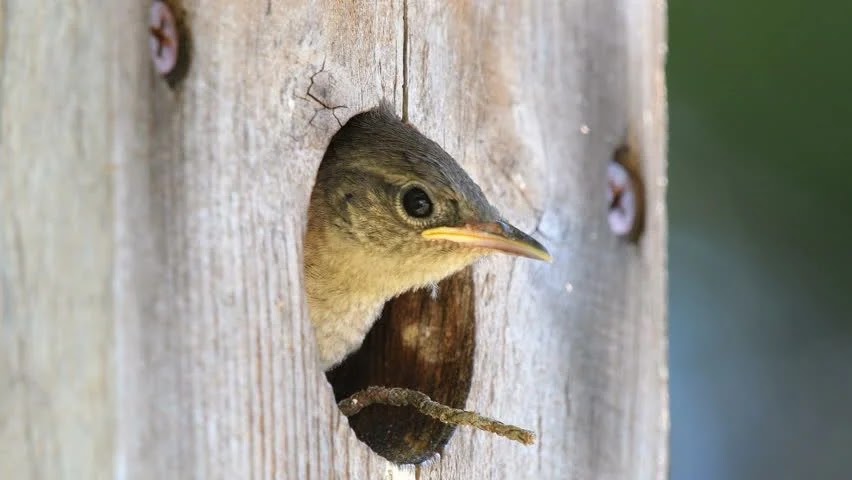
I could tell when Mother Wren was sitting on eggs because she would zip into the box and disappear for long periods of time. If it was especially hot, she would sit at the edge of the box and stick her head out of the opening. Then, she'd fly out to get herself a meal while her mate called from nearby, watching the nest.

She sat inside the box because that is what she has to do to protect her young. She keeps cool by panting, sitting by the box opening but also by flying into the shade to hunt for her food. Unlike people, she doesn't have any choice in the matter of how she spends her days. 

Two days ago I could tell the eggs had hatched because she started making more trips into and out of the box. Even Father Wren came to the opening and leaned in, feeding young. More recently he has gone in and out of the box, tho' not as quickly and surely as his mate. They are regurgitating food into the young birds' mouths and taking poop out to keep the nest clean.

Just as I saw with this year's first brood, soon the young will get big enough to move around the inside of the nest and will start jostling each other to get the food when the adults bring it.

Meanwhile, on the other side of my enclosed porch, I've seen only one hummingbird, a male, back in June. It came to the pink coral bell flowers, ignored the feeder I had out and flew off. I've seen none since. Usually I see females in July, when they are also seeking food for their young. Unlike the house wrens, male hummers don't hang around once mating is accomplished.

Where are the hummingbirds?

Toad, 2024 (Margo D. Beller)

So far this month I've seen nothing, and the pink flowers that had been blooming have faded and are mostly done thanks to an unusually hot summer that prompted many of my flowers to bloom at the same time instead of one after the other. The apple tree that provided me with enough fruit to make eight cups of sauce had its last apple plucked by a squirrel on July 5, about a week earlier than usual. Over the years the last apple day has been getting earlier and earlier as the weather has gotten hotter and hotter.

Luckily, the hot weather has also brought out another important source of food for young birds - insects, as well as insect eaters such as dragonflies. And toads.

Last week, a day after several weeks' worth of grass growth was finally cut, I went on the patio and pushed at the cover on my charcoal grill to tuck it in. Something jumped. It was an American toad, common in the east. It was dark and blended into the black cover's folds in the shade where I had put the grill. When I moved the grill it jumped out to the paving stones. 

I am guessing the combination of losing the long grass and the high heat and humidity forced it to find shelter where it could. It hung around for long enough to determine I wasn't going to bother it (I was watching from inside) and then it was gone.

This is not the first time we've had a toad visit our patio in July. 

(RE Berg-Anderson)

In fact, this American toad showed up on the fourth of July 10 years ago, tho not in the folds of the grill cover. It had somehow gotten into the bottom section of the composter I keep on the patio. When I moved the composter to sweep out leaves that had gotten behind it, out jumped the toad.

I can't imagine how this 2014 toad, bigger than the one I discovered last week, managed to get inside the composter. But out in the wild, I guess any port in a storm will do. I expect Mr. Slither to show up any day now, basking in the heat of the paving stones.

Saturday, March 2, 2024

Oh, Deer!

My brother-in-law lives in a rural part of New Hampshire. When we visit in winter his feeders draw a number of birds. Winter can be harsh up there, climate change notwithstanding. Sometimes the feeders draw something unusual - common redpolls or a flock of wild turkeys, for instance.

(Margo D. Beller)

Recently he announced the feeders had drawn something really unusual, at least to his yard - deer.

Welcome to my world.

In the past, hunting or natural predators have been very efficient in keeping down the deer population in his area. But now there are more homes being built on his road, and those neat parcels of lawn are very enticing for deer. Hunting season is apparently no longer enough up there.

All this, including hunting in restricted areas, has been going on in my suburban New Jersey neighborhood for decades. I've learned the hard way what happens when you grow plants that are not only attractive to you but to wildlife.

First it was the rabbits that nibbled at the asters. I put in a small fence that discouraged them. But it did nothing to stop the deer eating the asters or the euonymous shrubs or the lilies or the sedums. So I put in metal fence posts and hung deer netting. The fence posts would not stay in the ground so eventually they were replaced by thin, plastic-coated metal posts I could more easily hammer in, and on which I tied the netting. 

Protecting the evergreen euonymous
(Margo D. Beller)

Then I learned a hungry deer that was desperate enough would grab the netting with its teeth or use the strength of its hoof to rip a big hole. At first I used burlap to cover the netting on two front plots in winter, but the flapping and tearing caused by the wind had a neighbor complaining. Now I double a piece of netting to make it that much thicker, and I cut back the evergreen euonymous plants as winter approaches to make them harder to reach.

Like my brother-in-law I learned a deer will knock feeders around and eat the spilled seeds. One morning I saw an 8-point buck eating from the house feeder. Not wanting to be gored I banged on the enclosed porch's glass. It looked at me and ambled away. Another reason to take in the feeders at night. (I'd been taking the feeders in at night ever since the first bear attack, except when we've had heavy snow.) 

I learned a fawn could get behind the netting from around the corner if I didn't block the space with folded metal fencing. I learned there are plants deer are less likely to eat, though a hungry deer will always take a bite out of something (such as a canna leaf or a hot pepper) and then learn not to eat it again. (Of course, if enough deer take a bite, you have a dead plant.) 

(Margo D. Beller)

If I had known about deer over 25 years ago when I put in the plants what I have since learned, my garden would look very different. No azaleas and more daffodils, for instance. More ornamental grasses, fewer sedum. 

With Spring coming on I am already dreading the annual hassle of pulling the netting down so I can position myself as close as possible and then lean over the net to remove leaves or stray locust pods and get the beds ready for the season. Every few years I have to pull out the posts and replace the netting. (Last year I did this with the two front beds in a marathon session. Once netting comes down it can't be left that way because of the deer threat.)

Backyard burlap protecting yew plants I learned are
particularly attractive to deer. The backyard
neighbor doesn't seem bothered by the burlap. (Margo D. Beller)

Every year I say to hell with it, I'm taking down all this damned fencing. Then a herd of two to eight deer passes through and I remember why I struggle with this damned fencing.

My brother-in-law doesn't have to worry about this in his rural Eden, at least not yet. For now he'll be taking the feeders in at night, until the bears come out of their dens and he stops feeding the birds for the season anyway.