Cape May

Cape May
(RE BERG-ANDERSSON)
Showing posts with label ducks. Show all posts

Wednesday, January 2, 2019

Duck, Duck, Goose

At this time of year, when migration is done and most of the land birds I find in my travels are the same as those I can find in my backyard, I want to go where I can see something different. That usually means ducks and, to a lesser extent, geese.

Mallards and a male wood duck (Margo D. Beller)
So on this windy New Year's Day I took an afternoon walk not far from my home. There were 50 cars at the dog park, which means there were at least 50 people and 50 dogs, likely more of each. I have no dog and so kept walking along the road to the local pond.

In the pond, not bothered by the wind blowing patterns across the water, were Canada geese, some mallards, a couple of black ducks and what to my un-binoculared eyes looked like a male gadwall. These are all ducks of a type known as dabblers because they don't dive for food, merely put their heads under water or skim food off the surface. (Geese do that, too.) Usually I find a wood duck pair here but not on this day.

Besides dabblers there are the diving ducks that go under water to find their food. Common dabblers include ruddy ducks, buffleheads and three types of mergansers, among many others. For these, I need to go to bigger, deeper ponds.

Canada geese with a visiting pink-footed goose. (RE Berg-Andersson)
These ducks are short-distance migrants, finding New Jersey warm enough for them to winter in after a breeding season in the northern tundra. Various sparrows, finches, woodpeckers and jays are among the land birds I find in the trees and bushes on my walks while vultures and assorted hawks are aloft.

That's why for something a bit different, birders head to the ponds, inlets and sea coast to look for ducks, geese and other winter birds that arrive after the rails, egrets and most other shore birds have departed. (The exception is the great blue heron, which stays around all year and will frequently pop up from a close-by corner of a marsh and scare you with its size and gutteral "QUARK!" call.)

It was during the winter that a pink-footed goose was found in a small park pond not far from my accountant's office. It was also in winter someone found several northern lapwings, a plover usually found in Eurasia but visiting a farm in central NJ. (Luckily, they hung around for weeks so we could visit and not be overwhelmed by the large crowd of birders that came before us.) In recent years, several sandhill cranes have visited one of the few remaining Somerset County corn fields after the corn was harvested, searching for dropped kernels. These stately birds are always a treat to watch.

Brant geese (RE Berg-Andersson)
It was during our first-ever trip to Cape May, NJ, that MH and I found over a dozen types of ducks, most of them new at that point for us, including blue-wing teal, northern pintail and the more common black duck, mallard and gadwall we've come to know very well.

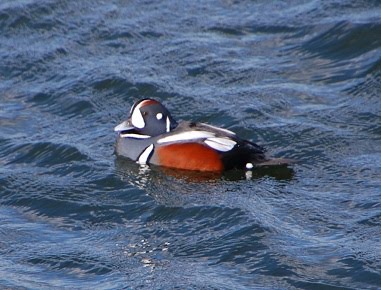
There were also American wigeons and green-wing teals. Over the years we've seen all three types of mergansers (common, redbreasted and hooded) and a vast assortment of sea ducks including three types of scoters (surf, black and white-winged), common eiders, long-tailed ducks, two types of loons (common and red-throated), cormorants (double-crested and great), harlequin ducks and the striking-looking canvasback.

One of my favorite winter ducks, the harlequin. (RE Berg-Andersson)
Meanwhile, Canada geese are everywhere there's water as well as on any golf course or office park with enough short grass to feed them. This time of year a search along sheltered coasts will bring smaller brant geese while larger marshes and fields will host snow geese, which are white with a pinkish bill.

Unless the waters freeze, these ducks and geese will be around New Jersey all winter. If a freeze comes, they head south for warmer places. Then we all hunker down and wait for spring to return.

Sunday, November 19, 2017

Getting Out to Sea

...(W)henever it is a damp, drizzly November in my soul...I account it high time to get to sea as soon as I can. 
-- From Herman Melville's "Moby Dick"

I am no sailor. After nearly drowning several times in my life, I stay away from water be it a placid lake or a raging surf. However, I have great respect for the power of the sea and those who work it for a living. When the wind howls and one wrong step can cost you your life, you are doing a job I know is important and I could not do.

Montauk sunset, Nov. 2017 (Margo D. Beller)
For some reason, despite my antipathy for water, I find myself drawn to it. That may come from my upbringing on the southern coast of Brooklyn, NY, in an area called Sheepshead Bay. Back in my youth the place had the atmosphere of a fishing village, especially along Emmons Ave., which parallels the bay. Farther along the road, there is Plumb Beach, which is now cleaned up quite a bit from the garbage dump it was, when you walked carefully along the sand to avoid used syringes and condoms.

My mother, who grew up on the flat plains of Alberta, liked to come to Plumb Beach to watch the waves. Listening to the water must have been a way to stay calm in an otherwise less-than-contented life. But my old neighborhood has changed and the fishing village has been replaced by high-end real estate, traffic and tall towers.

When MH and I started taking vacations in November around the time of the Veterans Day holiday, we chose shore areas because the tourists would not be there in the same numbers as in the summer. Our first November trip was to Stonington, Conn. We have since stayed along the Delmarva Peninsula; in Cape Cod and Cape Ann, both in Massachusetts; in New Jersey's own Cape May, and down along the North Carolina Outer Banks and on Atlantic Beach.

There are disadvantages to this. When the wind blows in the winter cold it can be numbing. Not as many restaurants are open and some areas of state or federal parks can be closed. If unexpected snow hits, it makes for treacherous travel.

Male (L) and female long-tailed ducks
(Margo D. Beller)
But still we go, because we can enter parks without a fee and, if we are lucky, we find a wealth of birds.

This year we decided to stay closer to home yet not in Cape May, and so ventured to Montauk, on the eastern end of New York's Long Island. We have visited the town on many day trips but wanted to do some exploring of the South Fork, where Montauk is at the very end, and the North Fork, where we had once visited Greenport and Orient, two of the towns where wineries have replaced the old potato farms.

The Long Island scenery is wonderful. We also saw some impressive birds including hundreds of them in the ocean off Camp Hero, an old military base now a state park. Winter is duck time. Among those in the ocean below a sheer drop were black, surf and white-winged scoters and common eiders. Gannets dove from on high for food while cormorants and common loons would pop up from the water before diving back down again. The ubiquitous herring gulls were joined by greater black-backed gulls and even a few ringbills.

In calmer waters we found more common eiders, a scoter or two as well as long-tailed ducks. All of these are usually seen in the ocean but when you are at Land's End and a storm is expected, shelter is a priority.

Double-crested cormorant
(Margo D. Beller)
We had one picture-perfect day, which we spent on the North Fork, an area that shares more with the salt-box, shingled, harbor people of New England than New York. In Orient Beach State Park, dozens of robins plus jays and the occasional house finch and myrtle warbler were hitting the red cedars, which were covered in blue berries. We saw the same feeding frenzy the next day at a county park we found after we left Sag Harbor (like New Bedford, Mass., a whaling center once) but this time it was dozens of cedar waxwings and goldfinches hitting the berries.

If only we could've spent more time with the birds and less time trying to find an affordable place to eat and drive roads where the people who service the rich were in a hurry to either get to their next job or get home and drove one-lane roads at a high rate of speed. Even those who own property and live out there full time drive behemoths that fill your rear-view mirror when they tailgate.

All of this part of Long Island is New York City East. While the North Fork seemed more artsy, I did not like the South Fork much at all. The Hamptons have always been rich but now they are Super-Rich, with obscenely expensive megamansions crowding each other along any available waterway, screened from lesser beings in the road by tall, thick hedges of privet. Privet is everywhere. Once in a while I saw huge hollies placed in front for the same reason, which at least is interesting. Privet is not, and when it flowers it stinks. The mansions were of recent vintage - salt boxes are an endangered species where land is worth more than your life - and likely very empty, their owners back in their city penthouses.

Myrtle warbler
(Margo D. Beller)
A long time ago my family spent our summer vacation not far from the Hamptons, in a little town called Center Moriches. On this trip, MH and I drove through. I expected change and was not disappointed.

When I was a child I remember my family walking along the road from the old hotel - which later was bought by Imelda Marcos, the wife of the Philippine dictator - past a duck farm. Hundreds of white ducks, bred to become part of the famous Long Island duckling dinner. My sister and I weren't told that, of course.

The duck farm was gone, the land cut up into luxury housing. The old hotel I remembered had been fenced in (likely by Marcos) and re-sided (likely by the people who bought it from Marcos) in a thoroughly ugly way. I expected this but it was still sad to see. I doubt we'll be coming back to the South Fork ever again. Aside from the sea, it is not our kind of place.

You've got to walk and don't look back, as Peter Tosh and Mick Jagger once sang.


Sunday, January 15, 2012

Winter Birding

To everything there is a season, and that is true for birding.

Spring and autumn get all the press because that is when the warblers and other tropical migrants pass through on their way north to their breeding areas of choice, or south to the warmer and buggier areas when it is cold up here. Summer is when a lot of birders go to the shore for relief and shorebirds.

I happen to like winter birding when the leaves are off the trees, the cold is bracing and the crowds are sparse. (A lot of birders follow the birds to South America to enjoy summer there.) That doesn’t make the birding any less interesting, especially this year when the unnaturally warm winter weather prompted a lot of migrant birds to hang around a lot longer than usual.

There are lot of birds that show up in New Jersey when the cold comes on. They consider New Jersey warm enough for them, a funny concept to remember when we are shivering from what we consider arctic winds!

Some of these are regular winter visitors. The junco, for instance. This slate-gray and white little guy - and in New Jersey it is always a guy because the browner females fly farther south for the winter (perhaps the males stay farther north so they can get to the breeding areas quicker) - is a pretty reliable indicator winter is coming on.

The white-throated sparrow below is another winter regular. The male’s white “eyebrows” and the yellow spot on either side of the bill and above the eyes get brighter as the winter goes on. Unlike the junco, males and females winter together, and you will hear the high whistling “O Sam Peabody, Peabody, Peabody” of the males as the territorial battles begin.

There are other winter birds not as common. The American tree sparrow, for instance, with its distinctive reddish cap and bi-colored bill, gray on top and yellow below.

The rough-legged hawk is a bird of the tundra, and when winter comes on it sometimes flies south to grassland areas, even urban landfills such as the one abutting the DeKorte Park in Lyndhurst, N.J., near the Meadowlands.

Snowy owl is another uncommon winter visitor and finding one is always a big occasion. This owl is, as the name implies, very white, hangs out in the open and hunts by day, unlike most other owls. This year, among the many recorded, a snowy has been at the Merrill Creek Reservoir in Warren County, NJ, for weeks.

Winter also means ducks. The common eider and the harlequin duck are standard winter ducks at the rocky jetty of Barnegat Light. If you look on a local pond before it freezes the chances are you will find all sorts of interesting ducks including one or more of the mergansers plus ruddy, canvasback and ring-necked duck.

But just about any waterfowl is likely to show up in any unfrozen water, even along the Hudson River shoreline between Hoboken and Manhattan, which is about as urban as it gets.

As I said, one big advantage of winter birding is the leaves are off the trees. Redtail hawks are easy to see from a great distance when they sit in a bare tree, and it makes it easier to find the white-breasted nuthatch calling from a limb over my head.


But perhaps the best thing about winter birding is you don’t have to even go outside if you don‘t feel like it. If you have a feeder out - better still, many feeders holding different types of seed and suet - the birds will come to YOU as you have your hot cup of coffee on a frosty morning.

Try it and you’ll be amazed by what you can see.