Cape May

Cape May
(RE BERG-ANDERSSON)

Saturday, August 24, 2024

A Life or Death Decision

Believe it or not, the plant pictured below was once small enough to sit comfortably on a desk. When the person who had that desk left the job, she left the plant behind. My first mistake was I took it home. My second mistake was putting it in a bigger pot. It grew and grew.

When it got bigger I wondered if pinching it would make it bush out. So I cut the top. Boy, was I wrong. It created a two-headed monster that got bigger still. Eventually I cut off the weaker of the two heads, but that created a long, skinny plant that needed to be braced in order for it to stand upright.

(Margo D. Beller)

Getting it into the house before winter and getting it to my enclosed porch before summer has been an increasing hassle as I age. To move it now I have a small handtruck with bungee cord, the best $29 purchase I've ever made, But even here I still need my husband (MH) to hold the pot as I pull it either up or down the step from porch to house and the three to the front room where I keep my plants in the winter.

Why do I mention all this? Because of the fungus gnats, which have continued.

When enough adults and nymphs got stuck to the yellow sticky traps I decided the time had come to do something radical. I bought potting soil. I spread a tarp on the porch and dumped old soil from five of the six plants into a styrofoam box, then repotted the plants in fresh soil. I quickly took them into the house and even put some yellow sticky traps in them in case I missed a gnat.

At that point, with the table I keep out there empty of plants, I pulled up the half-filled bag of sunflower seeds - and discovered it full of gnats.

Some people would've fainted at the sight of this infestation. Some would have screamed for help. I grabbed the bag and pulled it outside, then opened and started kicking it to get gnats to leave. Then I checked the old coffee containers holding seed. More gnats and a lot of rot. Out they went. The bag of seed is in a trash bag. The seed in the containers is in a garbage bag. Both are now on the patio. The box was taped and put near the compost pile until I decide what to do with it.

One of the containers and the seed in it were clean. The other containers had to be washed for recycling. I put three of them, empty, back on the porch for possible use. I'm hoping some of the seeds in the bag are clean enough to use until I buy a fresher - smaller - bag of seed for the feeders this winter.

That leaves the big plant. It is too big and trussed up for me to pull out of the pot easily to put in new soil. For now, I have a time-released water feeder in the pot so the majority of the top soil can stay too dry to support eggs. There are yellow sticky traps and vinegar traps in the pot and both types have been effective. 

Sticky traps, vinegar traps in the cups (with clear wrap
on top) and glass water feeder.
(Margo D. Beller)

I still find the occasional gnat and there is always the fear one will get into the house and infect the plants. So I have to decide: somehow pull out the plant, change the soil and bring it inside; leave the plant either outside or on the porch over the cold winter and watch it fade and die; or cut it down now, dump out the pot and hope my gnat problem is finally over.

I hate the idea of killing a living plant, especially one that I've had for at least 14 years. It wasn't its fault that when I gave it suitable conditions it went from a desk plant to a tree. Over the years through trial and error - mostly error - I've learned which plants to pinch, which to keep moist and which to leave alone. Like my evolving outdoor garden, my indoor plants have changed over the years. Some die, some are replaced. 

I've never intentionally killed a plant but whether I leave this one out in the cold to die slowly or hack it down now, that is looking more likely. 

No red-bellied woodpeckers at the feeder yet, but one will surely come.
(Margo D. Beller)

Meanwhile, I took seed from the one container that had no rot or gnats and put it in the house feeder. I put the feeder outside. Since then it has drawn cardinals, chickadees, titmice, white-breasted nuthatches, jays, a goldfinch and a house finch. Normally this feeder would've gone out in September (and my plants taken inside in October), but we've had September-like weather this week. Maybe now the feeder will draw some southbound migrant birds I wouldn't have otherwise seen. 

The birds are providing an unexpected benefit from what had been an unmitigated disaster.

Saturday, August 10, 2024

On Insects

"The Creator has an inordinate fondness for beetles."
-- J.B.S. Haldane

In suburbia we do a lot to protect our homes. We cut down tall trees before they can fall on them. We put in lights along the front walk, the garage and the front door to deter (or blind) any potential burglar and increase curb appeal in case we want to sell them. We put up fences to keep children and pets in and strangers out. We mow our lawns within an inch of their lives and then use our leaf blowers to get every last speck of substance off our property and into the street, where it miraculously disappears.

Lethal method 1: yellow sticky strips in the house plants
(Margo D. Beller)

Inside we clean germs - real or imagined - from surfaces. And if we see insects, we want them out ASAP.

That can be a tall task because there are a lot of insects.

According to my copy of the "Kaufman Field Guide to Insects of North America," there are over 24,000 types of beetles in 113 families in North America north of Mexico alone, so Haldane knew what he was talking about. They include leaf-cutters, ground beetles, ladybugs, dung beetles, scarabs, water beetles and long-horned beetles, among many others.

There are other insects including wood borers, wasps, bees, butterflies and moths. Some insects are beneficial, such as aphid-eating ladybugs and pollenator bees and butterflies. Some are bird food, such as the carpenter ants favored by pileated woodpeckers

And then there are the flies. Kaufman says there are 17,000 types on this continent, and they include pesky gnats, mosquitos and maggots. 

Lethal method 2: extension dust mop
(Margo D. Beller)

There are companies that make their living killing rodents, spiders and insects. There are also a lot of products homeowners can use to kill mice, spiders, flies, cockroaches and other space invaders, including ways that won't make you sick using them. 

Two years ago, during a drought, we were faced with an invasion of carpenter ants that had somehow gotten into one of our bathrooms. To get rid of them my husband (MH) went to a big box store and bought traps that contained poisoned sugar water. The hungry/thirsty soldier ants took the bait back to the queen and fed her. She died. Soon the colony started dying. Problem solved.

This year we have had lots of rain but we've also had another type of bathroom invader - drain flies. I would find what looked like a small fly hopping around the sink or on the wall. MH looked them up and we learned about drain flies, which, despite the name, are in the flea family and feed on organic matter in sink drains. (Organic matter? In my sink?)

Getting rid of them was as easy as using drain cleaner followed by pouring in a pot of boiling water. Problem solved.

But when it comes to insects the battle is never really over, it just moves elsewhere and with a different combatant. Currently, it is on the enclosed porch against fungas gnats.

"Fungus Gnat - Rondaniella dimidiata, Woodbridge, Virginia"
 by 
Judy Gallagher is licensed under CC BY 2.0.

I'd be having my morning coffee on the porch and something would flutter by. It would land on a surface and I'd catch it in a container and put it outside. Soon I started to see more of them, which is when MH again looked it up and I learned the name of this invader. (I'm guessing eggs had been laid in a plant I had outside and then moved to the porch.) I've since learned watering my plants has made the problem worse because wet soil helps them breed.

So I've stopped my catch-and-release policy and and have taken to elimination with extreme prejudice.

To my shame I first considered the flying insect spray we had in the garage, but that might (or might not, depending on the website article I read) harm the plants (and me). Then I went to the big box store and bought some yellow sticky strips to put on posts placed just above the soil in the pots to catch any adults. I'm letting the plants dry out and will then soak the soil with hydrogen peroxide to kill any eggs or larvae. I've also put out vinegar traps.

I hope all this works because winter will be here soon enough and the plants will have to go back inside. But so far I have found no dead gnats and the live ones are still flying around on the porch. 

My friend the spider caught at least three gnats. I'm hoping it gets more.
(Margo D. Beller)

So now I've gotten back to basics: smashing them with an extension dust mop. It gives me reach, exercise and the illusion I am doing something about the problem. 

I've also discovered I have an ally - spiders. Yes, those same critters others want to kill and get out of the house are spinning webs on the porch and catching some gnats. According to Kaufman there are 4,000 types of spiders in North America and I have found many of their webs in the house, on the lawn, in the trees and in various areas of the porch.

I am not crazy about spiders in the house because their webs show me where I have been lax and really need to clean. But they are catching insects, and on the porch spiders are more than welcome to spin their webs and gather as many gnats or anything else as they want.  

Raking

(This post was from 2011. I am reposting it with a fixed link and a picture.)

Despite nearly 20 years in suburbia I still find the leaf blower to be at best a necessary evil and I try to use it as little as possible.

The first time I go out after the leaves start to drop I use the lawn mower to mulch them. The next time, after more leaves are down, I convert my electric leaf blower into a mulching vac and crunch up as many as I can stuff into the compost pile.

But after the pile gets filled I must use the blower to herd the leaves closer together to save some time and energy before I use my rake and tarp. 

Unfortunately, I am in the minority. Most of my neighbors have lawn services that use leaf blowers, huge fans and tractors to shove the leaves into huge piles at the curb. The din is painfully loud and the gas smell pervasive. At least they finish quickly.

Those doing it themselves have their own blowers and fans that are just as bad and take longer to finish. My neighbors must work when they have free time and if that means going out as night is falling and working in the dark, so be it.

When I pull out the rake I am purposely slowing myself down. I can go out early and work quietly. I am not wasting energy but I am getting needed exercise. I can listen to the birds. 

Also, I get time to think. Here are some things I have thought while raking:

1. I always know where my neighbor’s property ends and mine begins during leaf-blowing season because he will not go one inch further. 

Pods I raked to the curb. (Margo D. Beller)

2. A pristine lawn won’t last more than a day before leaves come back on it, even if using a lawn service. So why fuss about it? “Let’s not finesse it,” my husband often tells me as we work.

3. Speaking of MH, raking is a nice way of bonding with your spouse. Every year MH and I start by getting in each other’s way but without saying anything we develop a pattern: he makes smaller piles, I sweep them into the tarp. Then we lug the tarp to the curb. The job goes faster and we rejoice in its completion together. 

4. The birds aren’t happy when I work near the feeders but they are very happy when I clear the big leaves and uncover the bugs.

5. If you stop every so often you might find something interesting. One year it was a brown creeper heading up a tree. This year it has been a redtail hawk being harassed by crows and 15 black vultures circling over the house.

6. You can see how the lawn is doing up close, including where the mushrooms have come up, the ground ivy has taken over and the skunks have been digging for grubs. 

7. Wind is the ultimate leaf blower. If I go out on a windy day I figure out the direction and rake accordingly. It amazes me how someone will try to fight the wind, wasting time and energy. Life is too short.

8. I would love to meet the person on the Shade Tree Commission who decided having locust trees on my street would be a great idea. Locust leaves are too small to be effectively blown or even raked, and the female trees usually have hundreds of hanging seed pods that fall and blacken the lawn. Luckily, this year was the one in three when the female tree on my property produced only a few pods. I would like to punch that commissioner in the nose.

9. Why don’t more towns require leaves be bagged? It’s hard enough driving on leaf-clogged streets, harder still to walk on streets without sidewalks where leaves on both sides make a two-way road into one lane. In the years I would walk home from the train every night I feared the oncoming car at my back that wouldn’t slow down. Luckily, I lived to tell the tale. When my town comes through the crew leaves almost as much behind as it picks up. I would think collecting ecologically approved brown bags of leaves would be more efficient and quicker.

10. You are going to see your neighbors and they are going to see you, whether you like it or not. So wave and be friendly. It might be the last time you see them until next fall.

Sunday, August 4, 2024

My Evolving Garden

"Gardening is an instrument of grace." —May Sarton

I went outside one morning between rain storms to cut some flowers for the kitchen. At the time what was blooming were white Shasta daisies, yellow daisy-like flowers that have spread beyond the two plants my sister-in-law gave me, purple salvia, some zinnias and purple coneflowers. The early spring flowers were long gone and the fall flowers - rose of Sharon, sedum - were still in bud. 

Garden flowers - zinnias, yellow daisies, goldenrod, coleus, coneflower.
(Margo D. Beller)
As I was preparing the flowers for the vase I thought about how my garden has changed over many years .

When we bought our house decades ago, the area in front of the bay window was flanked by two large rhododendrons and three azalea shrubs between them. At the side of the house were drifts of daffodils. In the back was a plot of the ground cover pachysandra. There was no patio, no paving-stone walkway. In the front, the dirt path had large flat stones for walking to the front door. I don't remember if anything was growing along that walkway.

Then we had to have major work done on the foundation. All those plants I mentioned above - gone. I regretted losing those daffodils and the rhododendrons.

The rhododendron I planted. (Margo D. Beller)

So when the work was done and it was time to plant a new garden I had to take into consideration zoning rules (a "park-like" lawn on the 35-foot setback that came nearly to the house), whether the plants needed sun or shade and, especially important for me, what kind of pretty flowers would they produce.

I planted a rhododendron where one of the previous owner's plants had been. I flanked the area with two rose of Sharons. In between were a row of yellow and green euonymous shrubs and purple asters at the front. I was not thinking in terms of perennials vs. annuals or how fall-blooming plants like asters would look in the spring. Like the plants, my thinking would eventually change.

Along the now-bricked front walkway I put in azaleas. In back, small yew shrubs. Where the daffodils had been, some andromeda bushes.

It didn't take long before I started learning about the animals that roamed the property, especially rabbits and deer.

After too many mornings when I discovered a rabbit nibbling on the asters, I bought a small fence to keep them away. That sorta worked (and thanks to the increase in the fox population I haven't seen a rabbit in the yard in years). But then I'd see damage to the asters and the euonymous shrubs and figured out something bigger was stepping over the low fence and helping itself. 

I can't remember how long it took to figure out I had a deer problem. I started reading about deer and what they are likely to eat, and quickly realized I had created a veritable White Castle for Odocoileus virginianus.

Columbine (with seedheads) that sprung up between euonymous shrubs.
(Margo D. Beller)

There are ways to deter deer. You can continually spray foul-tasting stuff on your plants, you can get a dog to patrol the property and pee in the garden so the deer smell it and stay away from a potential predator, you can put up barriers such as a fence or you can plant things that a deer is generally presumed not to like (but I've found will try anyway).

I eschewed the spray and I don't have a dog, so I went with fencing and plants - such as ornamental grasses and onions - in areas where I didn't put up a fence. 

After the azaleas stopped blooming I realized having just these plants looked boring, So I planted low juniper bushes between each azalea to make it more interesting. I discovered the joy of daffodils when a now-former neighbor insisted I fill a bucket with them after her son-in-law rescued hundreds from a garden crew that had dug them up from an office park. I bought more daffodils and got even more from a friend who said she didn't want them in her garden. Eventually daffodils were planted with ferns between the andromedas as well as in the spaces when the junipers eventually died.

The asters eventually died, too. I planted hyacinths, crocus and glory-of-the-snow and lilies. A friend gave me some goldenrod and snowdrops. A charity mailed me a packet of Shasta daisy seeds, most of which have sprouted. These are all behind deer fencing.

Fencing protecting yews. Behind them are the hostas.
(Margo D. Beller)

From an annual plant fair I bought butterfly bush, butterfly weed and hellebore. After several attempts to grow black-eyed susans failed I succeeded with purple coneflowers. I found columbine that had produced seedheads in a vacant lot about to be built over. These seeds have produced daughter plants everywhere I've spread them and beyond. I did not, to my regret, rescue a peony so I bought one that has flowered beautifully each spring. 

I bought a hydrangea bush to remind me of my parents' garden, but between the deer trying to eat it and the chipmunks tunneling underneath it didn't last. 

I planted joe-pye weed that grew 10-feet tall and threatened to overwhelm the bay window plot so I had to move them. They did ok after the move but they are now gone. The ornamental grasses I planted did much better than the Scotch brooms and lavenders I tried in the backyard.

Joe-pye in the wild. My experiment with them did
not turn out as well. (Margo D. Beller)

When a friend was breaking up her garden she begged me to take some of her plants, so I took irises, lily of the valley, astilbe, perennial geranium, fringed bleeding heart, yarrow, bishop's weed, monarda, vinca and several hostas. These plants have since been moved several times or have died, either because they reached their mortal limits or because they became so invasive I had to pull them out. Some of those that died I replaced with the same type of plant. 

In the case of the hostas I tried to get rid of as many as possible after the time deer ripped through the netting and nearly destroyed the potted plants, which I'd foolishly put in front. I now have two hostas hidden behind other plants. The others I gave away. 

And, of course, there are always weeds.

For my fencing I started with heavy metal poles I could never get fully in the ground. Then I discovered thin metal poles coated in green plastic that had no hooks. These don't last as long but I can hammer them into the ground. I developed a way of attaching the netting with green plastic garden ties, looping the top of the netting around the top of the poles. I also moved the low fence, putting it around my compost pile.

May Sarton wrote about her garden in her journals. She had vast drifts of flowers at her place in York, Maine. I don't remember her complaining about deer or about overdevelopment or climate change making the Earth too hot and changing when those flowers bloomed and when bees, birds and other pollenators would be stopping by to feed. 

Perennial geranium I bought and potted, and a hosta I kept that is not
yet hidden by the yew. (Margo D. Beller) 

But all that is happening now. With so-called development wiping out natural areas for residential and commercial lots the increasing deer populations gather and eat in small garden plots and suburban yards because there are no woods anymore (or predators that have been wiped out, or fear of being shot where people are now living).  

Meanwhile, the planet is getting hotter and plants are blooming before insects and birds can pollenate them. In years of massive insect populations the leaves of many plants are turned into lace. In other years, like this one, there has been so much rain my dogwood bloomed and the red spider mites were kept away from the flowers. Our recent heatwaves have been punctuated with massive downpours turning the street into a river and our driveway into a tributary.

The perennials have been growing in my garden long enough to be used to the conditions and can take care of themselves, which is fine for me. Annuals don't do nearly as well so next year's garden won't have them. If climate change makes my garden evolve into a desert or a floodplain, so be it. The garden (and I) will deal with it.

Sunday, July 28, 2024

Gone Again

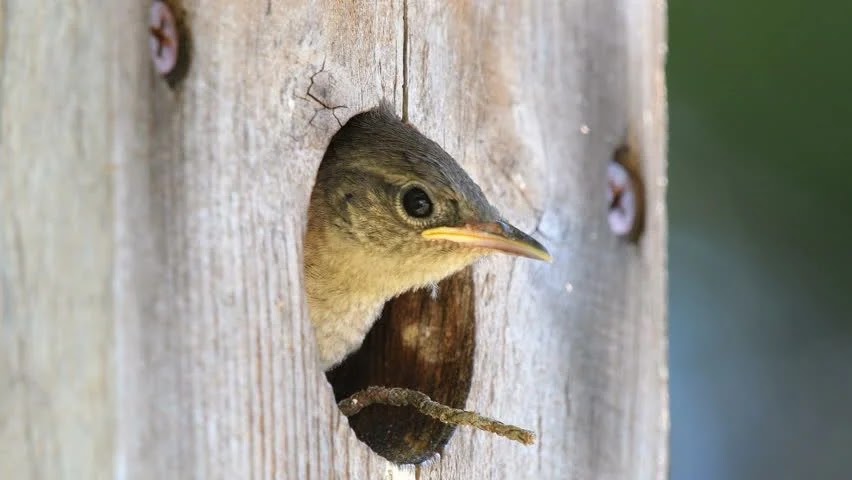
Once again a house wren brood has fledged and once again I managed to miss it.

As was the case with the first brood back in June, the young started getting antsy. One chick again stayed close to the nest box opening to intercept a parent bearing food. This chick at one point leaned so far out of the box the parent pushed it back inside. But the chick kept looking out, watching for food but also, to me, curious about the world outside the box.

Yesterday, I had my binoculars on the box when a parent came with food, shoved the one chick out of the way and allowed me to see the open mouth of its sibling. The parent fed that chick, checked for poop and left.

Empty nest, July 27, 2024
(Margo D. Beller)

I told myself I should get my camera, sensing things were about to change. As usual, I just sat there.

Later in the day, back from various Saturday errands, I took advantage of the less-humid weather to do some very necessary weeding, including clearing out crabgrass from between paving stones and pulling out ragweed before it could develop pollen that would make me sneeze more than I already do.

One of those areas was at the other end of the yard where ornamental grasses and other plants deer generally avoid are in an unnetted plot. Behind me I heard house wrens. They later flew to a shrubby area just beyond my compost pile, the same area where the first brood hid after fledging. Later, I rested on my porch and saw no activity at the nest box.

Unlike in past years, however, I do not feel sad at seeing the empty nest. I did what I intended, which was to help maintain the house wren population, even though house wrens are far from endangered. This year a pair had one chick and then a second (or the same?) pair had two chicks. With any luck the chicks will grow, fly south to the wintering grounds in Central and South America and then fly north to breed. Big ifs. Life is perilous for all birds, but especially for young birds that somehow know how to migrate without parental help.

I can only hope for the best. The box will be taken down and cleaned out in October, then stowed away for next year.

Monday, July 22, 2024

A Wren by Any Other Name

As we approach August, families have been passing through my yard - small flocks of robins, flickers, grackles, chipping sparrows, all pecking at the ground for food. Birds are also flocking to the cherry tree, where the berries have become ripe enough to consume. The robins, catbirds and jays have been joined by raucous families of titmice as well as the occasional house finch.

Over at the house wren box, the young - I'm guessing there are at least two in this brood - are now big enough that the parents feed them from outside, except when one (usually the female) goes in to remove poop. I can hear the cheeping of hungry young through the open window while I sit on my enclosed porch.

Northern House Wren, aka one of my backyard birds.
(Margo D. Beller)

Many types of birds, including the house wrens and the robins - have multiple broods in a season. Many more are one and done. At this point of the summer, some species of birds are already heading south to their winter feeding grounds. More will be on the move in August into September, including warblers, shorebirds and raptors.

At that point it will be time for people like me to prepare our gardens for winter and put out feeders for the birds passing through and those that will be spending the cold months in and around my yard.

It is at this point of the summer that the American Ornithological Society's (AOS) Committee on Classification and Nomenclature of North and Middle American Birds publishes its "check-list supplement." This benign-sounding document in reality contains what could be radical realignments of the way birds are categorized. Many types of birds previously considered separate species can be "lumped" into one - decreasing the number of birds to record on a Life List. Other birds have been found to be separate species and so are "split," thus increasing the number of birds to be sought by birders.

Here are a couple of examples.

The small common redpoll, which I've seen only during some winters in New Hampshire when they come farther south because of the lack of food in their usual territories are now considered the same species as a paler redpoll I've never seen and is considered a rare visitor to northern U.S. states, the hoary redpoll.

Meanwhile, the Audubon's shearwater, a bird that looks like a large gull and lives its life over the open ocean, is now five species of shearwater, only one of which (the Sargasso shearwater) is found in North American waters. The cattle egret, which is found in farm fields rather than at the edges of water, is now the Western and the Eastern cattle egret. AOS says they are different in plumage. The Western is what is found in the Americas, the Eastern in Asia and Australia.

Normally these changes in taxonomy don't interest me because they involve birds I don't see often or are not likely to see unless I travel to a completely different part of the world.

But the change to the house wren did interest me.

Where there was once one "house wren" there are now six: the northern house wren, the southern house wren, the Cozumel wren, the Kalinago wren, St. Lucia wren, St. Vincent wren and the Grenada wren.

According to the press release announcing the changes:

This split was a long time coming. Some of the island species, in particular, look and sound very different. Some sound so different that people who are intimately familiar with House Wrens from the mainland don’t even recognize their songs as being from a wren! Indeed, that was my experience on my first visit to Cozumel. Speaking of the island species, it was very nice to see this sentence in the acknowledgements of the supplement: “We thank Kalinago Chief Lorenzo Sanford and the Kalinago Council for permission to use ‘Kalinago’ in the English name for the newly recognized species Troglodytes martinicensis.”

Note that “Brown-throated” Wren of Mexico and the far sw. United States is included in Northern House Wren, so there is no additional species for the ABA Area. Northern and Southern house wrens switch over in Veracruz and Oaxaca, where they look different (warm “Brown-thoated” Northerns vs. grayish Southerns) and use different habitats (highland vs. lowland). Kalinago Wren was originally found on Dominica, Martinique, and Guadeloupe but persists on only the first island. The other species are found on their namesake islands.

So the birds in my yard are Northern House Wrens. 

Of course, the birds don't know what we humans call them. If they could understand the human need to classify they likely wouldn't care either. Neither do I. I'll continue to call the birds in my yard "house wrens" even after they fly south for the winter.

Saturday, July 13, 2024

Heat, Humidity and House Wrens

When it is so hot and humid outside I must stay indoors with the air conditioner on for most of the day, I try to imagine what it is like for the house wrens in my yard.

This past week the western half of the United States has been baking under brutal heat, with wildfires sparked. Meanwhile, in my half of the United States, we just got through more than five days where the temperatures were in the 90s and the humidity made the air feel like 105 degrees F.

House wren (Public domain photo)

Weather like that is dangerous. Weather like that keeps people like me inside and extremely uncomfortable unless I have the air conditioner on.

In weather like that I can't even keep a water dish outside because when the sun hits it late in the day the water becomes undrinkable. I can only go out to walk in the very early morning when the air, while still humid, is 20 degrees cooler than what it is forecast to hit for the high. If it is raining in the early morning, as it has for a couple of mornings, I am stuck inside and start to feel caged and anxious, not the best company for my husband.

In weather like that I feel sorry for the First Responders and others who must be outside to do their jobs. I used to travel to work but I would leave in the early morning, sit on a (usually) air conditioned train and then walk into an air conditioned office. The heat would not become an issue until my walk home from the train. But I was younger then and didn't think twice about being in an inferno. Now, I do.

This most recent heat wave wasn't the first this summer. There was a heat wave in June. And there will be a new one starting July 14. And August is weeks away. You can blame El Nino, La Nina, climate change, global warming - whatever you want to call it, it's hot. The Earth won't cool anytime soon without drastic actions.

So I look at the house wrens with amazement and admiration.

I could tell when Mother Wren was sitting on eggs because she would zip into the box and disappear for long periods of time. If it was especially hot, she would sit at the edge of the box and stick her head out of the opening. Then, she'd fly out to get herself a meal while her mate called from nearby, watching the nest.

She sat inside the box because that is what she has to do to protect her young. She keeps cool by panting, sitting by the box opening but also by flying into the shade to hunt for her food. Unlike people, she doesn't have any choice in the matter of how she spends her days. 

Two days ago I could tell the eggs had hatched because she started making more trips into and out of the box. Even Father Wren came to the opening and leaned in, feeding young. More recently he has gone in and out of the box, tho' not as quickly and surely as his mate. They are regurgitating food into the young birds' mouths and taking poop out to keep the nest clean.

Just as I saw with this year's first brood, soon the young will get big enough to move around the inside of the nest and will start jostling each other to get the food when the adults bring it.

Meanwhile, on the other side of my enclosed porch, I've seen only one hummingbird, a male, back in June. It came to the pink coral bell flowers, ignored the feeder I had out and flew off. I've seen none since. Usually I see females in July, when they are also seeking food for their young. Unlike the house wrens, male hummers don't hang around once mating is accomplished.

Where are the hummingbirds?

Toad, 2024 (Margo D. Beller)

So far this month I've seen nothing, and the pink flowers that had been blooming have faded and are mostly done thanks to an unusually hot summer that prompted many of my flowers to bloom at the same time instead of one after the other. The apple tree that provided me with enough fruit to make eight cups of sauce had its last apple plucked by a squirrel on July 5, about a week earlier than usual. Over the years the last apple day has been getting earlier and earlier as the weather has gotten hotter and hotter.

Luckily, the hot weather has also brought out another important source of food for young birds - insects, as well as insect eaters such as dragonflies. And toads.

Last week, a day after several weeks' worth of grass growth was finally cut, I went on the patio and pushed at the cover on my charcoal grill to tuck it in. Something jumped. It was an American toad, common in the east. It was dark and blended into the black cover's folds in the shade where I had put the grill. When I moved the grill it jumped out to the paving stones. 

I am guessing the combination of losing the long grass and the high heat and humidity forced it to find shelter where it could. It hung around for long enough to determine I wasn't going to bother it (I was watching from inside) and then it was gone.

This is not the first time we've had a toad visit our patio in July. 

(RE Berg-Anderson)

In fact, this American toad showed up on the fourth of July 10 years ago, tho not in the folds of the grill cover. It had somehow gotten into the bottom section of the composter I keep on the patio. When I moved the composter to sweep out leaves that had gotten behind it, out jumped the toad.

I can't imagine how this 2014 toad, bigger than the one I discovered last week, managed to get inside the composter. But out in the wild, I guess any port in a storm will do. I expect Mr. Slither to show up any day now, basking in the heat of the paving stones.