Cape May

Cape May
(RE BERG-ANDERSSON)

Monday, May 29, 2023

Summertime

 In summer, the song sings itself.

-- William Carlos Williams

Since I last wrote, we've had a roller-coaster month of May. There were days of rain so heavy it flooded my favorite walking trail. There were days that were much colder than usual, including one when I needed to protect my plants from possible frost. Then it turned hot and very, very dry. My husband and I did some traveling. I was downsized out of a job. Many of my early plants bloomed and faded, only to be replaced by others including the rhododendron, the irises and the peony. I accomplished several big garden projects - including weeding, creating a border trench, and removing and replacing deer netting and fencing - to my physical detriment. The lawn grass became very long but it was cut before any pregnant deer would want to drop a fawn on the lawn, which has happened in the past around now.

Rhododendron (Margo D. Beller)

And spring migration came to an end.

It is always with sadness that I acknowledge it's over. I think of what birds I found and what I didn't find. In my part of New Jersey the northerly winds in late April into early May seemed to have kept down the number of migrants passing through. The radar I looked at showed the birds flying north, bypassing most of my state, taking the path of least resistance. When we visited family in New Hampshire and stayed at a motel by Lake Sunapee it was a pleasure to sit on the screened deck at dawn and listen to the birds I had missed in my area. Except for our annual trip to Old Mine Road to listen for the birds that breed in the high terrain of the northwestern part of New Jersey, the only birds I have found lately are local breeders.

When it finally became warm enough I planted my pepper seedlings and moved the house plants to the enclosed back porch. In the backyard I went from two seed feeders and one suet feeder to one seed feeder and the hummingbird feeder. But there were nights it got cold and one when it got very cold, and that night I covered the pots and the peony, which had flower buds about to open. 

Peony, when the buds opened (Margo D. Beller)

Now, on Memorial Day, the so-called start of summer, it is hot. Yesterday I took in the last seed feeder and washed it out. Until then it had been drawing pairs of white-breasted nuthatch, cardinal, jay, goldfinch, house finch and song sparrow, the last one an unusual feeder bird for my yard. Now, the yard is quiet except for resident birds including the catbird. The birds should be either sitting on eggs or ready to do so.

That brings me to the annual saga of the yard house wren.

Every year the story is different. This year I hung the nest box in a different area of the dogwood tree than last year. In the past it only took a few days for a bird to come. But with this year's winds it took several weeks for a house wren to even show up in the yard, much less investigate the box. Early in May, just before we went on vacation, I saw a wren with a stick in its mouth go into the box. If it was a male, it was "dressing" the potential nest site to show its mate. Its mate would decide if she liked the location. If she did, she would bring in more sticks to create the nest. So I don't know if the wren was a male or female because they look alike.

My favorite walking path under water after
two days of very heavy rain. It has
since dried. (Margo D. Beller)

Fast-forward 10 days. I returned to work only to learn I and a number of others were out of a job. I spent time on the porch. What I saw from there were two house wrens actively shuttling back and forth with food to the box. According to the Cornell Ornithology Lab, incubation is nine to 16 days and the nesting period is 15 to 17 days. Maybe I had misjudged when the nesting period began?

Then, something happened.

We had a few cold mornings, including that very cold morning I mentioned when I had to protect my plants. The shuttling stopped. I didn't see much of the wrens. Recently, as I listened to the male singing from a nearby bush, the female came out of the nest box. But there was no active shuttling. She would return with food and go back inside. She would not come out again for a long time. 

I have no camera in the box so I can only guess at what is happening. 

Scenario 1: The young they had been actively feeding got big enough to fly, left the nest and the pair started a second brood.

Scenario 2: Something killed the young - the cold, a predator - and the pair immediately started a new brood.

Scenario 3: This is an entirely different pair of house wrens.

Wren box in its 2023 location
(Margo D. Beller)

In all the time I've put out a nest box I have never had a pair of wrens have one brood, raise the young, get them to leave the nest and hunt for themselves, and then the pair start a second brood. There would not have been enough time for that process, or for an entirely new pair of wrens to have found the box and lay eggs.

I lean toward scenario 2. Most likely the young had grown too big for the female to get inside the box and sit on them when the temperature dropped to the low 30s and so they died of the cold. Less likely is a predator getting to the young. One of the advantages the nest box provides is the small opening - too small for a cowbird to drop in an egg or admit a predator any larger than an extremely small snake

However, it would not have deterred disease from entering and sickening the young birds fatally. That's another possiblity.

At present I go outside in the morning when it is cool. I hear the male wren singing his territorial song. The female appears with food and goes into the box. After a while, when the male sings, perhaps telling her it is safe to do so because he is nearby, she will leave the box to hunt and then fly back and enter the box. The male stays in the area.

Perhaps in a week the pair will be shuttling to and from the box to feed young. This summer I'll have more time to watch for it. 

Sunday, April 30, 2023

Life and Dying in the Backyard

Every spring I am surprised by my plants coming back after the winter. This year is no exception despite temperatures that reached the 80s in February and the 30s in April, with very little snow but lots of rain. Although some plants did not get as tall or as showy as usual, they did flower. The same is true of the trees and the shrubs. Both the apple and the pear trees have flowered, despite being severely cut back early this year. Where there are flowers there will be fruit, albeit fruit too high for me to easily pick.

Dogwood flowers in 2016 (Margo D. Beller)

This post will focus on one particular tree.

I have lived in my house for over 25 years. In my suburban neighborhood "woods" means trees on the property border. Any trees planted in the front or back yards have been put in by the homeowner. Over the years I've had to cut down yard trees for various reasons. I have, however, planted two trees - the blue spruce we nicknamed Spruce Bringsgreen and a flowering dogwood.

I planted the dogwood because in the fall it is supposed to produce red berries for the birds. Since that tree was planted in 2007 I've learned berries are not guaranteed. Like the other flowering plants, it depends on the weather. Some years there would be lovely pink flowers on the dogwood. But that did not necessarily mean berries would follow. Some years yes, some years no. The fresh green leaves would go red in the fall. 

Dogwood berries, 2019. Note the discoloration
in the autumn leaves. (Margo D. Beller)

Since planting that tree I took it as a given that once established it would always be there. But like any other living thing, trees die. Sometimes they are killed by man, who cuts them down or pollutes the air. Sometimes they are killed by insects, as was the ash tree I had to cut down because of the emerald ash borer. Sometimes, however, they are killed by bacteria or fungus.

I don't remember when during the winter I first began to notice one branch was missing some of its bark but I did eventually notice, especially when more bare patches began to appear. I became alarmed when the apple and pear trees, the viburnum, the forsythia and the lilacs started leafing out and the dogwood remained bare. I thought the tree was dead.

My first indication something was wrong.
(Margo D. Beller)

I was going to write about it here. I even had a name for my post - Dead as a Dogwood.

But reports of the dogwood's demise were premature - after a recent heavy rain it started to leaf out.

Not everywhere, however. The part of the tree where the bark has come off remains bare, as are a few of the lower branches. 

I did some research into dogwood diseases, and to my horror discovered there are quite a few. The one that appears the closest to what is happening with this tree has the awful name of "crown canker."

Hoping for the best, I wrapped the lower part of the tree to prevent the bark that was just starting to flake from getting worse. I used my lopper on some of the lower branches and will have to use a saw or chainsaw on other parts. Because the tree went straight to leafing there will be no flowers. The leaves are small and I doubt there will be fruit. I don't even know if the tree will be alive next year.

(Margo D. Beller)

As I looked at some of the pictures I've taken of this tree over the years I realize the signs were there: discoloring in the leaves, the irregular production of fruit. It was not until the bark started falling off that I realized this tree is sick. Should I have used the sprinkler last year instead of letting the grass go brown and deprive the tree roots of water during the summer drought? Should I have added more mulch to what I had already put down at the base of the tree? 

Dogwood leaves, 2023 (Margo D. Beller)

I don't know. This year I'll use the sprinkler more and I'll use my saw on the dead branches. The tree may be disfigured but I hope it will recover. Or it may die. Living things die, even trees.

In the meantime, as I have for the past two years, I have put up the house wren nest box on one of the living dogwood branches. I heard a wren singing the other morning as I put out the feeders. The bird investigated the box, then flew to another yard. Will it be back? That, too, is unknown.

Sunday, April 9, 2023

The Ladies Who Sing

It is finally spring. Trees are leafing out. The daffodils are at their peak. The lawn has greened, the lawn services are out and the pollen is flying.

And there is birdsong, lots of birdsong. As light comes into the sky the dawn chorus begins - robins, cardinals, titmice, song sparrows.

This is my favorite time of the year. At any moment a migrating bird may stop in my yard to visit the feeders or hunt for insects in the trees and shrubs. The light comes into the sky around the time I wake up and by the time I get outside the birds are singing.

The other morning I was outside with my coffee, listening to the dawn chorus. There was a cardinal singing particularly close by and for once I wanted to watch him sing. I walked along the path to get a better look and stopped when the song seemed to come above me in the apple tree. But where was the distinctive red male cardinal?

Female cardinal (Margo D. Beller)

There was no male. The singer was the brown female, whose dull coloring allowed her to blend into the bare tree branches near the very top rather well. 

I had been fooled, but I'm sure I am not the only one who has made that mistake.

Here is the common thinking about birds: The males, brightly colored to attract a mate, do the singing to either draw a female or defend its chosen territory, its song warning other males of its type to stay away. The duller females mate, choose a nest site, then build the nest for the eggs she will incubate.

But that thinking is wrong, I've learned. Female cardinals sing just as often and as loud as their male counterparts. It turns out female birds of quite a few species do, too.

How have we managed to miss all these female singers? There are a number of reasons, some of them literally man made.

I did some research and it turns out the study of female birdsong has been increasing, and there have been quite a few articles on this very topic.

One problem with knowing if a female is singing: It is hard to tell the male from the female of many types of birds. For instance, I can't tell if the titmouse singing "peter, peter, peter" in my tree is a male or not because the males and females look alike. They are the same size and color. Some singing birds have only the most subtle difference in shading, such as the black head of the male robin and the dark gray head of the female. 

Male or female titmouse?
(Margo D. Beller)

Another problem: There have not, historically, been a lot of studies of birds beyond those of temperate zones in the U.S. Most of the birds that have been studied come north in the spring and go south for the winter. But there are many more birds, just starting to be studied, that stay in those South American rain forests and jungles and do not migrate because they have all the food they need. These female birds sing all the time, to protect territories or draw a mate. (Of course, there is an even greater universe of birds living and migrating in Europe, Asia, Africa and Australia.)

According to what I found on the Cornell Ornithology Lab site, a 2016 study pointed out that in a sample of more than 1,000 songbird species from around the world, 64% had females that sing. Many tropical species and some temperate-zone species, such as female cardinals, "sing regularly; while others sing during specific parts of the breeding season," according to Cornell.

Take the song sparrow. A 1943 - yes, that far back - study by Margaret Morse Nice, found female song sparrows sing early in the breeding season, mainly to warn other females away. But she also found female singers among temperate-zone birds including northern mockingbirds, Baltimore and Bullock’s orioles, white-crowned sparrows, European starlings, cedar waxwings and house finches.

To me that is impressive - her study covered nine years of observations - because in many of these birds the males and females look identical.

Both of these birds will sing very
sweetly for you, if you have ears to listen.
(Margo D. Beller)

That study is impressive to me for another reason - it's a woman doing the research. Bird research, as in most of the scientific fields, has been a male domain. Most of the researchers have been men and, back in the day, not many of them were interested in traveling outside the United States and were even less interested in dull females, much less whether they could sing. As in so many areas of our western patriarchal society, gender bias determined what we all believed.

That, however, has been changing, slowly. 

Here is a sampling:

The Auk, now known as Ornithology, is the peer-reviewed scientific journal of the American Ornithological Society. The society was formed in 1884! This is the place for people who go far beyond Sunday birding, the (mainly) men who make the rules as to taxonomy and other fine details of birds and their lives. Even here you'll find a study on female birdsong, complete with abstract, figures and tables, and references.

Femalebirdsong.org goes further: This site provides actual female birdsong calls and gives you a way to be a Citizen Scientist and gather even more data. There are also links to articles on the topic of female birdsong.

The Female Songbird Project is another a Citizen Science initiative.

Audubon: The granddaddy of bird preservation organizations puts the spotlight on a study "tackling the gender and geographical skew in avian song research."

But wait, there's more: Do a google search of "female birdsong." You'll find all sorts of other articles from mainstream publications including Scientific American and the Washington Post.

If you take away anything from this blog post, it should be to keep your mind open as well as your ears and eyes. Or, to quote Abigail Adams, who in many ways was far ahead of her time, remember the ladies.

Saturday, March 25, 2023

Spruce Bringsgreen Speaks!

Hello again! Margo told me that some of you have been asking after me. It has been a long time [Editor's Note: Nearly five years, to be exact.] since the last time I've written in this blog, so it's high time I tell you what I've been up to lately.

So far, about 50 feet. [Colorado blue spruces can grow 75 feet tall in the wild but 30-60 feet in the yard, so I think Spruce might be exaggerating a little.)

Spruce Bringsgreen after the Feb. 28, 2023, snow.
(Modified photo by Margo D. Beller)

Yes, I've been growing. I put out my first cones so I am now a mature Colorado blue spruce. I'm the pride of Margo's yard and, unlike some of the other trees she had cut back recently, I've been left alone to get bigger and spread out. Maybe a bit of tickling of my bottom branches as that guy she now has mowing the lawn instead of her husband works around me. The deer leave me alone because they know I'm prickly and don't cotton to being nibbled on.

It has been very nice in this yard. We haven't had a lot of snow in a very long time except once, which gave me a thick, warm coat. [See photo.] But that didn't last long. The way I am built, the stuff just slides off once the sun comes out. Soon enough I am my old self again.

Spruce dressed up for Christmas, 2018
(Margo D. Beller)

However, I will say that it has been sad to see some of the old neighbors cut down. Up and down this block the tree cutters roll by in their trucks and the air is soon filled with the sound of sawing, mulching and stump pulling. I know Margo dislikes it very much because she tells me that. Some of the old guys were sick and had to come down, I guess, but some of them I don't know why they had to go. Maybe they were in the way. 

The cedar I can see by Margo's front door was cut in half by the people who came to do her tree work. That cedar got almost as tall as the roof, and it used to provide shelter for some of the small birds. It also has softer leaves than mine and the deer would get at it, as they get to most things. 

[Note: One of the biggest problems in suburbia is people planting trees too close to the house. This cedar, and one on the other side of the front door, I had planted in 1995, when I was a new homeowner and didn't know better, as I was to learn about most of the deer-attracting plants I put in before I put up netting to save them. The other cedar eventually died after an ice storm and I cut it back myself. I needed professional help on this second one because it was too tall. It would almost double over when covered with snow.] 

The cedar before it had to be cut back.
(Margo D. Beller)

Now the birds take shelter in my branches. Being so tall, they can be high off the ground and away from those four-legged predators that seem to come through this yard with increasing frequency, particularly at night. 

I don't mind sheltering these birds. The ones that go "dee, dee, dee" [black-capped chickadees] are fine. They stay quiet, fly out for food, eat it elsewhere and then come back to me to hide or get away from the wind or to rest. But those black and white ones [male juncos] are terrible. They fight each other, they fly in and out, they make a lot of noise as they get in each other's way. But they'll be gone once it gets warm.

Sometimes a redbreasted bird [a robin] will bring bits of material and make a nest high on my shoulder, but it rarely stays. I don't take it personally.

It's hard to believe I've been planted in this spot for as long as I have [since November 2007]. It feels good to be rooted. I know Margo comes out to admire me frequently. I've no fear she will be cutting me down. That's about all a tree can hope for nowadays.


Sunday, March 19, 2023

The Woodpecker Story Continues

The story never ends, it just enters another chapter.

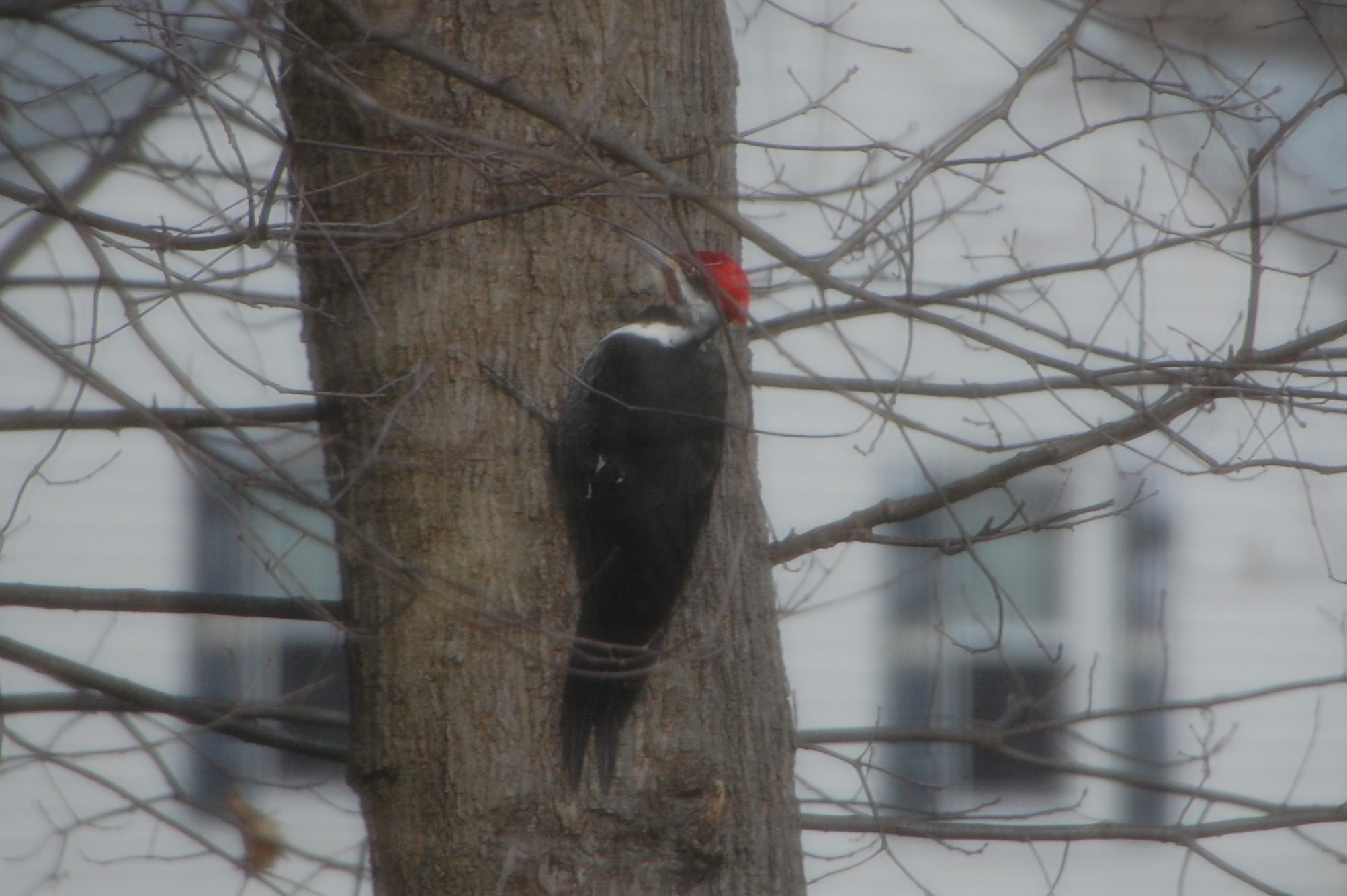
It was over a month ago I heard the knocking of a pileated woodpecker excavating one of my neighbor's trees. At that time I wasn't sure if it was digging out a nest or just hunting for carpenter ants. If the latter that meant the tree might decay and die in a matter of years.

Pileated trying to hide from a sharp-shinned hawk. 
(Margo D. Beller)

When a squirrel climbed too close the woodpecker flew off. It was then I saw two holes so it was looking for a meal. I later learned February is not when these birds build nests and breed.

And now we get to today.

After spending some time outdoors in the cold and wind I returned home and made some hot tea. When I finished my drink I went into the kitchen to wash the mug. Through the open curtain, at eye level, I could see a male pileated whacking at a different tree in the same neighbor's yard.

Was it the same bird as a month ago? Could be. This one continued to whack at the tree until it could put its head into the hole and use its long tongue to pull out an ant to eat. Even then it kept using its long beak to chop further into the hole.

(According to the people at Cornell, while the pileated woodpecker’s primary food is carpenter ants, it also eats "other ants, woodboring beetle larvae, termites and other insects such as flies, spruce budworm, caterpillars, cockroaches and grasshoppers." I'm glad the bird was getting rid of one or more of these pests.)

The woodpecker kept at its work. It did not notice me taking pictures from my enclosed porch. Nor did it notice another neighbor's kids playing basketball, the birds flying to the feeders or the squirrel sunning itself on the flood wall.

Pileated rather far along in excavating.
(Margo D. Beller)

But what did stop it, suddenly, was the appearance of a male sharp-shinned hawk. From my porch I saw it fly low to the ground, heading toward the hedge where many small birds roost. The male is smaller than the female, and mature birds have red breasts rather than brown streaks on a white chest. This bird, I could see, was small and had red on the breast. These accipiters are fast, nimble flyers, able to maneuver through a hedge and fly out with a meal. (I can only hope it didn't pick off one of the cardinals or other birds I've seen in the hedge, tho' these birds have to eat, too.)

The pileated, meanwhile, had moved from the hole to another part of the tree and flattened itself against it. It did not move for a long time. Pileateds have black backs so perhaps the idea was to be unobtrusive. Whatever the reason, it stayed still. When it sensed the danger had passed it moved back to the hole and continued its excavation. 

Back at work after the danger is gone.
(Margo D. Beller)

As I write this it is still at the hole, tho' when I looked for it out an upstairs window I saw it was briefly spooked by a squirrel climbing the tree. Unlike the February visit, however, it did not leave. It spread its wings to make itself look bigger - pileateds are the size of a crow - and the squirrel left. 

I expect the bird will be there chopping at the tree when I go out this evening to get the feeders, at which point it will leave as it gets dark. 

It will be interesting to see if the bird returns to another tree in this yard, and which of its meal trees will fall first. (Not into my yard, I hope.)

Saturday, February 11, 2023

A Knocking at the Tree

A woodpecker's drilling/Echoes To/the mountain clouds.-- Haiku poet Dakotsu Iida


Around 4 o'clock in the afternoon during a particularly hellish workday, I went outside into my backyard to get some air and listen to the bird sounds around me as I tried to calm down. That was when I heard the hammering. 

I looked around but there were no workmen at any of the neighboring houses, for once. So I followed the sound and looked at the nearby trees. That is when I saw the pileated woodpecker.

Backyard pileated woodpecker
(Margo D. Beller)

Back in early December I mentioned seeing this type of woodpecker - the largest of the woodpeckers in my part of the world - battering a dead tree in search of carpenter ants, its favorite food. I stood and watched until it flew off. Now, here was another one digging into what I took to be a live tree in the corner of my neighbor's yard, abutting a corner of mine.

My first thought was, uh oh, that tree will be gone in two years or less. If a pileated comes knocking it usually means the tree is infested with the ants and will soon die. The tree looked healthy, but then again so did the ash tree I had to cut down once all the little holes created by emerald ash borers were pointed out to me. This particular tree is not on my property so there is no reason for me to look closely at it. But the pileated obviously saw or smelled something that made it want to stop.

But it wasn't alone.

For as I was looking at the pileated with my binoculars and saw the red "moustache" that told me it was a male, I discovered that above it and picking at a smaller branch was a second, female pileated. Now I started to wonder, could the male be building a nest? I've had plenty of nests within sight of, or on, my property but not a woodpecker nest hole. 

The holes left behind
(Margo D. Beller)

According to Cornell's "All About Birds" information on the pileated

The male begins excavating the nest cavity and does most of the work, but the female contributes, particularly as the hole nears completion. The entrance hole is oblong rather than the circular shape of most woodpecker holes. For the finishing touches, the bird climbs all the way into the hole and chips away at it from the inside. Periodically the adult picks up several chips at a time in its bill and tosses them from the cavity entrance. Pileated Woodpeckers don’t line their nests with any material except for leftover wood chips. The nest construction usually takes 3-6 weeks, and nests are rarely reused in later years. Cavity depth can range from 10-24 inches.

So I had to wonder what was going on. Was the male building a nest or just hungry?

I went for my camera. By the time I returned the female had left but the male was still hammering away. I took some photos. Then I had to go back to work.

When I looked out an upstairs window about 90 minutes later, it was still hammering. But by the time I got downstairs and outside it was gone. My husband had been watching the bird but, he said, a squirrel had spooked it off. In fact, the squirrel was on the next branch. That's when I saw there were two holes, the original one and one above it, slightly smaller because the woodpecker didn't get as far into it before it was spooked off. 

The squirrel on the nearby branch
(Margo D. Beller)

So it was only looking for food, not making a nest. I checked the tree for the next few days before finally acknowledging it wasn't going to nest in my yard. The Cornell people confirmed that for me with a chart showing pileateds nest between mid-May and mid-July in most of its range, not mid-February. (Its range is almost like an upside-down U, mainly the eastern continental U.S. going up into southern Canada and down into the Pacific northwest.)

Now I can watch that tree and see how long before it comes down, and which way it will fall - away from my yard, I hope. In the meantime, maybe some of the smaller yard birds can use one or both holes as a winter roost.

Sunday, January 29, 2023

Dear Birder,

I don't get questions from my readers, but if I did they might look like this:

Dear Birder:

My neighbor has spent the last week having some very tall, very old trees cut down in her backyard and one in her front yard. Why would someone want to take down so many trees at once?

Perplexed

My cut tree
(Margo D. Beller

Dear Perplexed:

There could be many reasons why. Perhaps these were ash trees infected with the emerald ash borer, the reason I had a dead tree removed earlier this month. Perhaps the homeowner was afraid a strong wind or snow storm would bring one or more of them down on the house. Perhaps the owner is putting in a swimming pool or a deluxe playset for the kids and the trees were in the way. Or the owner got tired of picking up fallen branches.

It is not YOUR backyard so ignore the devastation. Put up more feeders to attract the birds the cutting down has displaced.

Dear Birder:

My feeder has two sides but when certain birds come they fight each other over one side. Why can't they share the feeder?

Wondering

Dear Wondering:

Far be it from me to decipher the thinking of birds. You do not say what type(s) of bird. There are some that are more territorial than others. White-breasted nuthatches, for instance. They are small but feisty and if another one or even a larger bird of a different type tries to get to the feeder the first will chase off the second. I have found hummingbirds to be the same way when I hang a nectar feeder.

Nuthatch on the feeder
about to chase off a
titmouse. (Margo D. Beller)

Cardinals will spend more time chasing each other away than eating, unless it is a pair. A pair, during mating season, will sit on either side of my house-shaped feeder but another male or another female approaching will get chased off. So I can't tell you why your birds fight. Maybe hanging more feeders farther apart will help.

Dear Birder:

This year I have a lot of juncos coming to my seed feeders. Last year I had very few. Why do I get a lot some year and none at other times?

Watching

Dear Watching: 

I wonder about that myself. I think a lot depends on the wind and weather during the migration period. Maybe when the juncos were heading south from the breeding grounds to your yard (the males stay farther north than the females; in my yard I see only male juncos) the winds were favorable and there was a lot of food (such as from your feeders) to encourage juncos to stick around.

Junco (Margo D. Beller)

I have been seeing fewer cardinals and white-throated sparrows and more house finches, at least those few times during the workday when I can look outside. But as we used to say in Brooklyn, wait til next year.

Dear Birder:

How are Spruce and the apple tree doing? We haven't heard from them in a while.

A big fan

Dear Fan,

Earlier this month, when I was writing about the trees I had trimmed back or cut down, I wrote about the apple tree. She had not been pruned back in about a decade. I think she looks better now. Gone are the web of lower branches where I used to hang the house wren nest box. Gone are the very high branches where I'd leave the apples for the squirrels.

How the apple tree looks now
(Margo D. Beller)

However, she has not talked to me yet. It will be a few months before any apple blossoms appear, and with the blossoms will come fruit. The last time she was cut back (not as drastically as this time) she provided a lot of apples. This time, with fewer branches, I don't know. I hope she will talk to me.

As for Spruce, he is standing tall and looks very healthy. He provides winter roosting spots for juncos, chickadees and titmice. It is too early to know if a finch, for instance, will try to nest in him this year after I cut back the arborvitae, where I always seemed to disturb something when I opened the front door.

Spruce Bringsgreen
(Margo D. Beller)

I will pass along your good wishes. Maybe he will write another post for me soon.