Cape May

Cape May
(RE BERG-ANDERSSON)

Sunday, July 16, 2017

Midsummer Musings

Summer is the annual permission slip to be lazy.

-- Regina Brett

As the sun rises this midsummer morning, its light is filtered through the backyard trees, throwing patterns on the porch, where I sit on the shady end. At various times the light hits the medallion atop my bird feeder, creating a stained glass effect that is very pretty.

Stained glass effect (Margo D. Beller)
Behind me, through the opened window, I hear robins, catbirds, redbellied woodpecker, titmice and... is that a house wren? I go to the screen. Yes, that is a house wren. Perhaps it will discover the nest box now that the apple tree is done for the year and the attacks by squirrels have ended. As I look, a small chipping sparrow flies to the paving stones to search for insects. It still has its breeding red cap, but when it flies south in a month or so, that cap will have gone brown.

Every so often a hummingbird has come to the feeder but at this moment I see a downy woodpecker has discovered it too, just like last year. I go outside and chase it off, and am rewarded when a hummingbird suddenly returns, causing me to freeze so I don't spook it off. As I stand on the path by the apple tree, a family of house sparrows, several jays, a robin and at least one calling chickadee fly into one of the few trees on my property I can't identify, which is full of hanging seeds. The birds sound agitated. Is there a hawk in the vicinity or am I the cause?

I don't know. There is still a lot about birds I don't know, including why they all suddently appeared and then, just as suddenly, why half of them flew off.

Downy on feeder, Sept. 2016
(Margo D. Beller)
This is about as active as I get early on a summer morning, rising because I don't sleep well nowadays and I want to sit outside while it's cooler and do my birding by ear.

In NJ, where I live, you have to get up early - even on a Sunday - if you want to beat the traffic "down the shore" to the beaches or have a sporting competition (I can hear the crowd noise from the recreation area a mile or so away from my house) or even take a walk. When I look at the state birding list I see a lot of entries from Brigantine, one of New Jersey's premier ocean coast birding sites. But to get to Brig before the summer traffic it would require MH and me to rise much earlier than we'd like.

Years ago, when I was working in the city on a rigid schedule, on weekend mornings I felt compelled to rise before dawn, dress and rush out to a familiar birding spot so I could listen, walk and shake off the week's nonsense. Then I started working at home, still on a rigid schedule, where I could fit in walks and wandering during a long midday break. I wasn't restricted to weekends anymore.

Now, I am still at home but my schedule is far from rigid, and with all the time in the world the best I can do most mornings is creak my way downstairs to my porch chair and listen to the yard birds.

There are many reasons for preferring this. For one, it is summer and, unlike the spring migration season when I want to find the gaily colored warblers as they head north, it is harder to find birds unless you get out ahead of the heat, humidity and the mosquitoes to walk and listen. The birds, when seen, may already be starting to molt into their duller fall coloring. And, to be blunt, I am 99% sure I am not going to find any bird I haven't seen before many, many times over the years.

Once I have made my annual late May/early June trip to the northwestern part of the state, where you drive along a road and can hear hundreds of breeding birds singing their different songs at the same time - a challenge to identify, I can assure you - I can't be bothered.

Also, I am older and perhaps more than a little lazy. I'm not happy about the lack of energy but there were several times during my life when it could've been cut short and I'd have never met MH or bought this house or met many of my friends. So I can live with this alternative.

As I sit and time passes, I see more cars are now rushing about. I am in no rush, even with places to go and things to do. I know where this road leads. You do, too.

Sunday, July 9, 2017

Weeds

Weeds are flowers, too, once you get to know them.
    -- A.A. Milne

Ground ivy (Margo D. Beller)
Summer is a time when daisies, brown-eyed susans, some flowering shrubs and other plants are at their peak. But it is also the time when I start to take note of all the weeds in my lawn, flower garden and in the waste areas along the road.

Any flower that is in the wrong place is a weed. So when you see the familiar yellow dandelion flower in your lawn, and you know that soon there will be the uglier seed head, it is time to go out and eradicate it before there are more.

My main lawn problems are ground ivy, quack grass, sorrel and assorted vines, some of which can be poisonous when handled.

I have a book that identifies weeds and tells you how to pull them out, their bad qualities and how you can use some of them. That is how I learned that lamb's quarters, picked when small, can be used like its cousin, spinach.

Knotweed and another common roadside weed I can't identify.
(Margo D. Beller)
Some weeds I leave alone. One year a clump of lamb's ears came over from a neighbor and started growing in my garden. I dug it up, moved it to another, unnetted area and it has since thrived, spread and flowered. Deer don't like it but the bees do.

However, most weeds I would not want in the yard. I don't mind clover or the yellow ground cover called cow vetch or its pink cousin the crown vetch, used by many to hold dirt on a hillside, but Japanese knotweed is invasive and will grow everywhere.

Some invasive plants can be useful. Raspberries, for instance, or wild rose. Both spread widely and, at least in my yard, I am carefully pulling them out of the wrong place because they both are covered in very sharp thorns and thus have to be picked when very small. I spent an afternoon recently crouched behind my rhododendron, behind the deer netting (always fun, gardening behind deer netting), because along with the many rose of sharon seedlings and wild mint (both active spreaders) was at least one wild rose.
Raspberries (Margo D. Beller)
But if you go along the roadside and find raspberries growing, pick your fill but carefully. They taste as good as the ones from the store. I have some wild strawberries in places in the yard and the small berries, while not as large or sweet, are tasty. But, again, they are not growing in the "wrong place" and so I leave them alone. What I don't eat, the birds or deer assuredly will.

Milkweed (Margo D. Beller)
Milkweed is another useful plant you'll find blooming along the road now. Butterflies, particularly the endangered monarch butterfly, lay their eggs on them and the resulting caterpillars feed on the leaves. Many organizations give away seeds to encourage more of these flowers, and many towns plant them in parks and other areas where they can spread. There is also butterfly weed, an orange milkweed, but this is a plant where once you have one growing it is not easy to move it because of the long taproot. But it draws butterflies the same way.

Five-leaved Virginia creeper and three-leaved poison ivy
(Margo D. Beller)
Thanks to my guides I now know a bit more about vines, but not that much more. There is one vine with oval leaves I see waving its tendrils as it grows tall enough to grab onto something, usually a rose bush where removing it can be a painful experience thanks to the thorns.

I've learned the vine I find every so often in my hedge is belladona, which has purple berries that are poisonous. The vine, if grabbed with bare hand, will make you itch so put your gloves on.

Another common visitor is the Virginia creeper. It has five leaves and will grow up trees, around yards and generally all over the place. Unlike the trumpet vine, it does not provide the lovely orange flowers that draw hummingbirds. Or at least not in my yard. The leaves will turn dark red and it will produce blue berries for the birds but I usually don't let them get that far.

Dead areas of my lawn are quick to fill with ground ivy, quack grass and other weeds I can't identify except for the three-leaved clover-like leaves of the wood sorrel, another weed (like young dandelion greens) you can use for supper if you like. There are many other weeds in many other shapes that I can't recognize. I pull them out just the same.

Maple sapling (Margo D. Beller)
Even trees can be a problem if they are growing in the wrong place. Sometimes squirrels or chipmunks bury their nuts and don't get back to them, or forget about them. Then I walk around the yard and find small oaks, beeches, elms or the occasional poplar from another yard. These get pulled out, too, although once I tried planting an oak sapling with nut still attached in a pot. A chipmunk dug it up and took the nut, leaving the rest to die.

But for me the absolute worst is poison ivy.

Thanks to all the rain this past spring, it seems to be everywhere. If left alone it will climb up trees and get so thick it will kill them. I have to be very careful when I pull it out or if I spray it. If you do get into poison ivy you have 20 minutes to wash the affected area with cold water to have any hope of avoiding itching.

However, earlier this year, despite my best efforts, a bit of rash came up on my right arm two days later and lasted for weeks. It was after that I started using weed killer, which may seem like an extreme measure, and is surely less than ecological, but it is better than my arm getting covered with an itchy rash or my lawn covered with this pest.

Poison ivy covering tree (Margo D. Beller)
Many wild and native plants are good. They need less in the way of water or food and they look pretty. Many, such as yarrow, have been "cultivated" so their more destructive traits are bred out and they can sit in your garden and not take over while looking pretty. And deer don't eat native plants. (I wish they would take out some of that knotweed.) If a wild New England aster or more goldenrod springs up in my yard this fall, I'll be leaving it alone.

However, when it comes to weeds I do not like, I do my best but pulling or spraying them is a losing battle. I can only hope to keep them under control enough for the plants I like to survive. I can put mulch down to smother them, dig them out by the roots or spray them but they will always come back if there is a bit of dirt, some sunlight and water to make them grow. They are survivors. They will be around long after I am no longer in this house.

Wednesday, July 5, 2017

Family Time

It is a pleasant day for early July, and I am on my patio with my binoculars. Behind me, I hear my neighbor walking around her yard with her two little girls. She will soon give birth to her third child.

Unlike humans, who can conceive and give birth any time of the year, the birds are limited to a short period after they have migrated north to their breeding grounds in the spring but before they must leave for their southern feeding areas in the fall.

Jay (Margo D. Beller)
So now, in early July, even though the house wren box is empty, the yard is full of calling birds again. This time, it is noisy families of titmice, house sparrows, fish crows and blue jays.

With all the feeding activity, whether it is an adult going back and forth to a nest or being followed by hungry, raucous young, there are plenty of opportunities for birders to get out there and find something again.

Even the wrens are not completely gone - coming back up the driveway after putting the garbage can at the curb the other day, I saw several little birds poking between the paving blocks by the front door. One flew past me to a nearby bush. It was a house wren. Its parents have already taught it to stop begging loudly because it is no longer protected in the box but out in the open.

Today the apple tree has been visited several times by squirrels, and I have had to clean up after them. It is a temptation to knock down more apples but I still have too many that must be used soon. So I sit in my folding chair and watch as a noisy flock of jays goes into the trees to peck the apples for a cool drink or pick bugs off the apples and leaves. These big birds don't have to worry about danger as much as the small wrens and, like their cousins the crows, they call loudly to each other and stay in a flock. For the most part, they feed themselves. But when one parent gives a juvenile some food, they all rush to the tree branch and beg before the parent flies off and they go back to the apple tree and then to the next yard.

In the past I have seen grackles and both kinds of crows - fish and American - hitting the tree for the same reason as the jays. The squirrels are a little leery of these bigger birds but, despite some hesitation, they go up and the apples come down, some so ripe they fall uneaten for me to collect. Were the wrens still in the box I'd be more concerned because big birds will eat baby birds.

(courtesy of Mike Anderson, director, Scherman Hoffman)
Catbirds are flying around, a cardinal is calling and a speckled young robin, its breast in the process of turning red, is poking the ground around the lilac. Downy woodpeckers, the young male's red head spot not completely filled in, are calling to each other as they explore the bark of the various trees. I watch one in a hemlock and see that, unfortunately, the wooly adelgid is doing its destructive work again for the first time in years. In hot, dry summers this fungus is kept down but after all the rains this season, it is back and will literally suck the life out of the hemlocks unless I spray them with oil, a messy and time-consuming process.

Hummingbirds are also coming to the yard. At the moment there are two females, one rather dusky and fidgety, the other with a shiny green back and clear white breast. Until I looked at her with my binoculars today, the lighting of her head made her look like a male with a dark, ruby-red chin. This hummer comes to the feeder and sits to eat. You don't realize how long a hummingbird's tongue is until you watch her with binoculars and see the light rippling of the liquid below from her tongue lapping at it.

Both she and the dusky one - who hovers over the feeder, her wings going a mile a minute as she feeds - have nests somewhere but not in the apple tree, although I've occasionally seen one fly there to rest and preen when the squirrels are taking a break from their raids.

I've seen a hummer nest only once, and that was only because I was standing on a bridge over a brook at the Great Swamp and the hummer led me to it. The nest of moss and lichen was at the end of a thin branch hanging over the brook, to keep it safe from predators. She flew in and sat on her eggs. It was a remarkable construction, strong enough to support them now and two or three growing hummers later.

Goldfinch pair (Margo D. Beller)
Finally, I hear a calling male goldfinch. Goldfinches do their nesting later than other birds because they feed their young exclusively with seeds, and it is in the midsummer that thistle and other seeds are ready. If I put out a feeder at all during the summer, it is a thistle sock for the goldfinches. At the moment I have no plans to buy seed but that could change. In the meantime, I'll just sit and listen.

Sunday, July 2, 2017

Wrens and Apples

The backyard is now lushly green. The flowers are gone from the shrubs and trees, and the grass is not too short or too long at the moment. There is very little other color except for the pink flowers of the coral bells and fringed bleeding hearts, the red hummingbird feeder and my bright blue bucket for collecting apples for the house.

Apple tree, July 1, 2017. Wren box is to right of the trunk.  (Margo D. Beller)
On the morning of July 1, I walked outside with my bucket and realized something was different. The constant chatter and begging of the house wren young was not coming from the nest box, as it had been the day before. No, one bird was calling from higher in the apple tree and two others were on the ground in the one area where not much sun shines during the day, behind me just off the porch.

I went over and found, barely, two very dark brown young wrens in the dirt calling for food while one of their parents scolded me from a nearby bush.

I went back to picking apples. Later in the morning, when the sun had dissolved the summer haze, I went out to find no wrens in the tree or on the ground, but they were calling from the thick hedges at the edge of the back yard. Later still I went out to pick up partially eaten apples dropped by the squirrels and heard absolutely nothing. I kicked myself for not having my camera on me the day before when I saw two of the young jostle for the best position at the box opening.

These birds had flown.

Empty nest (Margo D. Beller)
According to last year's calendar, the wrens in the box fledged on June 23. These wrens were about 10 days late, which makes sense considering the adults didn't take over the box until a week after the chickadee pair that had gotten there first suddenly abandoned it. So while the wren parents were shuttling back and forth to feed their young at the box at my neighbor's, the ones in my yard were not quite as frenzied, and the young made the occasional peep.

In years past, such as in July 2011 when I wrote my post "This brood has flown" (which I'll have to republish someday after messing up the link), I have come out one day to hear wrens and the next day come out to hear nothing. This is the first time I have witnessed an intermediate step. I don't know if they have left my property entirely but today I still heard nothing.

What drove them out?

It could've been the high humidity and heat. That box, with three growing young in a confined space including a twig nest, must've gotten very crowded and hot. It could've been instinct. It could've been my taking my long stick to drop more apples, carefully doing my hitting of tree branches away from the area where the box hangs. It could've been the four or so squirrels going back and forth into the tree after sweet liquid from the apples on a hot day.

Whatever caused it, the wrens are gone. I will leave up the box in case a wren wants to start a second brood in it before it is time for it to migrate south in autumn.

Meanwhile, I am done collecting apples. If the wrens had been "on time," they would've been gone before the apples ripened enough for me to use that stick on the tree. Well, having collected over 200 apples (a rough estimate) in a bushel basket I had in the cellar, the squirrels can have the rest. All I do now is pick up the mess and dump it in the non-lawn corner, where evidence shows me the deer have been devouring them along with squirrels or chipmunks.

What do I do with all those apples, you might ask.

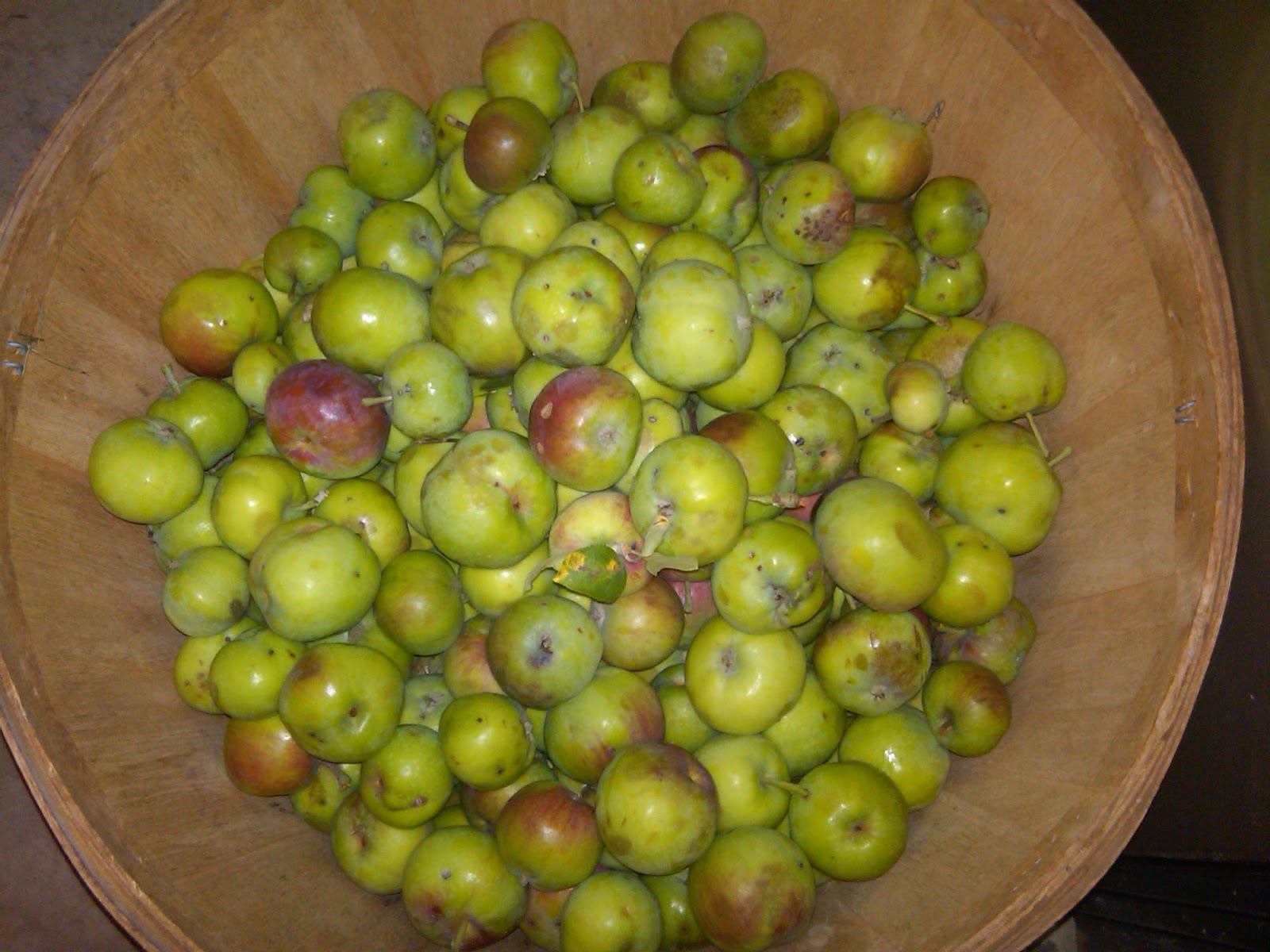
2017's bumper crop (Margo D. Beller)
Well, I have amassed many recipes. So far this year I have made 5 pints of apple sauce and one apple bundt cake. The apples I have not used are in another blue bucket in the basement, which I can carry more easily than the bushel basket.

The hardest part is the chopping. I used to peel apples but nicked myself too many times. So now I wash and cut. Long experience has taught me whether there will be a lot of usable apple or whether to just toss it after the first chop. I admit, after cutting up about 100 apples in two shifts (applesauce, then an apple cake, then more applesauce) with more I can use, I can afford to get picky.

These apples from my tree are smaller than the ones you get in the store, in part because I have to work fast before the squirrels get all of them. A farmer told me the apples look like a form of macintosh. In the picture above you see there is not a lot of red in them. I went for size - easier to cut a larger apple - over redness, and cutting into one bears this out. The redder ones are riper, and usually has evidence of rot or insects in them. The not-quite-ripe ones were firmer and I could use more of them, once I cut out the core and stem (as seen below).

My grandmother used to make apple sauce. I never learned her recipe but the sauce was delicious. She bought her yellow apples from the store. I can't say my sauce is any better but if I have any reason for making it - aside from having too many apples - she is it.

Making apple sauce, 2017 (Margo D. Beller)
But preparing the apples is not a task I enjoy, even though the finished product tastes fine to me and MH and to those lucky enough to receive a pint. So far most of the pints are in the freezer. Each year I have a good number of apples (last year was an exception - the apples were done the same day as the wren nest and I had so few I just cut them up and used them in pancakes), I collect a lot of them and then pick a day to do all the hard work. It requires a lot of time as well as standing and careful chopping, making sure I don't take off a finger or two.

The bundt cake was a first for me, and a really messy process because I don't do a lot of baking. I am more impressed by my baking friends than before, especially those with the right tools. I had to use my grandmother's very manual egg beater on the thick batter and was glad I had done some exercising recently because it gave my arms a workout. Did she use it to make her sauce? I don't know. As a small child at the time I had no interest in how the sauce was made, just that I wanted some. Nowadays people have more of an interest in what they eat and in making food themselves. This is a good thing.

As for the rest of those apples, I have bought an electric hand mixer, so I expect I'll be making another cake and yet more sauce.

Sunday, June 25, 2017

Down the Shore

Thou little bird, thou dweller by the sea, Why takest thou its melancholy voice, And with that boding cry Along the waves dost thou fly? Oh! rather, bird, with me Through this fair land rejoice!
-- Richard Henry Dana

As I write, in June, the backyard is very quiet these warm, humid mornings. The house wren box next door I can see from my chair is active, with both parents shuttling back and forth to feed their young. In my longish grass that MH won't shave to the nub as our neighbors' lawn services do, there are chipping sparrows and their begging young. At the box in my apple tree, the house wren sings softly and then enters the box with food. This nest is a week or so behind the other one, so the young are still small enough for the parent to enter. Soon, the chicks will be much bigger and noisier when the parent arrives to feed them.

Skimmer (left) and laughing gull (RE Berg-Andersson)
The singing birds I heard just a month ago are either nesting and keeping quiet to protect young, or they have moved on from my area to their breeding territories farther north. If you want to find any birds during the summer, you have to get out early when the birds are most active. It will also help you to avoid the heat.

It is at this time of year I look at the various bird lists and see more reports coming from what we in New Jersey call "down the shore." This can mean the beaches from Sandy Hook to Island Beach State Park to Long Beach Island down to Cape May, or it can mean the Delaware Bay side of New Jersey, or it can mean river inlets in between. Where there's water, there are likely a lot of birds in summer.

It is times like this I miss Plumb Beach, a short walk from where I grew up. At that time it was a dump but now it and the rest of the Brooklyn shoreline is prime birding habitat and lots cooler than where I live now.

Unlike Plumb Beach or the rest of the southern Brooklyn, southern Queens and eastern Staten Island shoreline (which make up most of the Gateway National Recreational Area), in New Jersey it costs money to go to the shore and look for birds along the beaches. You need to pay for parking and/or a beach pass. The shore gets pretty crowded in summer, as you'd expect. Even at Sandy Hook, which is also part of Gateway, you have to get there very early to tell the guard you are a birder so you do not get charged for beach parking. But I don't go to Sandy Hook in summer. I can't get down there that early and I don't want the crowd and the traffic.

Redwing blackbird, Bombay Hook (RE Berg-Andersson)
When I go birding in beach areas it is to places where you only go to go birding. In New Jersey, that place is the Brigantine National Wildlife Refuge, not far from Atlantic City, where you pay your fee and can drive along the dikes, stopping if you see a bird or other creature that interests you. (There are also trails in some areas if you prefer hiking and land birds.)

In the hottest days of summer you can find yourself in slow traffic, just like the highway you took to get down here, and you have to be careful not to ram another car as you scan the impoundments. Besides other cars stopping suddenly, you have to deal with other hazards such as green bottle flies that will hit your eyes and enter your mouth or your car if either is open too far or for too long, more common house flies, ticks and mosquitoes.

But there are the birds, sometimes thousands of shorebirds.

Great egret, Bombay Hook (RE Berg-Andersson)
I am not the best person to ask about shorebirds. I can identify the ones I know best including various herons, egrets, the sanderlings that run down to the water line as the ocean waves pull back only to rush away when the waves come in, more distinctive shorebirds including skimmers, ruddy turnstones and willets. But don't ask me if I am seeing a western sandpiper, a semipalmated sandpiper or a least sandpiper in that large flock flying quickly away. I will have to check my guidebook really, really hard, and even then I won't be completely sure.

There are other birds, however. In Delaware there is a similar place to Brigantine where you can drive on the dikes and slowly scan the impoundments for waterfowl, Bombay Hook National Wildlife Refuge. MH and I have been here in November when there have been thousands of snow geese but it is rare we come down in summer. As it happens, we were there in early June. The thousands of shorebirds reported Memorial Day weekend were gone except for three distinctive shorebirds called avocets.

However, we had many bald eagles, osprey, indigo buntings, herons, egrets and two birds I rarely if ever see. One is the clapper rail, the other the marsh wren.

The clapper lives its life in secret, within the thick vegetation of salt marshes. I have only heard one once, in one of the murky areas of one of my favorite New Jersey birding sites, the Great Swamp, where clappers and other chicken-like marsh birds such as the sora and the Virginia rail have been known to show up in summer, when the vegetation fills the watery areas. In Delaware, however, it was on the sand in front of the vegetation. I was so startled to see it I thought at first it was the sora, which does not hide itself much. Reason soon returned - soras are darker and smaller - and I realized what it was.

Clapper rail, Bombay Hook (RE Berg-Andersson)
The marsh wren, meanwhile, I would expect in an area with reeds and other vegetation. In fact, if you hear or see one marsh wren it is likely you are going to hear many more because they continually call to remind each other that this is THEIR territory. If you are lucky, one of these feisty little guys, whose song is thinner and faster than its cousin the house wren, will pop up, clutch a reed in each foot and sing for a long time. Listen carefully and you'll hear more wrens singing as you drive along the road.

Back to Brigantine: For the hardcore New Jersey birder, this is where you go, no matter how far away you live. But when I wake in the mornings nowadays, sitting on my porch before it gets too hot and humid and listening to what few birds are around is enough, even if in my mind I'm scanning the beach shore with my binoculars from the comfort of my folding chair in the sand, no one except MH around.

Soon enough it will cool again, nesting will be over and the birds will be on the move southward. 

Marsh wren, 2017, Bombay Hook (RE Berg-Andersson)


Friday, June 23, 2017

Chatting With the Apple Tree

Apple tree (Margo D. Beller)
We have passed the point on the calendar marked "First day of summer" although from a meteorological standpoint, summer began on June 1. There are two hummingbirds at the feeder. I know this because frequently they show up at the same time and one chases the other off. Because they look alike, I can't tell which is the Alpha and which is the Beta. However, one does tend to squeek when it flies off or is disturbed. I heard it from the tree this morning as I was picking apples.

Most apples grow in late summer into autumn. I have one tree that blooms in late April or early May and puts out fruit a few weeks later. Some years, such as last year, drought conditions prompted few flowers and thus fewer apples for me to pick. This year, with all the rain, there was an overabundance of flowers and now you can see the apples growing.

Last year I brought one to a farmer I know and he identified the apple as a sort of Mcintosh, although these are usually ready to be picked in the fall, too. But my apples are usually ready in late June into July. I know this when I see squirrels climbing up, grabbing one and running off with it.

Thus begins an annual routine. I go out with a bucket, pick up whatever the squirrel has dropped and then pick whatever apples look big enough to cook - ideally I'd like them redder but I am in a race against time here - before the deer can come and eat them. The other morning I had just done that when a big doe arrived and started browsing. I chased her off but she did not go willingly.

House wren in apple tree. (Margo D. Beller)
This is suburban life now. At one time deer were afraid of people. No longer.

I do this picking (or picking up) twice a day, in the early morning and at dusk. But judging by all the deer excrement under the tree, I can't get everything.

When we bought the house over 20 years ago, it had been standing at that point 30 years or so. The previous owner must've fancied himself a gardener because he put in five apple trees, a pear and a cherry. He also built up a small, terraced garden with railroad ties. However, he stopped taking care of it, then moved out ahead of a divorce and the ties rotted. Chipmunks nested beneath it. When we had work done on the house and surrounding property, the ties were removed.

However, the trees stayed. The cherry eventually rotted and I had three of the five apples taken down because the fruit was not usable to me but made a big mess in the yard thanks to the squirrels and deer. The fourth, a small tree and the same type as the one that remains, was killed by too much rubbing of antlers against it by young bucks.

Where one tree was removed is now a garden of ornamental grasses and other plants deer tend to leave alone. Where two others were are now planted a dogwood tree and my friend Spruce Bringsgreen. But I kept the last tree because the apples make good sauce or pies. It holds up the house wren box, where the adults are now shuttling back and forth to feed peeping young. It provides some shade. It is a place for birds to perch such as the hummingbird. During the flowering season, I discovered 14 cedar waxwings going after the bugs, or perhaps eating the petals.

But those apples do draw the squirrels and the deer.

Recently I sat outside on my patio, admiring this tree with its growing fruits. I had it trimmed a few years ago but now it is bushier than ever.

I am an old tree, she told me. I have to do much to protect myself and to protect my young. When I have too many, as this year, I must abort many of them while they are still small and hard. It can't be helped. I have to be able to bear more fruit next year and beyond. As you can see I have a gall on my trunk and an opening big enough for a chipmunk to sit in, but I keep going.

I had noticed all those little apples underfoot, I said. I guess a lot of trees do that. I notice the elm over there has dropped a lot of green seeds. I hope the squirrels and chipmunks will get to them later, when they have to be stored for winter.

I do not mind the birds in my upper branches, she continued. I do not mind the nest box you hang on my lower branch so you can watch the birds. I did not mind the yellow-bellied sapsucker that drilled little holes in a ring around my trunk for the sap last spring, the one you kept chasing off. It was trying to survive, too. I have withstood all that. 

I survived a hurricane, the one called Sandy. I have stood in deep snow and in fog and in heavy rain and in such heat that my leaves have turned brown and fallen before their time. I do what I must to survive.

I can understand that, I said. So do I.

What I do not like is you whacking me with a big stick every year, breaking off my branches and making the apples rain down before their time, she said.

I am sorry, I told her, but I am now past the age where I can climb trees or even stand on the upper part of a ladder to gently pick the ripe fruit. The squirrels are not so choosy, especially in those years where we have had high heat for days on end. The squirrels want a sweet drink and will ignore my water dishes for your apples.

I will remove the core and rot before using (Margo D. Beller)
And when they drop partially eaten apples, the chipmunks grab them, which is fine, but then the deer come, which is not. One deer is bad enough but the time I came out to find five of them was a horror. I once used an umbrella to hook your branches and pull them closer. Now, I admit, ever since I got the extension pole for another project, it has come in handy to bring down as many apples as possible at once.

But it is not as if your fruit goes to waste. I put the partially eaten ones into the corner of the yard, where I prefer the deer to poop than in the lawn under you. I throw out the really small or bad ones. I put the rest in the cellar and then, when I have the time, energy and inclination, I make pints and quarts of sauce I can freeze and use for months. I would love to compost the parts I don't use but I don't want a forest of apple trees to grow there.

You took down my child, she said.

Your child was small and destroyed by deer, I said. I would've loved to have had two of you for the apples and the shade, but what else could I do? I am trying to balance having something natural and pretty in my backyard with the new realities of suburban life, where wildlife I never would've imagined are showing up in the yard.

You know a bear was once in the neighboring tree, the one you took down, she said.

Yes, I do. That was the first time a bear visited, to my knowledge, many years before the visit that destroyed my bird feeder pole. I came out and found a large indentation in the ground, a lot of scat and broken branches. It is one of the reasons I later had that tree removed and put in my ornamental grass garden. You saw what a bear did to the pear tree over there.
Damaged pear tree (Margo D. Beller)

Yes, she said, I did, and I appreciated all the work you did to save it. It looks very healthy now. I hope a bear does not decide to climb me for my fruit. A 200-pound bear does a lot of damage to apple tree branches. But if it does, there is nothing much I can do about it. I am a tree. If I am struck down, I can only hope one of my seeds grows to keep my line going.

Do not worry, old tree, I said. As long as I can still get up in the morning and bend down to pick up dropped fruit and pull off apples before anything else can get to them, no bear will destroy you.

But we both know that in this life there are no guarantees, to anything.

No, she replied. There aren't.

Sunday, June 18, 2017

Living With Wildlife

I feel a responsibility to my backyard. I want it to be taken care of and protected.
--photographer Annie Liebowitz

When I was growing up in southern Brooklyn, I was aware of some birds - pigeons, sparrows, the occasional robin, cardinal or jay plus "seagulls" (I now know they were herring gulls) - and even less aware of other types of wildlife aside from squirrels and feral cats.

When I moved to the suburbs I learned otherwise. The longer I have been here the more troubled I become by how many different types of wildlife have been through my backyard. The more housing developments are built, the better the chance an animal you do not expect is going to be in the backyard.

Squirrel on caged feeder (Margo D. Beller)
Aside from squirrels, which I quickly learned will take over a feeder and keep the birds from the seed unless I put some sort of protective device either on or under the feeder, I can now say that my yard has had visits from chipmunks, rabbits, groundhogs, possum, an injured red-tailed hawk, racoon, other neighbors' dogs and cats, a garter snake, bear and even a coyote. One winter we had the tracks of a least weasel in the snow, but that was the only time.
(RE Berg-Andersson)

I have come outside in the early morning to chase off mallard ducks, Canada geese and turkeys, and I'm not even in the most rural or exurban of suburbs.

When we bought the house there were five apple trees, one pear, one cherry and a blueberry bush. Atop the bush was rusted metal fencing that I removed. Let the birds get the fruit, I thought. (I was still thinking like a city person at this point. Now, I'd have protected the bush and harvested the beneficial fruit.) When we were forced to have foundation work done, that and other plants were dug up. I now greatly regret not trying to save at least some of these plants.

When new plants were put in I included asters because these late-summer, early-autumn perennials were flowering at the time. I came out to go to work one morning and found a rabbit was eating heartily. This happened over the course of a week. Then I put in a small fence at the border of this plot.

That stopped the rabbits. But when I discovered the bushes in the back were being eaten from the top, I discovered deer. I've been living with the damage, and the deer fencing I put in in 1995 and have adapted over the years, ever since. (It is effective except against chipmunks, which can get behind or under it and do a lot of damage digging.)

Old Mine Rd. bear (RE Berg-Andersson)
The bear is a relatively recent phenomenon, as I've written before. Bears have damaged both of my feeder poles - one completely - and I've had to bring the feeders in at night in the spring, when the bears are coming out of their dens hungry. (I don't put feeders out between Memorial Day and Labor Day.) I have only one apple tree remaining but it is loaded with slowly ripening fruit. Despite bear damage last year, the pear tree also has a couple of fruits growing. All of this will draw squirrels above, deer below and possibly another bear visit.

Bear visits can be deadly to pets, livestock, property. People who feed wildlife, be it an alligator or a bear, are mighty surprised when this wild animal comes back for more - and does not distinguish between your handout and your child, as one family learned tragically last year. Search "man arrested for feeding bear" and you'll find all sorts of articles. There is a reason this is a crime. These are wild animals, not pets. When I put out bird seed in winter it is to help birds that might not find a food source. I don't consider them pets. Bears are in their dens and the deer are hitting my neighbors' plantings.
Sure, it looks cute now... (Margo D. Beller)

Many people enjoy wildlife. They want to see the baby rabbits, the squirrels, the large waterfowl that come up on shore and into their yards. I am not among them because of the damage they can do, even the newborn fawn its mother left in the long grass under the apple tree. (MH had to mow around it.) I came out one day to find it had been placed behind my deer netting around my back plot. When it saw me it took out half the fencing trying to get away. I now block access with a wheelbarrow.

One winter I looked out front to see over 100 Canada geese on my snow-covered lawn, the street and the yards across the street. In the snow, all the area looked the same to the geese so they had traveled beyond their usual field behind my neighbors' houses. I got them to move off my lawn and when one of the neighbors came out across the street, the flock took off, their green droppings raining down. Since then the field has been cleared for our community garden and my neighbors put up fences and shrubs to keep the geese away.
...but it becomes this. (Margo D. Beller)

The pro-bear people blame homeowners in bear-prone areas for living there. My house was built in 1964 in a former meadow.

Is that my fault? I was a child in 1964, and as an adult I came out here to have my part of the American Dream - a house, some space, something I can call mine.

Garden plot with fencing. (Margo D. Beller)

I now know after 20 years or so that I have to share.


I feel a responsibility to my backyard. I want it to be taken care of and protected. Annie Leibovitz
Read more at: https://www.brainyquote.com/quotes/quotes/a/annieleibo344659.html