Cape May

Cape May
(RE BERG-ANDERSSON)
Showing posts with label downy woodpecker. Show all posts

Sunday, November 9, 2025

Still Life, With Woodpeckers

It is autumn once again. The ornamental grasses and other shrubbery are turning gold and brown and the trees in my yard have lost their leaves except for the red and white oaks. Other trees in the area have leaves but they are fluttering with each breeze to the ground like rain. Even though age has forced my husband and me to hire a lawn service to get the bulk of the leaves and locust tree pods to the curb, today I went out with my rake because I miss the calm I get from simple yard work outside.

Male redbelly at his preferred feeder. (Margo D. Beller)

But though my rake is far more quiet than a leaf blower, the calm was soon broken by the incessant and increasingly high-pitched barking of a neighbor's dog. After I finished, that noise was replaced by several homeowners using the inevitable leaf blower. Here in the suburbs, leaf blower season will last until it finally snows and people will stop caring about having a perfect green lawn.

It is dark at 5 p.m. Eastern Standard Time now, and southbound bird migration is just about done in my area. If the Merlin app on my phone is any guide, there are still a lot of different birds that will be stay through the winter in the general vicinity of my backyard early in the morning. (I usually hear about half of them.) But the catbird, warblers and other summer birds are now far south of here.

Once in a long while I do find something interesting in the yard - a Carolina wren, a gold-crowned kinglet, more recently a yellow-bellied sapsucker softly tapping on a branch of my old apple tree in the dim light of dawn. I like sapsuckers, and rarely see them, but this tree has had enough stress in its life and its trunk is already covered in tiny sapsucker holes of past years. So I walked toward the tree and the bird flew off.

Nearby tree. The leaves will soon be gone.
(Margo D. Beller)

Now, on my enclosed porch and running a fan to cut the leaf blower noise, I watch my feeders. It is not the coldest of days so there has been little activity. Suddenly, a red-bellied woodpecker - the red going up the back of its neck to its head showing this is a male bird - comes to the house feeder for a sunflower seed. It takes it, flies to a nearby tree and then pounds the seed against a limb to break open the shell and get to the meat.

The redbelly, a medium-sized bird, has drawn the attention of the much smaller downy woodpecker. There is no red spot on the back of the neck, so this is a female. She is on the dogwood tree, closer to the other feeder pole. When the redbelly flies off, she flies to the pole and slides down until she can jump up to the suet that hangs upside down in its feeder.

She picks at the suet, then quickly flies back to the dogwood as the redbelly returns to the house feeder for another seed. This is the law of nature. If you are a little bird and a larger bird, especially one of your type, flies at you, you quickly get out of the way. So each time the redbelly came to the house feeder - first one side, then the other - the downy would leave the suet for the safety of the dogwood.

Downy woodpecker at suet, back when I hung it near the house feeder.
(Margo D. Beller)

I don't know why this redbelly is not inclined to hang below the suet feeder as downys and the larger hairy woodpeckers do. This bird kept at the house feeder before deciding to try the caged seed feeder that hangs near the suet. The cage feeder is for the little birds but bigger birds like the redbelly will cling to the cage, put its head in and try to grab a seed from the central tube. It is not a comfortable position for the bird and eventually it goes to the house feeder.

The downy, meanwhile, climbed to the top of the dogwood. I thought she would fly off but instead she flew to the pear tree. I turned in my chair and saw her tapping at the trunk. She waited to see if the big bird would come back, then flew to the house feeder for her own seed. She took it back to where she had been on the pear tree to hammer off the shell and get at the seed. The redbelly, perhaps sated, flew off from another tree. The downy ate and later left.

I have seen downys come to the house feeder when titmice and chickadees make their runs back and forth to grab a seed. But should a large jay, redbelly or cardinal fly in, the smaller birds fly to the bushes and wait for the big birds to leave. 

This tableau has and will be repeated countless times, especially when the weather becomes colder. At this time of year I am not nearly as active as I would like. I feel aches and pains more often. I dread the coming of cold, snow and the dry heat from the furnace that affects my sinuses. 

When life becomes still, watching the feeders will be the best thing I do.

Sunday, May 19, 2024

Something Is Happening

One early morning, a female downy woodpecker, the smallest type found in the U.S., climbed up the dogwood tree as she has done for months. She looked over at the suet feeder hanging on the nearby pole. She calculated the distance as she prepared to fly over and expertly turn upside down to get at the suet. (The feeder is designed specifically for woodpeckers. See photo below.)

But on a recent May morning as she climbed the tree she found a small, wooden structure. As she came close to it, a small, brown bird flew out from the nearby bush and attacked her. She spread her wings to make herself look larger but the smaller bird was not put off. She left and he - for this was this year's house wren protecting the nest - returned, singing, to the bush.

From 2020: A female house wren checks to see
if the coast is clear before leaving her
young to get food. (Margo D. Beller)

Shortly, the downy flew back, but to the bottom of the dogwood. She climbed a bit and recalculated her approach to the feeder. The house wren, meanwhile, flew to an upper branch near the nest box and sang. The downy came to eat at the suet feeder but soon flew off.

Watching the wrens from my screened porch is my usual morning entertainment. When I last wrote, the two wrens had put in enough twigs for the nest and were flying in the yard looking for food. Every so often the female would go into the box and the male would sing nearby. 

Then I went away for a few days. When I returned, things had changed.

In the first couple of days after I returned the female would be in the box most of the time, only coming out to eat. The male would usually fly close to the box and sing. Maybe he was telling her the coast was clear? I don't know, but she would go out for a time and then go back in. The male would sing from the nearby bush. He did not go into the nest box.

Downy woodpecker demonstrating how it hangs
beneath the suet feeder. (Margo D. Beller)

Then I saw something interesting one recent morning - the female flew out of the box holding a big blob of poop. That could only mean one thing: The eggs had hatched and now there were young to brood, feed and clean up after. So I wasn't surprised to see the female now making more frequent trips out of the box. The male did not participate in the feeding but I know from past years the two adults should soon be shuttling back and forth to feed the young, which will have grown to fill the box.

For now, however, both parents are defending their young. If another type of bird is in the dogwood and comes too close to the nest, as the downy did, the wren behavior becomes more aggressive.

I am not an ornithologist. I only know what I observe. And it seems to me the wrens' behavior is different depending on the size of the other type of bird and whether that bird has a long, pointy beak. 

So a downy or other type of woodpecker would be chased off because it could, if it wanted, put its beak in and grab a young wren with its long tongue. However, a cardinal, with its stout, seed-cracking beak, didn't seem to be a threat. (The pair I saw one morning that flew to a branch were more interested in that bonding activity known as "the kiss.") A smaller finch, such as a goldfinch or house finch, gets chased off even though they are seed eaters. 

However, a blue jay or its cousin the crow would definitely not be welcomed. (Years ago I saw a jay snatch a young wren that had fallen to the ground.) Neither would squirrels.

A blue jay is a predator of baby birds such as house wrens.
(Margo D. Beller)

Another unwelcome bird is the all-too-common house sparrow. These birds don't want to eat baby wrens but they have been known to pull out the young and take the nest for themselves. When house sparrows flew to the dogwood one morning the male wren flew at them while the female came out of the box and blocked the opening. When the sparrows refused to leave I came outside and they took off. I'm not sure if the wrens appreciated my help but the female went back into the box while the male sang from the nearby bush.

I reckon that sometime in the next week the food shuttling will begin. In the meantime, I've removed the feeders that hung closest to the dogwood. It is getting to that point where the birds will want protein from insects more than they'll need fat from sunflower seeds. Plus they'll have to take insects back to their own young. I still have one feeder out for the birds but that will soon be inside for the summer, too.

Monday, March 5, 2018

Watching the Woodpeckers


Downys will eat suet, seed or even sip from a hummingbird
feeder (both pictures Margo D. Beller)
Early the other morning I sat on the porch with my coffee, trying to wake up and hoping birds would be coming to my feeders, which I had just refilled. There was nothing for the longest time and then a male downy woodpecker suddenly appeared on the dogwood tree branch beyond the feeder pole where I keep the suet feeder and a long feeder full of sunflower seeds. Either food would appeal to it, but the bird just sat there.

Maybe was waiting for the breeze to die down so it could fly safely over without being blown off course. Maybe it saw a predator flying overhead. Maybe it saw the slight movement from me on my enclosed porch when I raised my coffee cup for a sip. Downys, the smallest of American woodpeckers, can be rather skittish.

Male red-bellied woodpecker (Margo D. Beller)
I enjoy sitting on my porch in the morning when the sun is here, especially in the aftermath of the recent powerful nor'easter that produced gale-force winds that prompted me to take all the feeders inside to protect them. I figured no intelligent bird would risk being blown into the side of the house, no matter how hungry it was.

It is too easy to ascribe human emotions to birds. So as I watched Mr. Downy - I could see the red spot on the back of its head, which the female does not have - I tried to understand the way his bird brain operates.

After sitting in the tree a long time, he flew to the suet feeder, took a few tentative pecks, then flew back to the tree. This suet feeder is made in a particular way to keep pests such as grackles and starlings off the block of fat - the bird must hang under the feeder. Woodpeckers do not mind that. This suet feeder has drawn downys, the larger but similar looking hairy woodpeckers and the larger-still red-bellied woodpeckers of both sexes to it.

I've seen eight types of woodpeckers, all but one of them in New Jersey. There are many more found in the American west, the desert southwest and in the higher elevations of New England. In my area, besides the three I have mentioned, the more common ones are the flicker, the pileated and the yellow-bellied sapsucker. In fact, one day in 2011 I saw all six.
Pileated woodpecker (Margo D. Beller)

There is also the redheaded woodpecker, of the same family as the red-bellied woodpecker and, like that bird, originally from the south but slowly finding suitable breeding grounds in New Jersey despite our tendency to cut down dead trees, which is where the redheaded builds its nests and feeds on bugs. It is too easy to call a red-bellied woodpecker a redheaded woodpecker because when you look at it you see the red on its head but not the bit of pink on its belly. However, when you see a redheaded woodpecker you can see why it got the name.

The pileated (pronounced PIE-leated, although I tend to say PILL-eated) woodpecker is a crowsized bird athat got its name thanks to its striking red crest (which is what pileated means, having a crest). It has black feathers and white down the face and neck. When one flies over me in the woods I never fail to be stunned by its size and beauty. When you see one whacking at a tree you can be sure that tree is filled with carpenter ants, its preferred food, and that means the tree will likely be dead within two years. (I base this on seeing a female pileated whacking at a yard tree for several mornings running on my way to the train; the tree fell over and had to be removed within two years.)

The other woodpecker I have seen was in North Carolina, a bird that makes its nest in living, mature, long-leaf pine trees, which is why its existence is more precarious than even the redheaded woodpecker. In fact, we went to the Croatan National Forest specifically to find this bird, where it is protected.

Red-cocaded woodpecker (Margo D. Beller)
Between MH and me, I think we've photographed all the woodpeckers mentioned except for the brownish flicker, which forages for ants with its long bill and longer tongue on the ground and is easily spooked, and the yellow-bellied sapsucker, which gets its name because it drills holes in trees and drinks the sap or eats insects attracted by the sap. My apple tree is girdled with little holes from a sapsucker. One year I spent several days shooing a sapsucker from the tree before all the holes could kill it.

Meanwhile, back at the dogwood, the downy continued to sit. I finished my coffee and went back inside the house. After hanging my winter coat I went to the kitchen window. As expected, there he was, on the suet feeder, eating heartily until he flew off to a different, taller tree, out of my sight. But he'll be back.

Sunday, July 16, 2017

Midsummer Musings

Summer is the annual permission slip to be lazy.

-- Regina Brett

As the sun rises this midsummer morning, its light is filtered through the backyard trees, throwing patterns on the porch, where I sit on the shady end. At various times the light hits the medallion atop my bird feeder, creating a stained glass effect that is very pretty.

Stained glass effect (Margo D. Beller)
Behind me, through the opened window, I hear robins, catbirds, redbellied woodpecker, titmice and... is that a house wren? I go to the screen. Yes, that is a house wren. Perhaps it will discover the nest box now that the apple tree is done for the year and the attacks by squirrels have ended. As I look, a small chipping sparrow flies to the paving stones to search for insects. It still has its breeding red cap, but when it flies south in a month or so, that cap will have gone brown.

Every so often a hummingbird has come to the feeder but at this moment I see a downy woodpecker has discovered it too, just like last year. I go outside and chase it off, and am rewarded when a hummingbird suddenly returns, causing me to freeze so I don't spook it off. As I stand on the path by the apple tree, a family of house sparrows, several jays, a robin and at least one calling chickadee fly into one of the few trees on my property I can't identify, which is full of hanging seeds. The birds sound agitated. Is there a hawk in the vicinity or am I the cause?

I don't know. There is still a lot about birds I don't know, including why they all suddently appeared and then, just as suddenly, why half of them flew off.

Downy on feeder, Sept. 2016
(Margo D. Beller)
This is about as active as I get early on a summer morning, rising because I don't sleep well nowadays and I want to sit outside while it's cooler and do my birding by ear.

In NJ, where I live, you have to get up early - even on a Sunday - if you want to beat the traffic "down the shore" to the beaches or have a sporting competition (I can hear the crowd noise from the recreation area a mile or so away from my house) or even take a walk. When I look at the state birding list I see a lot of entries from Brigantine, one of New Jersey's premier ocean coast birding sites. But to get to Brig before the summer traffic it would require MH and me to rise much earlier than we'd like.

Years ago, when I was working in the city on a rigid schedule, on weekend mornings I felt compelled to rise before dawn, dress and rush out to a familiar birding spot so I could listen, walk and shake off the week's nonsense. Then I started working at home, still on a rigid schedule, where I could fit in walks and wandering during a long midday break. I wasn't restricted to weekends anymore.

Now, I am still at home but my schedule is far from rigid, and with all the time in the world the best I can do most mornings is creak my way downstairs to my porch chair and listen to the yard birds.

There are many reasons for preferring this. For one, it is summer and, unlike the spring migration season when I want to find the gaily colored warblers as they head north, it is harder to find birds unless you get out ahead of the heat, humidity and the mosquitoes to walk and listen. The birds, when seen, may already be starting to molt into their duller fall coloring. And, to be blunt, I am 99% sure I am not going to find any bird I haven't seen before many, many times over the years.

Once I have made my annual late May/early June trip to the northwestern part of the state, where you drive along a road and can hear hundreds of breeding birds singing their different songs at the same time - a challenge to identify, I can assure you - I can't be bothered.

Also, I am older and perhaps more than a little lazy. I'm not happy about the lack of energy but there were several times during my life when it could've been cut short and I'd have never met MH or bought this house or met many of my friends. So I can live with this alternative.

As I sit and time passes, I see more cars are now rushing about. I am in no rush, even with places to go and things to do. I know where this road leads. You do, too.

Sunday, September 4, 2016

Acting My Age

There is the bucket list, and there is the anti-bucket list.

The bucket list is what you want, need or have to do before you die. Usually it refers to places to go and things to see.

There are places I would like to visit, sooner rather than later, such as the interior mountain west, the Point Reyes Seashore, the forests of Oregon. There are places I have visited and want to see again - Seattle, New Orleans, San Francisco.

And there are places I have visited I have no desire to see again. That is the anti-bucket list, for lack of anything else to call it.

At the top of the anti-bucket list is the North Lookout at Hawk Mountain. Hawk Mountain is one of the finest places to go in the Autumn if you want to see migrating raptors. It was once where sportsmen and farmers would climb and shoot eagles, osprey, redtails, kestrels and other raptors out of the sky, just for the hell of it.
On the North Lookout at Hawk Mountain (RE Berg-Andersson)

That ended thanks to the courageous actions of a number of people and one rich woman who bought the mountain to create the Hawk Mountain Sanctuary.

There are number of areas where you can walk or climb and sit on the rocks to watch the hawks fly in, presuming the wind is out of the north and the air is warm enough to promote thermals, the air currents on which the birds coast, saving their energy for less-windy areas.

The top place, literally, is the North Lookout. To get there you climb over rocks large and small, up an incline. Over the years, there have been a lot of people walking up and down to the lookout and between the first time MH and I visited and the last time, it seems to me there was some significant erosion or rock shifting. Or maybe it was being older. Or all those people of different ages jostling us. Whatever, it was extremely difficult climbing up and more treacherous climbing down.

When we got back to the bottom I turned to MH and said, "This is the last time we go to the North Lookout."

There are other lookouts not so far up or treacherous to visit, and the South Lookout is accessible to those in wheelchairs or can't walk.
Higbee Beach, Cape May, NJ (Margo D. Beller)
Here is another example: I love Cape May. If you are a birder, this is mecca. Always something to see, but especially during the spring and fall migrations.

In Autumn, many southbound migrants travel at night (to avoid diurnal raptors) and as the sun rises find themselves over Delaware Bay. At that point they turn around and fly north.

One of Cape May's best areas is Higbee Beach Wildlife Management Area. There are trails through fields, there is a path down to the beach and there is a dune - a very high dune.

There are some birders - all men - who go up there every year to count and note the birds passing through. One September, we visited Cape May and got up at dawn to visit Higbee. I attempted to climb to the viewing area. I got about halfway up and realized the trail was going straight up! I could not go up and going down was going to be extremely hazardous. I used the phragmites as a kind of bannister and resolved not to do that again. (There are more than enough other fine birding experiences in Cape May.)

Finally, in Dutchess County, N.Y., there is a preserve owned by the Nature Conservancy. It encompasses Thompson Pond and Stissing Mountain. I read about it from my old edition of the "New York Walk Book."

There are three trails and the first time we went there we took the longest of the three, the Yellow, which is nearly three miles long around the pond. It did not get as close to the pond as I would've liked and on the eastern side of pond it was wet, muddy, overgrown, uncomfortably close to the neighboring farm property where someone was using his ATV and his cattle crowded close to the fence to watch us as we made our sodden way along, slowly.

That was last year. This year, looking for something to do, I suggested we go back to Stissing Mountain and the pond, but use the other trails. The Blue trail is 0.2 miles and came much closer to the pond than the Yellow trail. We saw and heard a number of fine birds - three great blue herons, a singing yellow-throated vireo, a foraging black-throated green warbler, among them. The Blue trail brought us to the Yellow trail. We walked it until we met up with the third trail, the White, 0.8 miles. It took us into the woods, uphill, over rocks, around downed trees. Few birds.

By this time, several years on from our Hawk Mountain finale, MH's knees have gotten worse and my back isn't great. By the time we came down the Stissing Mountain ridge line we were extremely tired. It was obvious no one had bothered checking on this trail to clear the downed trees. MH and I agreed that unless we were in the area anyway there was no longer any reason to come to this spot.

The Baby Boomer generation does things. We rush out and run around and take pills to ignore the pain and pretend we are never going to age or get infirm or die. We do things our parents would not do, for whatever reason, and we refuse to think anything can stop us.

Until it does. Steep climbs, deep mud and water, downed trees to get around, lose rocks that can turn an ankle. And don't get me started about coming face to face with a bear or mountain lion or someone with bad intent. I've been lucky to avoid all three and I don't want to test my luck.

Sorry, my g-g-generation. I don't want to die before I get old.

Male downy woodpecker, Sept. 4, 2016 (Margo D. Beller)
An Update

What you see here is a male downy woodpecker. As I mentioned last time, the hummingbird feeder not only has drawn rubythroated hummers but downys, which are small enough to sit on the feeder and has a small enough bill and long enough tongue to enjoy the sugar water within.

The reason I am noting this is because after my last post I came out to find one male and one female downy sitting on the feeder.

Today I came out to find one downy on the feeder itself, one at the top of the feeder pole and one hovering around, trying to decide whether it wanted to fight the first male for access.

Three sugar-addicted downy woodpeckers?

Soon enough, the hummers will be gone and so will this feeder. Next year I may have to do something else to feed the hummers.

The downys, and the others, will have to make do with the seed and suet feeders.

Sunday, August 28, 2016

The Green, the Woods and the Woodpeckers

A New Leaf

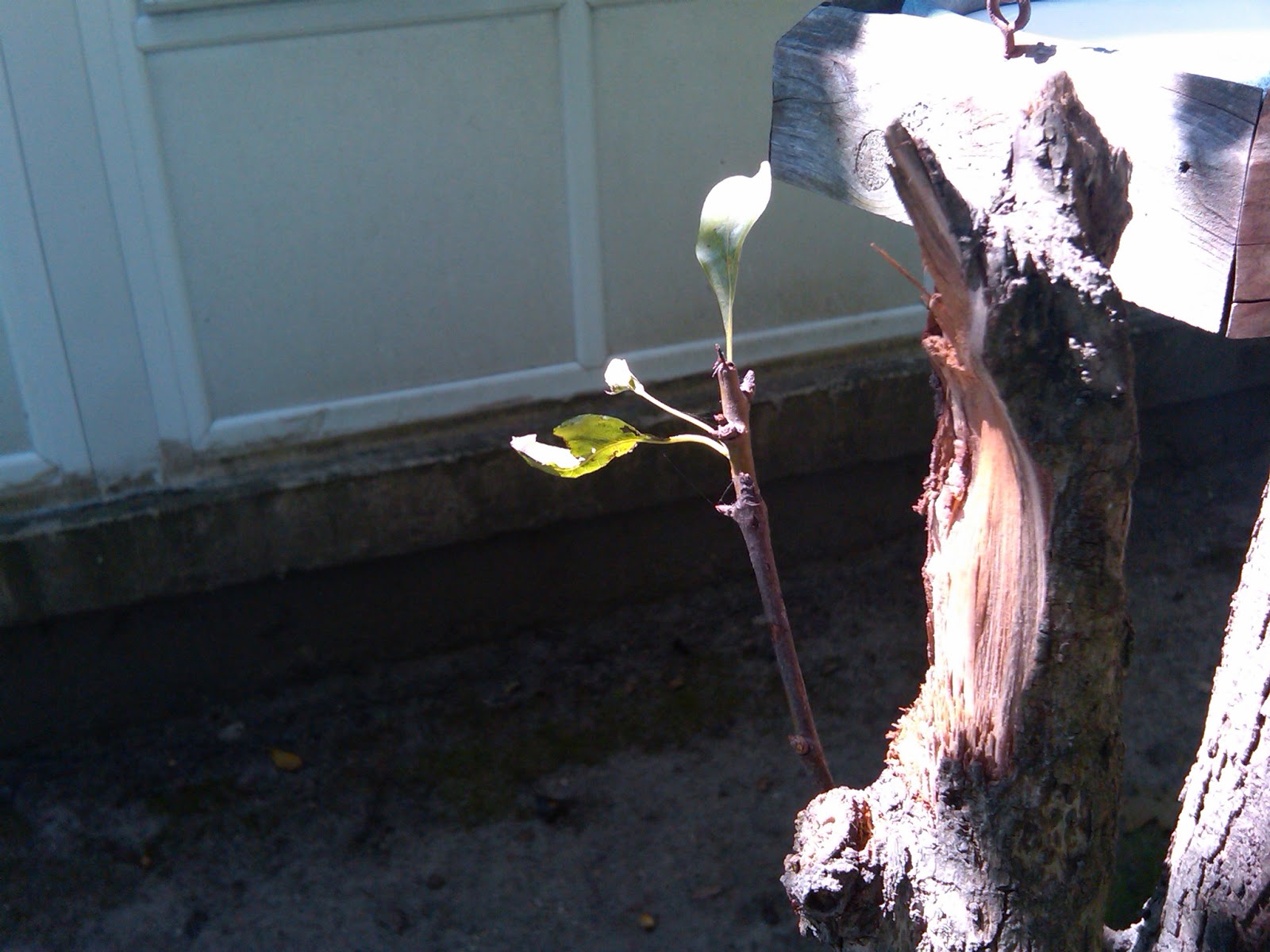
A few weeks ago I wrote about my shock at opening the kitchen shade and looking out the window to see two big hunks of pear tree broken. I said at the time it was likely another bear visit, this time going after the one pear in the tree rather than a seed feeder. I still think it was a bear.

I worried about the pear tree, especially after I did some "pruning" that took off far more than I anticipated. I began to think about what kind of tree I'd get to replace the pear.

Today I went outside to refresh the water cooler and dish. I discovered that once again, Nature provides.

Below shows the growth coming from the snapped ends (once I sawed the broken part off).


New growth from broken pear branches (Margo D. Beller)


A Walk in the Woods

MH and I like to find new places to hike. If we find birds, so much the better. If there's no admission, better still.

So the other day we looked at a map of New York and found the Neversink River Unique Area. It's the word "unique" that interested me. All places are unique to me. However, the "uniqueness" comes from the deep gorge leading from the trail down to the river.

We did not hike that far in. We started uphill along the path from the parking lot among hemlock and pine in an easy grade (maybe not for MH's old knees) until we got to a level part of the path with a clearing. Oaks and maples with the pines. I heard the tittering of black-capped chickadees and titmice but when I saw movement and looked up, I saw something quite different - a male hooded warbler. Moments later, a Philadelphia vireo. A pileated woodpecker called loudly. Black and White warblers chased each other. All told we found five warblers (mourning warbler and ovenbird rounds out the list) in one small area.

This is why I go birding, the element of surprise, of one moment hearing nothing and then suddenly be surrounded by birds. This has happened to me a few times when seeing one bird led to seeing all sorts of "good" birds in a small area. It helps when it's migration, either spring or fall. I suspect the warblers and vireo were using the local knowledge of the local birds to find food.

The only problem was the shooting. Two guys were near the trailhead as we returned, one showing the other how to use a gun. Neither were young. One had the gun, the other a spotting scope, perhaps to make sure the other guy didn't kill anything. The guy with the gun was shooting low into the trees. The sound was loud and scary to me. I made sure they knew we were there as we hiked back to the car and they acknowledged. Eventually they left after other hikers showed up and as we were getting ready to drive off. Maybe we spooked them the way they spooked off the birds.

Hunting and trapping are part of the history of the Unique area, too. 

Woodpeckers With a Sweet Tooth

The law of unintended consequences bit me today.

We have had a lot of rain this summer but in the last week it has not rained much and gotten very hot again. I went outside to check the hummingbird feeder and found it filled with ants that drowned trying to get a drink. I dumped it and took out the cup that, filled with water, acts like a moat to keep them out.
Hummer feeder after downy flew off and before hummingbird arrived. (Margo D. Beller)
I came out today and found a male downy woodpecker on the feeder. I chased him off a couple of times. And then a female downy came to the feeder. I've had to chase her off a few times.

I realized that woodpeckers and hummingbirds have something in common - a long tongue.

So the downys - the smallest of our local woodpeckers - either sat on or perched on the feeder, dipped in their beaks, stuck out their tongues and drank, just like the hummers. It explains why the sugar water levels seemed to suddenly drop very low. I attributed it to the heat.
This would be a better picture if not for the screen but the dark object at the top center is a hummingbird. (Margo D. Beller)

Now I know the downys have a sweet tooth.

We are soon into bird-feeder time and the hummers should be heading south. This feeder will come inside for another year but the seed and suet will sustain the downys and other woodpeckers. I'll worry about a new breed of sugar-sucking woodpeckers next year.

Sunday, December 28, 2014

Winter Birds, Part 2 - Personalities

Recently I wrote about the birds at my feeders during this 2014 winter season. Today I want to focus on their personalities.

It is never a good thing to put human characteristics to wild birds, just as it is never a good thing to consider the birds at your feeders to be "your" birds. I don't consider the visiting cardinals mine, for instance, although I've learned to tell the various males apart thanks to their frequent visits.
Cardinal pair (Margo D. Beller)

I gain great understanding of bird behavior watching the birds at my feeders, but I know if I had no feeders up they would not be in my yard - or at least where I can see them. That is why I put out feeders containing sunflower seed or suet, to feed them and draw them down where I can see them, particularly on days when I might not want to go out in the field.

It is impossible to include all the birds I've ever seen in the backyard. Many do not come to the feeders, but are drawn to the area by seeing all the other birds that do come. For instance, I've seen many robins in my backyard but they are on the ground, searching for worms and insects. Or they are in the bushes and trees, picking off the ripe fruits. But they do not come to seed feeders and I use plain suet rather than suet mixed with fruit, just to keep the squirrels away.

I am not an ornithologist. Nor am I a psychologist. That said, here is what I have observed at the three feeders usually up during the winter.

Titmice, chickadees and white-breasted nuthatches: These birds like to grab and go. Once in a while a titmouse, for instance, will stay on the feeder and use the perch for cracking open a seed. Usually, they grab a seed and fly off to the nearest tree or shrub to have its meal protected from predators such as sharp-shinned hawks.
Nuthatch (above) and titmouse (Margo D. Beller)
These birds don't mob the feeders or chase each other off, most of the time. There is a pecking order and the birds tend to take turns. For instance, one white-breasted nuthatch grabs a seed, takes off and then a second one shows up. These are the birds I prefer at the feeder, plus the cardinals.

House finches and house sparrows: I consider these and mourning doves to be real pests. The house finches and house sparrows will mob both feeders, chasing each other and other birds away. They sit in the feeders and just eat and eat, dropping bits of seed to the squirrels waiting below. If I didn't go outside every so often and chase them off, the other small birds would get nothing.

It is usually a smaller female mourning dove that will fly to the top of the house-shaped feeder and then, with great trepidation, figure out how to fly down to the perch, which it fills because of its bulk. It will then sit and pick through looking for broken seeds since its thin bill is not made for crunching seeds like the finches. Most of the seed she drops to other mourning doves and squirrels below. These, too, I chase off.
House finch and feeder, cardinal and junco wait. (Margo D. Beller)

Blue jays: When these big birds show up, everything else scatters. They dive-bomb the house feeder (they are too big to get through the cage of the second feeder and can't hang upside down to get to the suet), gulp a bunch of seeds and then fly off to either regurgitate them for caching or swallow them whole. Their movements are explosive but at least they don't hang around for too long.

Female purple finch (Margo D. Beller)
Cardinals: A large, sometimes skittish member of the finch family (see my post of Nov. 20, 2011). I find them starting at dawn and have seen them eating at dusk. (Only the robin tends to come out earlier and stay out later, based on the calls I've heard.) They hold their own against the smaller birds but larger birds will scare them off. If the feeder is mobbed by smaller finches the cardinal won't come to it, which is when I chase the pests off. Males will chase off females, even their own mates, during the winter when they come to eat, but in spring males will allow mates to feed with them, usually feeding her directly so that it looks like they are kissing.

Visitors: The smaller goldfinches (see my post of July 1, 2011) will come to the feeders at certain times of the year and are usually left alone by the more aggressive house finches but in winter a lone goldfinch must get to the seed early to beat the later-rising pests. The same is true for the rare purple finches. This year I had 3 females visit at one time. They were left alone. But when there was only 1 it was quickly chased off.
Male rose-breasted grosbeak (Margo D. Beller)

Bigger visitors tend to be left alone, such as the rose-breasted grosbeaks that usually show up in May during the spring migration northward. Like their smaller cousins the house finches, these, too, will sit and eat for long periods of time but they are so pretty and such rare visitors they are welcome to all the seed they can handle.

Carolina wren is another winter visitor, although these wrens are around all year long. Carolina wrens are small but they have a big song and are very aggressive. They are such rare visitors they are usually left alone but they will aggressively defend their right to eat against the pests. These wrens are also looking for broken pieces and don't seem to mind hanging upside down to eat suet. I am always pleased when a Carolina wren visits and then sings in my yard.
Carolina wren (Margo D. Beller)

Woodpeckers: The smallest type, the downy, is skittish when bigger birds, including other woodpeckers, fly in. Otherwise, they will hang upside down and eat suet no matter what kind of tumult is going on at the house feeder above it. The same is true of the largest of the 3 woodpecker types to visit, the red-bellied woodpecker. This one will whack at the suet or come to the house feeder. I've also seen it grab the cage, put its head through and use its long tongue to grab a seed.

Rarely, a hairy woodpecker visits. This one looks like a downy woodpecker on steroids but is not as big as the red-bellied. Most of the time it eats just suet but last year one female liked getting on the house feeder's perch and take seeds.
Downy woodpecker (Margo D. Beller)

Invasion: There are those times in late fall into winter into early spring when thousands of grackles with some red-winged blackbirds, starlings and cowbirds will show up in my yard. Most will be on the ground searching for food but many flock to the feeders, which is why at the first sight or sound of them I bring the house feeder inside. (The reason I bought the upside-down feeder was to keep the starlings and grackles off the suet.) These birds will eat until the feeder is empty and then fly down the road and repeat the process.

Sharp-shinned hawk feeding. (Margo D. Beller)
Finally, there are the raptors. These do not come to the feeder except to pick off the birds feeding. I've seen a juvenile Cooper's hawk slam into the caged feeder as an American tree sparrow fled the other way. MH once saw a broadwing hawk pick off a red-bellied woodpecker and I've seen redtails and even a northern goshawk in my trees. They are drawn to the feeders for the same reason as the smaller birds - the need to feed.

However, I try to make sure the raptors feed elsewhere, if possible.

Sunday, August 10, 2014

It started with a woodpecker... 3/17/11

This was my first post. Back on May 27, 2012, I rather stupidly deleted the links of many of my older posts -- not understanding why the headlines of the posts were hyperlinked. I've learned a lot since then, such as linking, pictures, spacing and captions. 

But when I was trying to find an older post for a newer one, I realized it was time to start republishing the lost posts, and restore the links.  I will be doing this over the next few days, but I am starting with some of the oldest ones.


Most likely it was a downy, like this one, but the first entry in my first bird notebook only says "woodpecker." We'd gotten the house-type feeder in the picture above from a relative a month or so before and, after buying some millet, put it in an apple tree outside our screened porch and waited to see what would happen.

First came that woodpecker and then a little gray bird with a crest. Looking it up, I learned to identify the tufted titmouse. That was over a decade ago.

After the birds came the books - we already had Peterson and a Reader's Digest book I called the "idiot's guide" for its simplicity covering the broad swath of nature. Then came, among others, Kaufman, Sibley, Stokes. The more books we got, the more I wanted to see the birds in them. We started buying more feeders, including the suet feeder that drew the downy in the picture. I stopped using millet and started using sunflower seeds. More birds came. I was hooked.

So what started with a woodpecker in the backyard has grown into a fascination with birds across the US. The areas I know best are New York and New Jersey where I've lived and worked, and New England where my husband's family lives. Little by little we have visited different regions including coastal and interior North Carolina and the Florida gulf coast town of Apalachicola and nearby St. George's island. When I visited California for a family party I added 10 new birds just at one place, Ballona Creek at Playa del Rey.

But birding for me is not about numbers, it is about seeing something new and unexpected. A large form in a tree along a highway that turns out to be a redtailed hawk. A bird flying low over a marsh you suddenly realize is a short-eared owl. Your first male bluebird in spring. This is why I enjoy birding, although sometimes the chase makes a fine story.

So as time goes on I'll be writing about the birds, places and what I hope will be interesting stuff. I hope you come along for the ride.

Thursday, March 17, 2011

It started with a woodpecker...


Most likely it was a downy, like this one, but the first entry in my first bird notebook only says "woodpecker." We'd gotten the house-type feeder in the picture above from a relative a month or so before and, after buying some millet, put it in an apple tree outside our screened porch and waited to see what would happen.
First came that woodpecker and then a little gray bird with a crest. Looking it up, I learned to identify the tufted titmouse. That was over a decade ago.
After the birds came the books - we already had Peterson and a Reader's Digest book I called the "idiot's guide" for its simplicity covering the broad swath of nature. Then came, among others, Kaufman, Sibley, Stokes. The more books we got, the more I wanted to see the birds in them. We started buying more feeders, including the suet feeder that drew the downy in the picture. I stopped using millet and started using sunflower seeds. More birds came. I was hooked.
So what started with a woodpecker in the backyard has grown into a fascination with birds across the US. The areas I know best are New York and New Jersey where I've lived and worked, and New England where my husband's family lives. Little by little we have visited different regions including coastal and interior North Carolina and the Florida gulf coast town of Apalachicola and nearby St. George's island. When I visited California for a family party I added 10 new birds just at one place, Ballona Creek at Playa del Rey.
But birding for me is not about numbers, it is about seeing something new and unexpected. A large form in a tree along a highway that turns out to be a redtailed hawk. A bird flying low over a marsh you suddenly realize is a short-eared owl. Your first male bluebird in spring. This is why I enjoy birding, although sometimes the chase makes a fine story.
So as time goes on I'll be writing about the birds, places and what I hope will be interesting stuff. I hope you come along for the ride.
What was your first bird and where did you see it? Let me know at bellerbirder@gmail.com