Cape May

Cape May
(RE BERG-ANDERSSON)
Showing posts with label age. Show all posts

Saturday, October 12, 2024

Before and After


Scherman Hoffman field, October 2024
(Margo D. Beller)

Same field after a controlled burn in 2017
(Margo D. Beller)

Everything changes. Nothing stays the same. Babies are born, they grow, they become adults and have babies of their own. Places where I used to walk often I don't visit for different reasons.

Years ago, working at a stressful job five days a week where I had to rise long before dawn to catch a train that would get me to my 7 a.m. shift, I would rise before dawn on Saturdays and go birding. One of the places I'd visit was the closest New Jersey Audubon center, one county away. I would take the 8 a.m. bird walk with the then-director or with the then-education director. 

Eventually, I overcame my squeamishness at being part of an organization and became a member. I started volunteering by putting plants in the ground. But soon I decided I'd rather write so I suggested running the center's blog. The then-director liked that idea.

The path to the river trail, one of the few areas that hasn't changed
much except for some erosion. (Margo D. Beller)

I wrote that blog for many years. It allowed me to attend various events such as an owl prowl and a program on the American woodcock. (One woodcock landed about a foot from me after doing its high-altitude mating flight during the group's subsequent night walk.)

Unfortunately, the head guy at the NJ Audubon organization decided that to strengthen the "brand message" all the centers should end their blogs and there would be only one, produced by a company that specializes in hiring freelancers to take press releases and turn them into articles. My blog was summarily obliterated, not even archived.

Luckily, I had kept copies of those posts, some of which I have republished on this blog. 

I was damned mad. I stopped going to Scherman Hoffman. There are plenty of other places for me to visit that are within closer driving distance. I did not renew my membership. The then-director, who said he was sorry I had to go, later retired. So have the people I once worked with for the blog. I even stopped buying my bird seed there.

The Passaic River from the river trail. Across is Morris
County. (Margo D. Beller)

One of the times I took my husband (MH) there was just after a spring controlled burn, done to eliminate the overgrown of invasive weeds and other plants. The 2017 picture above is from that walk.

I've written about the gnats that infested my bird seed. Slowly but surely the pail is getting emptied so I will need more seed. I went back to Scherman Hoffman recently to see if it was still selling seed grown by NJ farmers. Like everything else, it isn't doing that anymore.

As long as I was there I decided to take a sentimental journey and hike the trails again. After all, now I have much more time on my hands and I don't have to rise before dawn on a Saturday to get in my birding. What I found here, as I have also found at another place I once visited more often, the Frelingheuysen Arboretum, is things have changed, and not for the better.

At the arboretum, which is off a road that has become four times busier with traffic seven days a week because of the malls that have gone up where there were once woods, trails have been marked, paths have been blocked, other paths have been created and all have been made more "inclusive." It is too stressful to drive there unless I am going to the county library across the road, which I rarely do.

Autumn colors (Margo D. Beller)

Like the arboretum, the center was created from an estate - actually, two estates. The arboretum is a Morris County (NJ) park. The NJ Audubon center is privately run and depends on what funds it can wrangle from members and other sources. So while there are now many, many more plants providing food and shelter for the birds, the hillside paths have become seriously eroded from flooding rains and thousands of feet. Trees have been planted in some areas but some of the paths have become so rocky I was glad I was going uphill so I could steady myself with my stick and walk against gravity.

A bridge over a brook now has handrails, which is an improvement, but the path along the Passaic River - the border between Somerset and Morris counties - is so filled with tree roots as to be dangerous for someone like me who is not always steady. Another path, once marked "vernal pool" is now a "Pond Trail" named after someone I don't know and who has probably been a NJ Audubon benefactor.

Dogwood (Margo D. Beller)

Even the store where I once got my birdseed and some of my feeders has changed. Where once it was run by one woman - now also retired - it has two part-time managers; one woman who knows birds, another who knows retail. Retail is definitely important, tho the seed is relegated to the garage. High-end optics, however, are front and center.

I guess you can sum up my feelings with the old Yogi Berra-ism: Nobody goes there anymore, it's too crowded. I suppose it has to be that way for parks to survive. The more people who come, the more they will care about the environment. That's a good thing in the abstract. But for me those "popular" parks, even those with a nice number of birds in season, are not where you'll find me now.

Thursday, January 14, 2016

A Cold, Cruel World

This may be hard to believe, but there are times I leave the feeders inside because I can't deal with the horde of house sparrows. Now that it is getting to feel like winter for real, that group has been joined by an increasing number of house finches.

Unlike the sparrows, which usually flee when they see me come on the porch, the house finches just stay on the feeders in groups, eating. That's all they seem to do, eat. This is common behavior for finches, including the house finch's larger cousins the grosbeaks and the cardinals.

House finch (Margo D. Beller)
However, with the return of wintry cold I find that the lack of neighbors who put out feeders is giving me a bigger pain than usual.

The birds are getting more aggressive. The sparrows have gone back to their bad habits and are hitting the house feeder en masse. Even the cardinal, which can be skittish, is now taking advantage of its larger size to fly in and scatter the finches or sparrows in order to eat. But at most I've only had a male and a female cardinal this year so far, compared with the four pairs we've had in the past.

The cardinals must not like sparrows either. But the pair that has claimed our yard as their territory must eat or die, especially in the cold.

The one creature that is happy about all the sparrows and finches. (Margo D. Beller)
Still, the constant eating by these pest birds, who go through my seed the way a hot knife goes through butter - quickly and destructively - are taking away the joy I had in watching a diverse group of birds in my yard. With such a mob, rare winter visitors to the feeders including the purple finch or the American tree sparrow or the red-breasted nutchatch can't get a beak in edgewise.

If people want me to keep feeding the "poor" birds, they should put up their own feeders. Birds don't need my seed to survive, although it helps, I know.

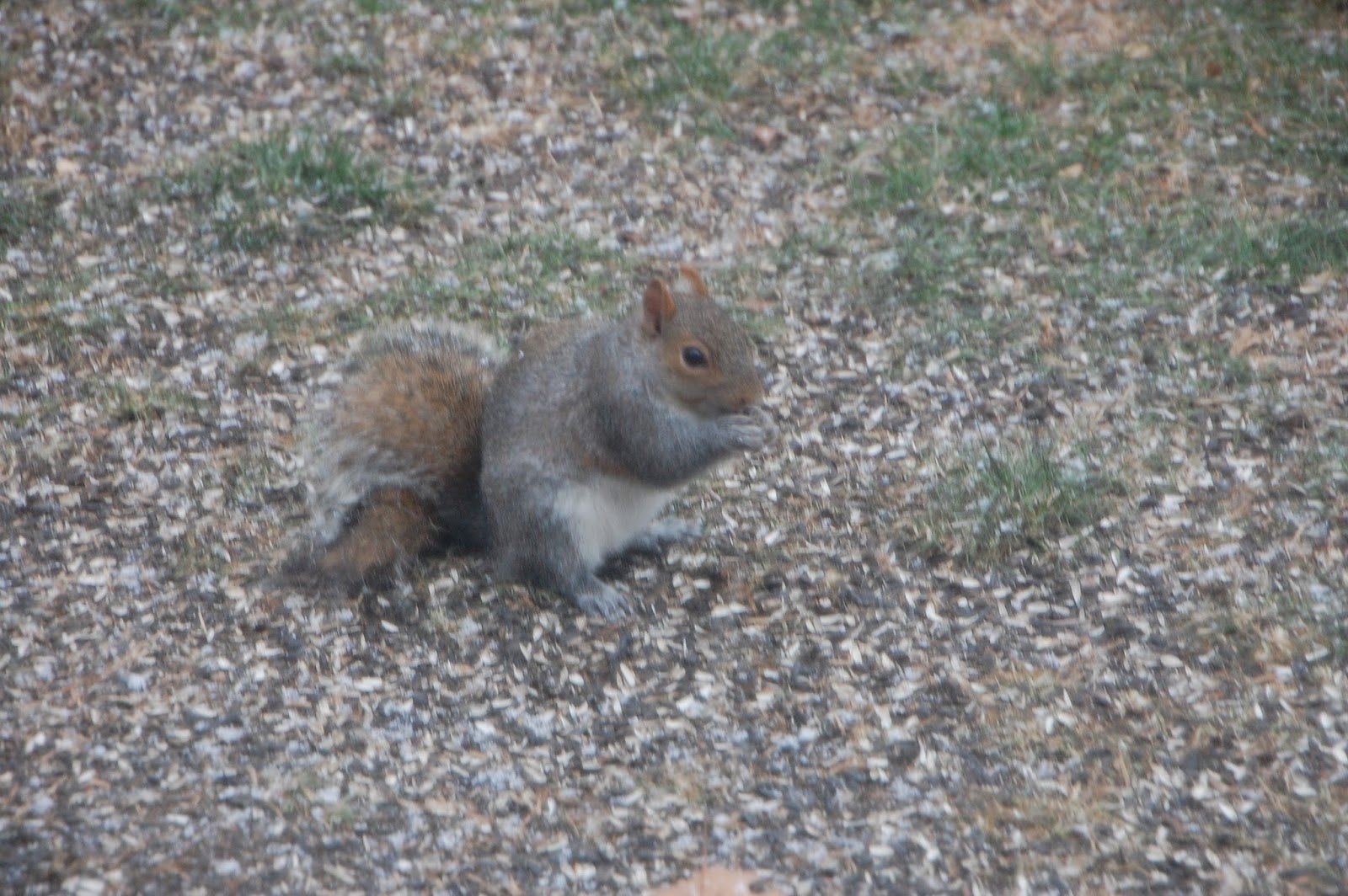
In fact, thanks to the messy birds, I have a growing number of juncos - a winter sparrow visitor - and squirrels taking advantage of the droppings. I wouldn't mind this if the horde didn't waste so much seed that when it finally flies off - and the other day there must've been 40 of them joining the ones from my yard - they've left nothing for the birds I want to see, including titmice and chickadees.

Titmouse manages to get a seed - Jan. 2016 (Margo D. Beller)
As you can tell, the cold makes me irritable. Unlike the birds I have to fight the internal need to eat more when the days get short and the temperatures drop below freezing. Like the bears (by now, I hope), I feel the need to hybernate. It has been particularly hard this January because in November we had September weather and in December we had October weather. Turn the calendar page and January being January is a shock to the system.

So forgive me if I keep my feeders inside once in a while during this coldest of periods so I can have a rest from refilling them two or three times a day, and force the birds to act like birds and look around for their food. The feeders will be back outside soon enough.


Sunday, August 17, 2014

Considering the Alternative

Robin Williams' recent suicide had me thinking about my father.
My father, a doctor who died over 20 years ago, had Parkinson's for the last 20 or so years of his life. Every day he got up in the morning and left the modest, middle-class home he lived in and went to his medical office in the lower level of the modest, middle-class home where his parents lived a block away.
Unintentional sepia, at Shea Stadium (Margo D. Beller)
A child of immigrants and a striver. As far as I know, he never thought of killing himself.
Then again, my father was the type of man who would not let feelings like that be known to anyone in his family. He defined himself by being a respectable man in an honored profession.
But I am sure he felt terrified at what would be coming because soon after his diagnosis he contacted one of medical school classmates who was running the Parkinson's program at Mt. Sinai Hospital in NY and allowed himself to be used as a guinea pig to test what was then new and untested treatments. I'd have done the same thing.
There is no cure for Parkinson's, and while the drugs helped a lot, he got worse. Along the way his doctor-wife died, his children moved out, his parents died. He kept going to work until he was finally forced to retire. A few years later he died of complications from a stroke. He was 73.
Robin Williams was 63, a few years older than me. Like my father, Williams was, by all reports, comfortable financially and had people around him to care for him, family and those he could hire.
But I know he was terrified, too. Battling depression and addiction, a man known for manic, sometimes physical comedy, the thought of becoming rigid and debilitated must have put him over the edge.
A lot of us know that feeling. One of my friends, about Williams' age, told me if she ever gets too sick to take care of herself she wants to go out on a "sunset cruise" where she is sailed beyond U.S. waters, drinks poisoned champagne and her body tossed to the fishes. 

Some people just soldier on, like my father, until the end. Those who go to church trust in a happy hereafter for their souls. One of my friends smoked himself into an early grave and when he went it was sudden and he never saw it coming.
I'm not a church-goer and MH and I don't smoke or have children to care for us. At some point, one or the other of us won't be around to care for the other or this house and its considerable amount of stuff. I fear that day.
So do most Baby Boomers I know, the ones who believe the advertisers who tell us we can keep going (using their products) as though we are still 20-year-olds despite the increasing stiffness in the morning, the misplaced glasses, the names and dates we can't remember without notes.
Williams wasn't aging well, according to one news report. Neither am I.  As the joke goes, consider the alternative.
Many do.
I find it no coincidence that there is an increasing movement in many states for doctor-assisted suicide. After living a life of doing what we want and setting trends for generations to come (or so magazines like AARP's tell me), my generation is terrified of coming face to face with the inevitable.
"Hope I die before I get old," sang Roger Daltrey in 1965. Does he feel the same way now at 70? (Or does Pete Townsend, now 69, who wrote the song?)
When we didn't "die young and leave a beautiful corpse," we thought we'd live forever. Advertisers abet this -- like the guy in the vitamin ad I've seen who is told by the voiceover to "do what you've always done" and not let "age get in the way" of surfing that 50-foot wave despite being over 60.
But it's coming, whether you like it or not. I can't ignore the decay as I get closer to the age my mother was when she died, which is why I and others were shaken by Robin Williams' suicide. I own my comfortable, middle-class home thanks to my father, but I would not say I am financially secure. What is "secure" nowadays at our age when we are one medical catastrophe from financial disaster?
There are times when the dreariness of everyday life -- making the bed, folding the laundry, the prospect of shoveling the snow again and paying the bills on declining income - makes me want to end it. Like the man in the old song, "I'm tired of livin' and scared of dyin'."
But Ole Man River just keeps rollin' along.