When you put out feeders, as I do, you can't pick and choose which birds come to eat the food. (
Or bear, for that matter.)
There are many birds I have enjoyed at the feeders, resident birds and colorful migrants such as the rose-breasted grosbeak.
 |
| Rosebreasted grosbeak (Margo D. Beller) |
But there are many I do not enjoy. And this year my backyard has turned into an ecological disaster because of an overabundance of house sparrows. The
unusually warm weather for December has not helped.
House sparrows are everywhere. They are common as dirt. You see them in the cities, frequently dull with soot. They make their nests in any opening they can find -- awnings, hinges, street lights, tiny spaces around window air conditions. They are just as active in the suburbs, breeding prodigiously.
House sparrows aren't even true sparrows. They are related to the
weaverbird of Asia and Africa, not native to the United States. They likely hitched rides with vessels coming to the New World from the old and,
like the starlings, found the new land to their liking and bred enough to take over.
These chunky, gray and brown birds have no song but you'd know their calls, the "cheep cheep" coming from bushes. They are very opportunistic eaters, grabbing bread if they can't find insects or seeds, preferably small seed such as millet. But if they find sunflower seeds -- such as what I put out -- they will sit and crunch it up in those large bills.
Or maybe I presume you know what a house sparrow looks like. They are so common as to be ignored by most people. When I try to remember what kinds of birds I saw growing up in Brooklyn, long before I became interested enough to go out in the field to really see birds, I could remember "sparrows" -- meaning house sparrows.
My old,
open, house-shaped feeder -- the only one that will accommodate a big bird such as a cardinal or jay -- provides easy access to the seeds, which is why these pests prefer to eat there, only moving to a second feeder that is harder for them to get into -- a tube feeder surrounded by a cage -- when there are too many of them at the house feeder.
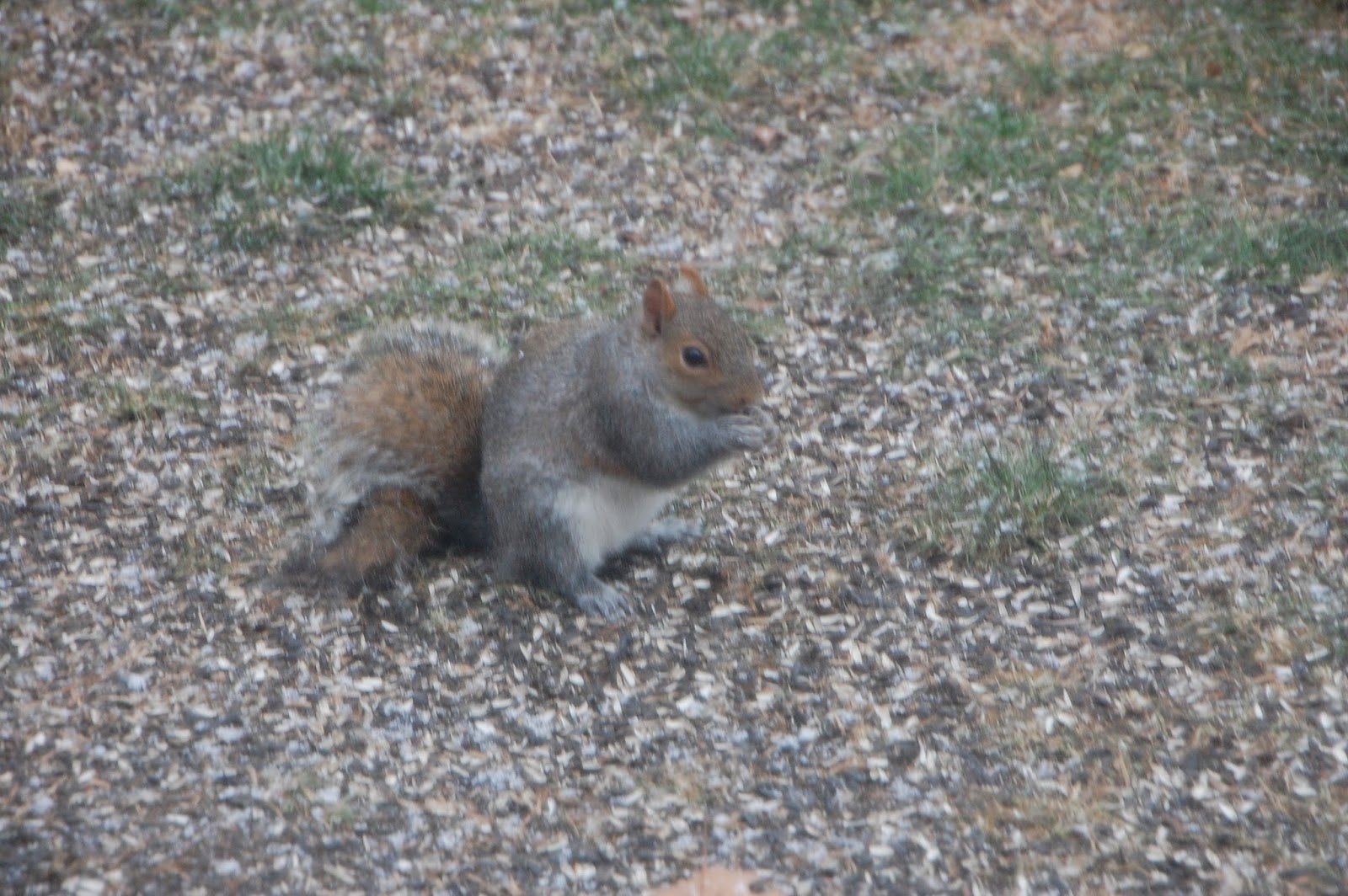
When I put out the feeders, the birds are hanging around in the bushes, giving the occasional "cheep," waiting for another bird -- a titmouse, a chickadee -- to come to the feeder first and take a seed. That's when the sparrows consider it safe and hit the feeder in such numbers they will spend as much time fighting each other as eating, blocking access to other birds and generally making such a mess the squirrels sit below and wait for the droppings.
This is the point when I come out on the enclosed porch and stand by the window. The birds retreat to the bushes. If I stand long enough they fly to bushes at the edge of the property. Even when I go outside and walk to the edge, the sparrows never go far. They are not going to leave a rare, easy food source.
 |
| Cardinal pair (Margo D. Beller) |
Hence my problem.
I used to have a neighbor who had a feeder and filled it with cheap seed, mainly millet. She'd feed the birds all year long, even when she didn't have to because of the surfeit of insects. A few sparrows came and soon there was a large family. The neighbor moved elsewhere. The new homeowner used the feeder for a year but since it has been empty.
The house sparrows were happy to hang around and multiply. I ignored all this until I put out the feeders this fall.
Thanks to all the house sparrows now in attendance, the number of cardinals coming to the house feeder is way down.
Cardinals are big birds but they are skittish. They will fly off when they feel threatened, unless conditions are so dire (or another cardinal is on the feeder) they fight to stay. The eastern blue jay is another big bird, but being of the same family as the American crow, it is feisty and doesn't care what is in the feeder when it flies in.
The chickadees, titmice and even the white-breasted nuthatch will fly to the caged feeder if the house feeder is besieged, or will wait for me to scare off the house sparrows, at which point they quickly fly in to grab seed and go. They don't mind my standing at the window. They have learned I mean them no harm. They are very smart.
But so are house sparrows, I'll give them that. The ones coming to my feeder have learned to grab and go like the other birds. They've learned when they sit and eat in the feeder I am going to come out on the porch. They've even learned the sound of the door opening, and they can see so well a mere movement sends them flying.
As I said, these are common birds, in all senses of the word. People have used house sparrows for metaphors because they are so lowly and common. The idea is, you can never be too lowly or common to be ignored. Here are some instances.
The old TV show "Baretta" had a theme song, "Eye on the Sparrow," sung by
Sammy Davis, Jr.
A gospel hymn with the same title -- recorded by a number of people including,
in her last movie role, Whitney Houston, says, "I sing because I’m happy, I sing because I’m free/For His eye is on the sparrow, and I know He watches me."
Evita Peron -- the real-life
"Evita," wife of Argentina's dictator Juan Peron and quoted at the top -- used the sparrow to downplay her great power and appeal to the masses as one of them, a lowly sparrow.
Meanwhile, the British scienctist,
J.B.S. Haldane reportedly quipped, when asked to reflect on what science had taught him about the mind of God, that “God is incredibly fond of beetles.”
He could've said house sparrows, too.