Cape May

Cape May
(RE BERG-ANDERSSON)

Monday, September 2, 2019

The King of Hawks

This post is based on one that originally ran on Sept. 9, 2017, on the blog of New Jersey Audubon's Scherman Hoffman sanctuary. The NJA blog was significantly overhauled since then and the archives were deleted. However, I was able to keep a copy so this can again see the light of day.

There was no birding before the binocular, there was simply ornithology.

-- Pete Dunne

When summer is ending, there is nothing like the prospect of finding an area with a clear view to the north and then waiting for the annual migration of south-bound raptors. It doesn't matter if I am on a mountain, in a park or in my front yard, looking up and seeing a small speck that could be a broad-winged hawk or a red-tailed hawk or a peregrine falcon is exciting. There are areas where hawk watches are held every year because these areas, if they are on mountain tops, provide the warm columns of air called thermals these bird need to soar and float southward, allowing them to conserve their strength. 


Southbound Cooper's Hawk, Hawk Mountain (RE Berg-Andersson)
For many years, the author and birdwatcher Pete Dunne has been coming to the hawk platform at New Jersey Audubon's Scherman Hoffman sanctuary. His visits, in early or mid-September, are timed to when the flight of broad-wings is at its highest and other raptors are increasingly on their way to their wintering grounds. Pete always draws a big crowd. Twice I have watched him in action on the platform, encouraging young birders, providing identification tips and, if you picked up a copy of one of his many books, signing an autograph.

Pete ran the NJ Audubon center in Cape May for a long time but after suffering a stroke in 2014, he stepped down to become the group's Birding Ambassador. Nowadays, however, he has given that up and when he is not in the field he is writing a book or a blog post somewhere.

So it seems fitting that I reprint this NJ Audubon post, my 300th on this blog, in September about a man who is an institution in the birding field as well as a humble guy for whom there is no stupid question and always much to learn:

At high noon, on a mid-September day that feels like mid-August, Pete Dunne sits in a chair on the Scherman Hoffman sanctuary hawk observation platform, calling out what he sees through his binoculars and providing a wealth of observation tips.

“That’s a Turkey Vulture. It holds its wings in a V. V for vulture.” 

“There’s a Broad-wing flying just above a Red-tail in that cloud. You can see the Broad-wing is a little smaller and its wings look like a candle flame.”

“That’s a Sharp-shin passing over us. It looks like a flying mallet. A Cooper’s hawk looks like a flying crucifix.”


Pete Dunne (Margo D. Beller)
The crowd is a bit smaller than when I was last on the platform while Dunne was visiting five years ago, but it is no less avid. Up go the binoculars as sanctuary director Mike Anderson uses a clicker to count off the number of raptors seen while making sure everyone can see what Pete Dunne is seeing. Dunne visits this New Jersey Audubon sanctuary every September from his home near the Delaware Bay, close to Cape May at the state’s southern tip as the gull flies. He ran New Jersey Audubon’s Cape May Bird Observatory for many years before a stroke in 2014 prompted him to step down.
Since then he has been New Jersey Audubon’s Birding Ambassador. His mission is to inspire your interest in birds and conservation. He comes north to Scherman Hoffman in mid-September because it is in the “Broad-wing belt” when these buteos can be seen flying south for the winter in the greatest numbers. There are more of them seen now in northern New Jersey than in Cape May, he said. Also, it gives him an excuse for the Morristown-born Dunne to visit family.

But today the weather is not cooperating, even for Pete Dunne. While the rising warm air, or thermal, will keep a flying hawk aloft, the wind is out of the south. Southbound migrants prefer a strong wind out of the north to push them along so they can conserve energy.

Shortly after I arrived at noon, two hours into his visit, five Broad-wings were counted among the raptors seen including a couple of Red-tails, some Turkey Vultures, a few Black Vultures and a Sharp-shin, the smallest of the accipiters. We waited. The small number does not bother Dunne. He remarks that the previous year on the platform there were no Broad-wings seen although there were plenty of other raptors, including Bald Eagle and Osprey. When no hawks are flying, he points out migrating Monarch butterflies and the occasional non-migrating Blue Jay. The binoculars come down and people break into small groups, sharing birding stories and other interests, including choral singing and politics.

At this point Dunne stands and asks if everyone has a pair of binoculars, and points out the ones in a box for a free loan. “Everyone knows what a loan means, right?” he says, smiling. If you don’t know how to use them, he’ll show you. He discusses differences in price and features, which can be substantial. He asks how many of those on the platform are first-time visitors. There are a few. The crowd is generally older and long-time birders and most have been to Scherman Hoffman’s platform. The platform is big enough to hold all these people and more but Mike Anderson told me Pete Dunne’s annual visit is easily the largest crowd up there. He’d love to have a daily hawk count but the usual two evils – lack of time and money – prevent that.


(Margo D. Beller)
There are young people on the platform, too, searching for specks in the sky. Dunne encourages them because they are the future. He talks to them like a friendly uncle. After all, he was once a wunderkind birder, encouraged by his father. Dunne was so much into birding that he was devastated when the father of his primary birding companion – a girl – forbid her to travel with Dunne in the woods anymore when both achieved puberty. Dunne said he didn’t understand why he now had to bird alone.

He got over it and has birded alone or leading large groups for most of his 66 years. He is a hero of mine for being self-taught and not a trained ornithologist. He was one of the creators of the World Series of Birding, an annual competition where the idea is to find as many birds as possible, either throughout New Jersey or in a particular large or small area. The competition raises money for conservation. Dunne’s first team included Roger Tory Peterson. He knew David Sibley before Sibley became famous with his illustrated birding guides. Dunne has written a slew of books including “Tales of a Low-Rent Birder” in 1986 (which is how I first heard of him), “The Art of Bird Finding” in 2011 and books on raptor identification, including his newest, “Birds of Prey.”

We once crossed paths at Cape May’s Higbee Beach as he led a very large group to a larger tour bus as I was arriving just after 7 a.m.. You’d never know he’d had a stroke. He took a moment to point out to me a singing Carolina Wren. His enthusiasm is infectious, which is a good thing if you are on a mission to expose as many people as possible to the wonder of birds.

When I left the platform an hour later, he was still up there, still talking to the crowd and watching for Broadies. According to Mike Anderson, those who came after got to see about 20 Broad-wings, four Bald Eagles and an equal number of Ospreys, five American Kestrels, Northern Harriers, Cooper’s and  Sharp-shinned hawks. Oh, and a Mississippi Kite, not a sanctuary record but it must have been quite a sight.

You don’t need a Pete Dunne to see hawks from the observation platform. There’s still plenty of migration season left for you to come up and find them.

Sunday, August 25, 2019

Late Summer Blues

I trust in nature for the stable laws of beauty and utility. Spring shall plant and autumn garner to the end of time.
-- Robert Browning

T.S. Eliot was wrong. August is the cruelest month, not April.

In April you can sense the days are getting longer, the plants and tree leaves will soon be coming out, the temperature will warm. In August you realize that, hey, it's awful dark at 8 pm. In August the heat and humidity eventually gives way to cooler, dryer days and you walk outside to discover the weeds are everywhere and your summer flowering plants are shot and ready to be cut down and composted.

Monarch feeding on butterfly bush flowers (Margo D. Beller)
When I look in the trees, I am as likely to see a falling leaf or a migrating butterfly as I am a bird. Already the apple tree is nearly bare and many of the maple and dogwood trees I see are losing the green in their leaves and showing the underlying red or yellow.

In August the squirrels are dropping as many acorns as they are caching, making it likely I'll either get bopped on the head or step on something that will hurt my foot and might make me lose my balance.

In August many weeds are tall and flowering, particularly ragweed sending out its pollen, just in time for when I can finally open my windows for fresh air instead of being stuck inside in air conditioning circulating the same stale air.

In August many of my peppers seem to come ripe at the same time, so I am cutting and freezing most of them. My tomato plant has suddenly covered itself with yellow flowers, so I will have more fruits soon. My basil is just about done. The coleuses are tall and lovely and I have taken cuttings to pot for next year. But because of the hordes of white flies I am leaving these and the vegetable plants outside to be killed by the frost. At that time the dahlia and canna bulbs will be removed for storage.
In autumn I prefer asters to the ubiquitous mums. (Margo D. Beller)
In August many of my neighbors go away on vacation because it is the last time they can before school starts in September. Even tho' it has been decades since I've attended school, there is something about the advent of September that depresses me. Perhaps it is realizing it is only a couple of months until the end of the year. Where did the summer go? When they return they will start filling their doorways with pumpkins, mums, ornamental kale and corn threshes to connote a harvest time they've never experienced unless they grew up on a farm.

August is when birds are on the move south. The mature female hummingbird I've seen at the feeder for the better part of two weeks has not re-appeared, although an immature (grayer) hummer has come to the few remaining coral bell flowers to feed. There have been others at the feeder but I have not been outside long enough to see if they are the same bird or different.

Inkweed, like ragweed, grows huge in fall. The berries will turn
black and be eaten by catbirds and other birds
heading south. (Margo D. Beller)
Hawk-watching season is already upon us. Hawk Mountain, one of the premier viewing sites in the eastern U.S., opened for fall watching on August 15 and has already reported osprey, bald eagles, various accipiters, harrier and broadwing hawk. There will be many more "broadies" moving through my area, peaking in mid-September. Warblers may pass through my yard but unlike in the spring they won't be brightly colored and won't be singing territorial songs. Mating season is long done, the young have fledged and now the only thing on these birds' minds is getting back over land and sea to the winter territories.

Finding these migrant birds in the trees is harder at this time of year. It's a little easier in more wide-open areas such as the shore or a sod farm. I went to one sod farm recently and found some unusual sandpipers and plovers, including the upland sandpiper, which are endangered because of increasing development eating up the dry open spaces they need to survive the trip south.

Finally, August is when I realize it is dark in the early morning and it is dark before 8 pm. Daylight will continue to decrease and before long we will turn clocks back and it will be dark by around 5 pm. Lack of sunlight makes me moody, in part because I can't avoid the inevitability of the passage of time. I know the longer days will return in the spring but until then the cold is coming, and possibly worse.

Wednesday, July 31, 2019

Abandoned Nest

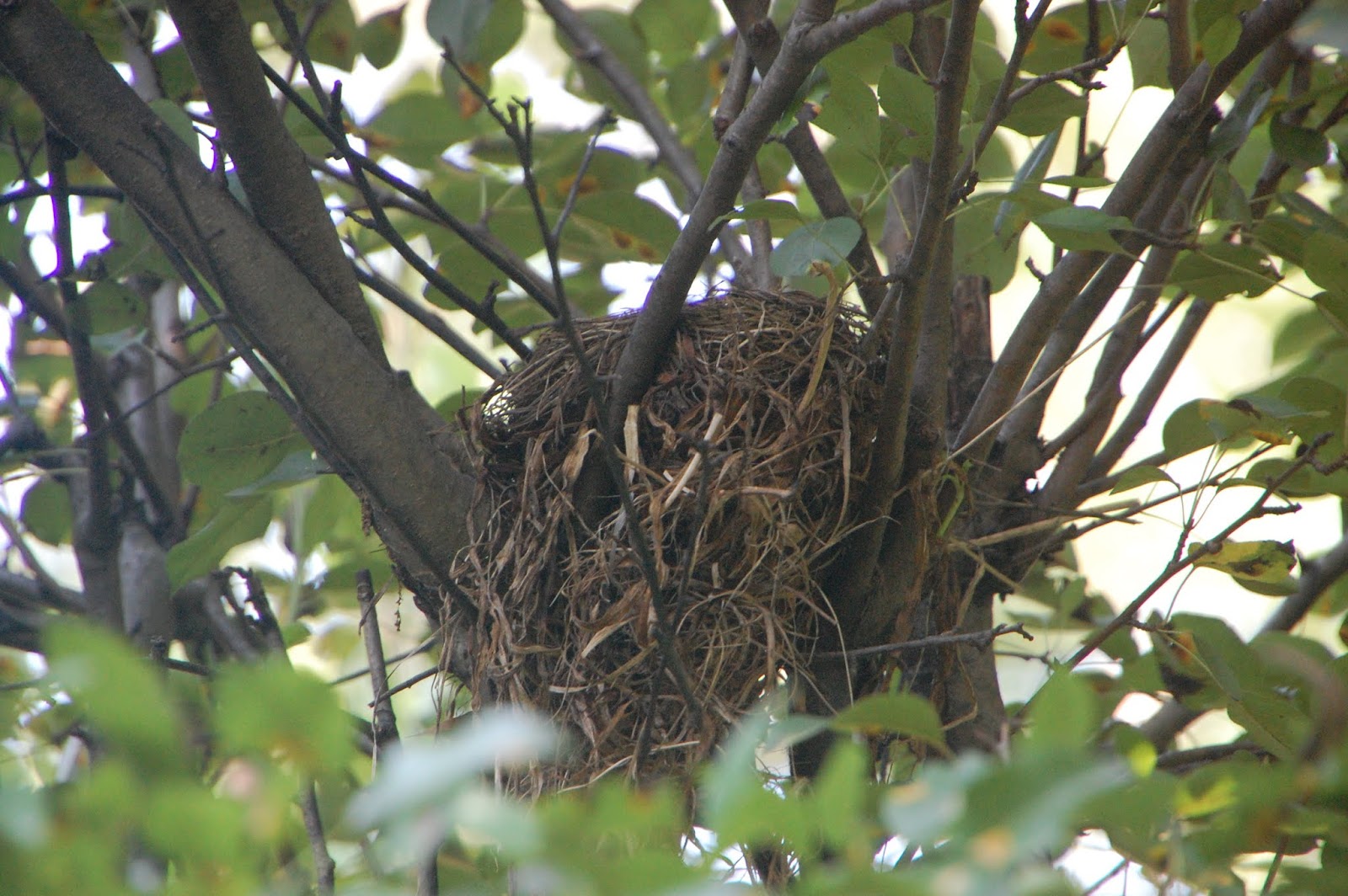
The robins in my backyard pear tree alerted me to the nest being built, and they alerted me when the female was sitting on eggs and then feeding young.

Now they are gone, and that silence alerts me the nest is abandoned.

Robin nest, July 31, 2019 (Margo D. Beller)
I first noticed the nest being built by the female on Saturday, July 6, when she flew back and forth with long strands of grass or possibly the spent greenery from the daffodils I had put atop the compost pile a few days before. On July 10 she was sitting in the nest, her head barely above the rim. She wouldn't move until the male signaled he was nearby and then she'd leave for a dinner break.

I looked forward to watching the parents tend to the young, something I could never see when I was watching house wrens going to and from the nest box I hang in the apple tree.

The female returning from a dinner break.
(Margo D. Beller)
On July 26 I noticed a change. Now the male, who had been tending to juveniles from a previous brood, was spending more time at the nest when his mate went off for food, which she did for longer periods of time. He'd stand at the edge, sometimes poking around inside, until the female returned. He'd fly off, she'd stand on the rim, lean down and vigorously move. I imagined young birds, helpless but with mouths open, being force-fed as she regurgitated food directly down their throats. This back and forth went on for a few days.

Meanwhile, we went through days of intense summer heat and humidity, thunderstorms, then days of drier, more comfortable air. Through it all the female was brooding her young. When she sat on eggs, she seemed to be in a daze; when the young hatched, she sat much higher in the nest and was more alert and watchful. I was on the porch one morning when fish crows started calling from trees nearby. Crows, as well as their cousins the jays, will eat baby birds so she sat atop her young and did not move, hiding them amid the tree foliage until the crows flew off.

I can't sit on the porch all the time, unfortunately, especially in very hot and humid weather. But on July 30 I went out in the late afternoon and saw no activity at the nest. I wasn't bothered by this, figuring the parents were off getting food and the young were big enough to sit quietly in the heat unprotected. But I did wonder, and today there continued to be no activity, not even a call from a parent robin.

So I decided to take a closer look.

My attempt to see into the nest (Margo D. Beller)
I don't climb trees. However, I did take an extension pole, attached a paint roller, duct-taped a hand mirror and tried to get it up above the nest to look inside. I was not successful but the fact no parent came screaming at me told me this was no longer an active nest.

What happened?

I could be optimistic and say I miscalculated, the birds were bigger than I thought and all had fledged. But my instinct is it was something more cataclysmic: either a predator (crow? squirrel?) got to the young birds or the heat got to them or the female robin was hit by a car as she was flying low over the road and the young starved.

Nature is cruel, as MH reminded me when I told him about my attempt to look in the nest. I don't know what happened with the house wren nest earlier this year and I don't know what happened with the robins. I do know that eventually the nest will fall apart and drop from the pear tree. Perhaps I'll get a better indication of what happened then.

Monday, July 29, 2019

Saving Water by the Barrel

This post is based on one that originally ran on March 6, 2017, on the blog of New Jersey Audubon's Scherman Hoffman sanctuary. The NJA blog was significantly overhauled since then and the archives were deleted. However, I was able to keep a copy so this can again see the light of day.

"When the well's dry we know the worth of water," said Benjamin Franklin. That is never more true than during the summer.

Thirsty titmouse at hanging water cooler
(Margo D. Beller)
Here in New Jersey, unlike in other years, we've had plenty of water from an overabundance of spring rain. Reservoirs levels are at or over capacity, making it certain we won't need restrictions on watering lawns or plants. But that is not always the case. In many years July into August is a time of brown grass and thirsty flowers. The birds are thirsty, too, when they come to the water cooler, their bills open to release the heat.

Back in 2017 I attended a program where people learned the value of saving water by making rain barrels to store water for those dryer times during the summer.

I was there as an observer and didn't make my own rain barrel. In my yard MH only mows every few weeks and keeps the mower higher so the grass protects itself, leaving our lawn a bit greener than our neighbors' albeit crunchy in spots. My plants do well in drought and only need to be watered once a week with the hose. But I admit that after attending the program I felt guilty about how much water is wasted coming off the roof and pouring over the driveway to the street and down the drain.

As I wrote in 2017:

Dry forsythia and viburnum, 2015 (Margo D. Beller)
One inch of rain pouring off the average suburban house roof -- 800 square feet -- means approximately 600 gallons of water, according to a fact sheet from the Rutgers University NJ Agricultural Experiment Station in New Brunswick. That's enough water for your garden and your lawn twice over.

Wasting water leads to drought restrictions, usually during the hottest part of summer. So this year, instead of over-using the sprinkler or hose, why not consider a way of collecting at least some of that runoff each time it rains -- a rain barrel.

New Jersey Audubon's Scherman Hoffman sanctuary held its third annual program on how to build your own rain barrel, and it is easy to see why this is a popular program.

Not only did those attending learn something about making their gardens more sustainable while saving water, but they were able to use shop skills many might not have realized they had to create a 55-gallon blue plastic rain barrel (donated by Ocean Spray) at a fraction of the cost of what you'll find at your local Do-It-Yourself store..

Alexandra Cavagrotti, Americorp Watershed Ambassador for the region encompassing the Passaic, Rockaway and Whippany rivers in northern New Jersey, said most homes shed water through gutters and leaders down nonporous surfaces such as driveways, where the water picks up lawn chemicals, car substances and other pollutants and runs into street drains and thus down to streams, rivers and, ultimately, the ocean.

House sparrow at water dish (Margo D. Beller)
Rain barrels are a good way of cutting down on some that polluted, wasted water, said Cavagrotti.

Sherman Hoffman program director Stephanie Punnett said the sanctuary has two rain barrels. "When you have 275 acres, water is problematic," she said. The rain barrels "have been a great help with our native planting" program, that includes removal of invasive, non-native plants throughout the sanctuary.

Plus, rain barrels are fun to make.

Certainly the people making their own were enthusiastically having fun using a drill to create a hole for a faucet and one for draining overflow, then caulking the faucet and putting mesh over the donated screen to keep mosquitoes out (standing water is prime mosquito breeding territory in summer).

One woman, who happened to be Cavagrotti's mother, was wielding the drill like a pro, with the barrel steadied by her husband. "I've built whole houses," she told me when I asked if this was her first rain barrel. I can believe it.

"You get such a feeling of satisfaction" from wielding a drill, said another woman. (Having used a drill I know the feeling.)

For those not power tool-inclined, Cavagrotti and several other Ambassadors helped drill the holes. Americorp is a public service program supported by the U.S. federal government, foundations, corporations and other donors. These Ambassadors teach the importance of water to schools and at programs such as Scherman Hoffman's.

When they finished, everyone put their barrels into their pickups, SUVs or sedans (with a little shifting around of seating), to take them home and position them under a downspout (or not -- Scherman Hoffman's barrels are not connected to the roof, said Punnett, because all of the Hoffman Center’s downspouts are connected directly to a groundwater recharge system. The rain barrels are connected to two other buildings on the property). The more creative can even decorate their barrels for use this summer.

Dry lawn, 2015 (Margo D. Beller)
And that's one thing to keep in mind if you want to buy or build your own rain barrel.

Once it's November, no matter how unusually mild the weather, unhook your rain barrel, use up the remaining water, clean the barrel out and store it inside. You don't want a barrel full of ice that might expand and damage your handiwork. According to Cavagrotti, it's best to use your rain barrel from April through October.

Also, while rain water off a roof is all-natural it may not be all-edible. Some roofs are treated with chemicals to keep mold and moss off. Birds and squirrels have been known to leave their mess on roofs.

So while the water flowing from roof to rain barrel may be fine for your lawn or your flowers or even washing your car, don't put it on your vegetable garden or in your pet's water dish or into a bird bath.

Some of the people making their own rain barrels, 2017
(Margo D. Beller)
You can get more information on rain barrels and wise water use from a number of online sources including the Rutgers Cooperative Extension Water Resources Program.

If you don't want to buy or build a rain barrel, there are other ways of using water wisely in your garden this summer.

Use soaker hoses (available at most garden supply stores) that provide an even, small drip to the roots of plants. Install native plants that are accustomed to your area and can survive dry conditions. Plant more trees -- they will not only provide shade from summer heat but they will suck up rain water that would otherwise go down the sewer drain.

Or create a "rain garden," using trees and native plants, that features a depression in the ground for pooling water. There are many websites on how to design a rain garden including that of the Rain Garden Alliance at http://raingardenalliance.org/planting.

Sunday, July 14, 2019

Family Time, Again

She is nearly invisible in the messy cup nest she built at the top of my pear tree, her yellow bill showing as she raises her head to look at me. But I am behind glass on my enclosed porch and no threat to her. After taking about a week to put the nest together, she is sitting on three to five blue eggs and will rarely move off them for the next two weeks or so unless she must.

Like the neighborhood children freed from school to run around their yards and play, my yard is filled with the sound of noisy young, in this case birds.

Robin in my pear tree, July 13, 2019 (Margo D. Beller)
The American robin female in her nest is not the only robin in my yard. There are others flying around, many of them juveniles whose breasts are mottled rather than orange to help camouflage them. Their nest was in my large yew hedge. An adult male robin is feeding them. There could be two robin pairs or these juveniles may be an earlier brood of the same female robin in the pear tree. (Robins can have up to three broods, if conditions are right.)

This is the time of year when, if you are looking for them, you'll likely see birds either holding food for young or nesting materials. Those with food will lead you to squawking young, which, when they get a little bigger, will flock after their parents and make themselves very visible.

In my yard, besides the robins, the types of birds followed by young so far have included cardinal, flicker, chipping sparrow, starling, titmouse and grackle, with large flocks of cedar waxwings flying overhead. The other morning I watched a young grackle pull a worm from the grass beneath the apple tree. The bird is completely dull brown while an adult grackle is iridescent, with a bright yellow bill and eyes. When you are a young bird, you need all the help you can get to survive into adulthood.

This old nest was within a wild rose bush I was cutting
back. It was well hid and protected by thorns. (Margo D. Beller)
Bigger birds - jays, gulls, great blue herons, crows - will eat baby birds, which is why you will often see these birds chased off by smaller birds - red-winged blackbirds, mockingbirds, Eastern kingbirds, for instance - protecting their young. Danger can come at any time from soaring raptors and neighbors' prowling cats.

Take the robin in my pear tree. According to the Cornell Ornithology Lab, on average "only 40 percent of nests successfully produce young. Only 25 percent of those fledged young survive to November. From that point on, about half of the robins alive in any year will make it to the next."  And robins are relatively big songbirds, about eight to 11 inches long. 

All these bird families passing through my yard are fascinating to watch. Small chipping sparrows land in the longish grass and seem to disappear except for the young's buzzy contact calls. Larger starlings stick with their parents as they hunt in the grass and in the winter will join with other family groups to create the huge flocks that seem to undulate in the air like a single organism. When the berries on my viburnums, dogwood and other shrubs are ready, the robins and other fruit-eating birds will feast (as will the squirrels). Then, when it turns cooler and the leaves start to fall and the insects die off, many of these birds will fly south to their winter grounds to eat there in preparation for next spring's migration and breeding.


Mother Robin coming back from a food break. When I took this picture the
male flew off to the flood wall. I am guessing he was watching things
while his mate was away. (Margo D. Beller)
Unlike in past years, I am not watching a house wren brood. The nest box I cleared a few weeks ago was visited by a singing male. I was hopeful. However, it didn't attract a mate and didn't build a nest. It used the box as a temporary roost for a few days and hasn't been seen since. But that's the nice thing about the natural world. While there are no house wrens this year, I have a front-row porch seat for when Mother Robin's eggs hatch.  

Sunday, June 30, 2019

Warbler Neck, Birder's Ear and Other Ailments

(RE Berg-Andersson)
"We don’t stop playing because we grow old. We grow old because we stop playing.” 

-- George Bernard Shaw

The birds sang around us as we walked the path through the woods at a federal park near where we live. Towhee, wood thrush, veery, white-breasted nuthatch, catbird -- all heard and tallied in my head as MH and I slowly stepped downhill.

He carries a stick wherever we happen to hike, even on a flat, paved trail, because of his knees, girth and fear of falling down. On this particular trip I left my stick at home, but I have had more than my share of falls, one of them on another trail at this same park, and so I walked slower than usual, avoiding the rocks, roots and areas where runoff from recent rain made the ground almost too smooth.

"There's a peewee," he called from behind me. "There it goes again."

I didn't hear it. 

It called about a dozen or so times, he told me. With all the birds that I could hear, it rankled me I could not hear this bird, whose call ("pee-oh-wee!) is its name. It is a thin and high-pitched call. 

This is not the first time he has heard a bird I did not. This has happened several times with the peewee alone. Unless the bird is close to where I am standing, I am not hearing it.

I don't like this high-frequency problem, another in a series of ailments that affects my birding and my aging life in general.

Like others of my generation, too much loud music heard at concerts or through headphones has damaged my hearing. According to the people who make hearing aids, 48 million Americans have some degree of hearing loss. If I can't hear higher pitches, there will be some birds with faint, high calls (Cape May warbler, Blackburnian warbler, the aforementioned peewee) I won't hear. Rather than call it "deafness" or "approaching old age," I call this condition "birder's ear."

But wait, there's more. Hearing problems can also affect balance, something you need if you are going to hike in the woods alone. Aging knees are a problem when hiking up and down hills, frequently over rough terrain, and there are many trails we now don't hike anymore as a result. I have met people who watch for birds from the comfort of their cars so they don't put pressure on their legs. They won't see as much but they are content with what they can find.


(RE Berg-Andersson)
I am not,. I always want to find more birds so I need my hearing. Long ago I realized that once trees leafed out I was never going to see all the birds calling around me. I would have to learn their songs. Since then I have refined that to learn tones so I can tell, for instance, the buzzy trill of the worm-eating warbler from the dry trill of the chipping sparrow and from the sweeter trill of the pine warbler. Although each bird has a different type of favored habitat, there are occasions when these overlap, such as the time I was in one park that had pines (pine warbler), fields (chipping sparrow) and brushy hillsides (worm-eating warbler) and I heard each bird singing.

So if I can't hear a call as easy to identify as a peewee's, I wondered, what else am I missing?

Busy birders such as me also get sore arms from poling ourselves along the trail, aching ankles if they are not braced and sore knees from walking for miles, especially around water or mud. And that workout includes standing still. Try standing in one place without making a sound for more than five minutes. (I find my stick very good to lean on.) It all starts to add up after a while.

Same with another condition that afflicts we of a certain level of age and experience: "warbler neck."

I consider myself to be in decent physical shape. I exercise and try to control my eating. For me, birding is a way of getting out of the house, away from stress and into nature. It also allows me to test my memory and keep my brain sharp. I never thought of it as exercise for those, like MH, who don't do a lot of physical activities. But it is, and no less an authority than Prevention Magazine recommends it for the sedentary. 

In the field (Margo D. Beller)
Of course, as in all exercise, no pain, no gain. And while I have seen a lot of birds in my time, they have recently become a pain in the neck. Literally. 

You look in the treetops for little birds flitting around and there is a ping that, after continued use, becomes painful enough to make turning your head hard to do. This is another reason I have been using my ears instead of my eyes. My bad posture doesn't help. Nor does wearing heavy, 10x50 binoculars. Neck pain prompted me to switch from the usual strap to a harness that spreads the weight over my back and shoulders. But a strap still presses on the shoulder near the base of the sore left side of my neck.

The National Audubon Society, knowing a trend when it sees one, has an article that not only lists the best exercises to help your warbler neck but provides a YouTube exercise video and a helpful list of "jams" to help you bust a neck move. 

MH likes to remind me birding is supposed to be fun. It is. As long as it remains so I'll put up with the ailments and, by extension, the aging. After all, consider the alternative.

Tuesday, June 25, 2019

Summer of My Discontent (Squirrel Division)

Apple season is nearly over and the only fruit still on the tree is way at the top, where I can't reach it even with my extension pole. However, the gray squirrels have no problem. They climb the main trunk to a branch, then carefully go along until they reach an apple. If the thin branch bends too far and they could fall and break a leg, they leave the fruit alone. At least for the moment.

I watch them do this from my porch and find myself developing a begrudging admiration for Sciurus carolinsis, even as it wreaks havoc throughout my backyard.

"Eastern Gray Squirrel" by DFChurch is licensed under CC BY-NC-ND 2.0 

According to the "Mammals of North America" field guide (Kenn Kaufman is one of its authors), the Eastern gray squirrel has a varied diet that includes fruit, nuts, bird eggs, tree buds, insects, even carrion. "As many people have learned, these squirrels are also very good at raiding bird feeders," the authors add with droll understatement.

Well, duh.

Thanks to the squirrels, I've finally taken in my last feeder for the summer. Either the recent heavy rains pushed down the protective baffle to a height where the squirrels could jump on it, or a squirrel that wanted some food ASAP managed to grab the edge and pull the baffle down. Whatever happened, I went out one morning with the feeder for the cardinal family and a short time later looked out and couldn't understand why it was at such a strange angle... until I saw the two squirrels on it. Out I went and in came the feeder. No more summer feeding. 

The cardinals came and looked for the seed but flew off. I am presuming the young cardinal following its parents can now feed itself because I no longer hear it begging. The male still flies to the feeder pole every so often as a perch to scan for insects below and I feel a twinge of guilt. 

Meanwhile, the squirrels climb the apple tree almost as fast as I can pick up partially eaten apples in my bucket, dump them in a far corner and then go back inside. If I am not fast enough to pick up this fruit, the deer come to finish it off. Judging from all the deer poop I shoveled up the other day so MH could mow the area, I haven't been very fast. 

Apples and nest box (Margo D. Beller)
So I started racing the squirrels for apples by whacking the branches with the extension pole. I know the apple tree wasn't pleased but it was me or the squirrels. So far I have made six pints of apple sauce and one apple cobbler. 

However, the decline in remaining apples comes too late for the house wrens, which deserted the nest box. The combination of too many hungry squirrels in the tree and my being out there with my stick, albeit as far from the nest box as possible, was too much for the wren pair, which would scold me even if I just stood under the tree. 

One morning I went out with my bucket and found the box turned around after a night of heavy rain. I turned it back and saw the opening was filled with nesting material, so much I could not imagine how even something as small as a house wren could get in there to tend to young. I left it alone. Over the next few days I would hear a wren sing as close as a yard away, but nothing came to the apple tree. Finally, I pulled some of the material out of the box. No peeping chicks. No smell of rotting eggs. A few days later I took down the box and cleared it. Many twigs, a few feathers, even a bit of plastic. No eggs. I re-hung the box and now hope for another wren pair in my yard that won't be as jinxed as the last pair.

So that's the havoc. Where does the squirrel admiration come in?

How squirrels adapt (Margo D. Beller)
These rats with bushy tails are survivors. When we have a hard winter with a lot of ice-covered snow and the squirrels can't reach their buried stores, they devise rather interesting ways to get to the feeders if the birds don't drop seeds fast enough. I've written about the really bad winter where squirrels used the accumulated snowpack as a springboard to vault the baffle and grab the "anti-squirrel" cage of the feeders. One squirrel, I discovered, tried to gnaw through the metal bars (the green plastic that keeps the bars from rusting was gone) and then tried to pull the bars apart to stick its head inside. (How it would've gotten past the plastic tube I don't know but I'm sure it would've, somehow.)

Squirrels are smart. They know they can't get behind my deer netting (unlike the smaller chipmunks, alas) because they might not be able to make a clean getaway if I suddenly show up. Do a search under "squirrel feeder videos" and you are likely to find both videos from the makers of these "squirrel-proof" feeders and the people who were greatly entertained watching the squirrels attempt to get food from them. But these feeders don't stop squirrels, they only slow them down (as my picture above shows). 

There is always one particularly smart squirrel that vexes me by its acrobatics even as I admire its abilities. According to MH, who once raised gerbils, the smart squirrel is likely a female that does what she must because she is "eating for six," i.e. pregnant. 

There was the squirrel I found grasping a screen on my enclosed porch and then, after much calculation, jumping across to one of the feeders. There was the squirrel that figured out it could climb the pear tree to jump to the porch roof and go after the acorns other squirrels were dropping from the oak trees above. There are also the stupid squirrels that are hawk or owl food or suddenly run out in front of your car and become roadkill. They will scamper along power lines or even gnaw on them, electrocuting themselves and creating a power outage.

There are regions where people still hunt squirrels but in urban areas such as Central Park, gray squirrels have become used to being fed by humans. In my backyard squirrels dig many holes to bury nuts for winter or dig up other squirrels' nuts to eat. They can do a lot of digging, including in my unnetted flower beds. They might even climb into your house attic.

If humans want to take their picture and feed them peanuts from their hands, the squirrels won't mind. If I am stupid enough to put out a feeder at a time when most birds aren't as interested in sunflower seeds, squirrels will take things into their own paws.

Apple season is just about over. Acorn season is around the corner. So is squirrel birthing season. Joy.