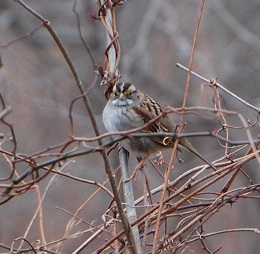
Cape May

Cape May
(RE BERG-ANDERSSON)

Sunday, March 5, 2017

Drilling Down

If you keep your eyes open you can learn something you didn't expect in the darndest of places.

Rain barrels donated by Ocean Spray (Margo D. Beller)
Recently I attended a program on how to build your own rain barrel. I learned that an inch or so of rain off an 800-square-foot roof will drain about 600 gallons of water. Your average rain barrel holds 50 gallons of water. More barrels mean more water saved for your flowers and the lawn instead of using the sprinkler or the hose in the hottest part of summer when there might be water restrictions.

That was good to learn. But what I didn't expect was what I was reminded about changing sexual roles.

Ocean Spray had donated 15 barrels for this program put on by New Jersey Audubon's Scherman Hoffman sanctuary, with a Watershed Ambassador (I learned I live in Region 6) from the Americorp service partnership of federal and private groups. When it came time for the hands-on part of the program, it was fascinating to see who did what.

Mrs.  Cavagrotti drills her rain barrel (Margo D. Beller)

Shop class - using machine tools, carpentry, hands-on stuff like that - wasn't offered to girls back in my day. We had to make do with "home ec," or learning to cook and sew so when we grew up we could efficiently run a household, presumably one with kids.

Looking back, I kinda wish I'd learned carpentry. I've had to pick up knowledge of machine tools along the way via the School of Trial and Error.

Don't ask me to build my own birdhouse. I have no circular saw. But if you need a curtain rod put up, I'll bring over my tool set.

At this program there were couples and single women of different ages.

For one couple the man was the driller and the woman steadied the barrel for the hole that would eventually hold a caulked faucet. But for another couple - who happened to be Ambassador Alexandra Cavagrotti's parents - there was no doubt who was in charge of the drill.

"Have you done one of these before?" I asked Mrs.Cavagrotti (unfortunately, I didn't get her first name). "I've built whole houses," she replied. I can believe it watching her. Her husband held the barrel.

As the noise made the room seem more like a mechanic's garage than a bird sanctuary class room, I noticed a couple of women I'd put in their 40s or early 50s. One grabbed the offered drill. "I don't want to sound sexist but have you ever used one of these before?" I asked. "Yes," she said. "You get such a feeling of satisfaction from using a drill."

I can understand that feeling. No need to call and then wait for a man to do a simple project and then pay him. Once you've used a drill, you realize the power - in more ways than one - in your hands.

But that is a recent attitude, relatively speaking. One older woman waited for Cavagrotti or one of her co-Ambassadors (who speak on the importance of water and conservation at schools and other programs) to come over and drill the hole. However, one younger woman impatiently waited for one of the three drills so she could customize her own barrel.

My drill set, with bits (Margo D. Beller)
At my house, MH is a master of the electric hammer and screwdriver (I prefer the manual type), but wouldn't touch the drill when I wanted to put up curtains, finally, in two south-facing rooms one summer. I'm glad he didn't. After some mistakes the curtains are up and so is a new towel rack. I also used the reverse function to take out some old, stripped screws.

When she was growing up my mother, who became a doctor at a time when that was actively discouraged, didn't use power tools. That was the province of her brother, the engineer. When she married my father she found a man who couldn't screw in a light bulb if his life depended on it. She learned the basics of home repair from his father. Since she was my role model in many things, I took it from there. But I didn't go the final step until MH handed me the drill and said, "This is YOUR project."

So if you want to learn something about rain barrels, check the Rutgers University Cooperative Extension Water Resources Program at www.water.rutgers.edu.

If you want to learn something about yourself and self-esteem, pick up a power drill.

And take some shop classes.

Sunday, January 15, 2017

Dust in the Wind

Generations come and generations go, but the earth remains forever. -- Ecclesiastes 1

Nothing is permanent in this world. This is a law of nature that transcends all things, including blowhards about to become President of these United States.

In my little New Jersey town I only have to walk a few miles to what used to be the property of the state-run Greystone psychiatric hospital. I have not written much about Greystone lately because once the old Kirkbride building came down, all the protests and shouting ended. The hospital moved to state land at the western-most part of the property and the much of the rest was sold for $1 to become Central Park of Morris County.

Kirkbride, as it was. (Margo D. Beller)
MH and I took our walks, thinking it odd that there was just a lot of space at the end of the road behind a storm fence instead of the hulking, stone building, a building it took close to a year to take down because it was put up to last.

There had been plans to build housing here, doing lip service to the preservationists by promising to use part of the old building to house a mental health museum. However, the whole plan died, thankfully. It would've created too much traffic and cost to provide services in one of the few, large, open spaces in a crowded part of northern Jersey. 

The other day I drove us to the end of the road and discovered the fences were gone and big boulders or huge tree logs lined the edge to keep out ATVs. However, there were no signs saying people could not walk in there. And that is what we did.

Looking south -- The ground had been frozen but recent rain made it muddy and spongy in parts. (Margo D. Beller)

Looking north -- It is hard to believe I am standing where one of the largest, continuous foundations in the world once stood. (Margo D. Beller)

Looking west -- You can't see it well here but there is a road between the hill and the field. On the other side of the road and to the right is what is now Greystone hospital. (Margo D. Beller)

Looking east -- You can see the rocks and logs put in to keep ATVs out. Beyond is Central Ave. heading back to my town. (Margo D. Beller)
I stood on this field for a long time, even as MH went back to the car. It took a very long time to take the building down, remove the mountains of stones, fill in the former foundation, put in grass and then leave it all alone until it was deemed time to remove the fences, that the danger to people like me was past.

I stood here, thinking of the human condition. Here was this huge building, built to last as I said, and then it's gone, as if it never even happened.

Dust in the wind.

We can build our monuments to ourselves, our legacies, but when circumstances intervene - a change in presidential administration, global warming, a nuclear holocaust or just everyday dying - it all means absolutely nothing in the long run.

This field, where I look forward to hiking and looking for birds when winter is finally done, is proof of that.

Monday, December 26, 2016

A Holiday Wish

As the year draws to a close, remember that each new year has the promise of being better than the one before.

Already the days are getting slightly longer because we've passed the first day of winter. Soon there will be more light, flowers and other plants will grow again and the birds will be on the move -- migrating, singing, coming to your feeder in beautiful arrays of breeding color.

2016 was not a good year for my health but I know from several tests and exams that 2017 is going to be a much better year for me. Soon I will be the same age my mother was when she died, and I am more than grateful to the Almighty for the time I've had and the time yet to come.

The future, particularly here in the United States, may look scary but I am hopeful humanity will win out over bellicosity and 140-character acts of cruelty.

May you and yours have a joyous new year filled with hope, light and the promise of a new day.

Sunrise over Appalachicola, Florida. (Margo D. Beller)

Monday, December 12, 2016

December in My Soul

Winter finally arrived in New Jersey, bringing with it arctic air, biting wind and even a bit of snow.

Winter is not one of my favorite times. Snow and ice make it harder to walk. Shorter days mean I can't do as much outdoor activities, such as birding, as I would like. Longer periods of darkness make it hard to get up at my usual early hour.

The journey begins, 12/10/16 (Margo D. Beller)
I've had health problems this year, and sometimes I don't feel like myself, which can be depressing. Winter makes that feel worse.

So this weekend, with the threat of more snow looming, I decided to go out and see what was flying around. I went to Great Swamp.

The Swamp is a large piece of land that is mainly run by the U.S. government although there are smaller parts run by Morris and Somerset counties.

My trip was to the federal area, which is in two parts - the "management" area where hunting is allowed in season and underbrush is burned or severely cut back (in short, managed) and the "wilderness" area where maintenance is minimal. The wilderness area is more of a challenge, but I didn't want a challenge when it was very cold. You get to be a certain age and you think of what happens if you're alone and fall and can't get up or, in the case of one unfortunate man I once worked with, you slip into the Passaic River and your body isn't found until winter is over.

My usual winter hiking attire. (RE Berg-Andersson)
It is scary getting older. You don't move as fast, even when driving a car. You forget things. Moving around seems harder and more painful. You feel weighed down. For that reason, I eschewed the frozen mud and rocky trails of the wilderness area and took the more wide-open trails of the managed area.

I started with one area of the Swamp where one trail is a boardwalked loop and thus is very popular with parents with children and those who want an easy stroll. At the time I visited it was super cold and relatively early so there were few people around. However, I wanted the second trail to the duck blind, which is partially boardwalked, partially frozen ground.


(As I was lacing up my boots a couple drove up in a powder blue Jaguar. They looked at me and moved to the boardwalked trail, which I expected. But they seemed perturbed by my orange hat, boots and walking stick because they kept stopping to look back at me. Maybe they thought I would try to steal their car. By the time I came back the car was gone, presumably with them.)

I was the only one in this area. I walked slowly and quietly to listen for calls. It was the first time in a while I felt like myself, completely in sync with all around me -- alive. I scanned the sky for hawks and was pleased when a redtailed hawk hovered over my head and then flew to the top of a tree, allowing me a long look.

Frozen - 12/10/16 (Margo D. Beller)
The waters were frozen solid enough for the juncos to skate on the surface as they picked at whatever infinitesimal things they could find to eat. The titmice were as much on the ground as they were in the trees.

The duck blind showed large water fowl way out in the swamp - Canada geese, mute swans, noisy mallards and a few black ducks that decided to fly in. I've been at this blind in many seasons. One year, a channel was open in the frozen water and down it swam pintails, green-winged teals and American wigeons in a sort of parade. Not now. If these smaller ducks were in the far distance with the big guys I couldn't see them.

Passing over the bridge on the way back, I thought of the time one spring when the thick ice started to melt, cracking like rifle shot. Then I looked up to see a flock of snow geese heading north. But now all was ice. A small flock of titmice and white-breasted nuthatch were hunting for food along with two gold-crowned kinglets. This is why I look at everything, because you never know who might be tagging along with the more familiar birds.

Redtail over parking lot. (12/10/16)
Back at my car, I drove to another part of the Swamp, the tour road created out of what used to be part of a mapped street, Pleasant Plains Rd. At other times I've seen harriers over the fields, yellow warblers building nests and bluebirds singing from their boxes. This time a winter visitor, a fox sparrow, popped up from the brush just long enough for me to admire its coloring. I found another one farther up the road in a flock with its cousins - song sparrows, white-throated sparrows and juncos.

It is tempting when it is cold out, especially after a serious medical condition, to stay holed up all winter like the bears in their dens. It can be depressing to do that, making you feel trapped, the furnace heat drying out your skin and making your eyes tear.

You might as well be dead.

So when the damp, drizzly November in my soul turns to cold, hard December, I account it high time to get out of the house and go birding as soon as I can.

Call me Crazy. But at least I'm happy.


Saturday, November 5, 2016

Raking It In

“Thinking is learning all over again how to see, directing one's consciousness, making of every image a privileged place.” 
― Albert Camus, The Myth of Sisyphus and Other Essays

The other week we were driving home from a family gathering in New Hampshire. We made a stop at one of New Hampshire's waysides to use the bathroom and stretch our legs. The trees were full of colorful leaves, just past peak in this region of the U.S.

A woman was standing nearby with her dog, which strained to come to me. I walked over and pet it. The woman and I talked. She was in awe of the colorful leaves because where she lives, in Arizona, you don't see fall foliage like that. "Someday I have to bring my grandchildren here so they can see this," she told me as MH walked back to the car. She bade me farewell and walked with her dog to her waiting husband sitting in their van.

(Margo D. Beller)
I thought of that woman as I was raking today. I'd like to have a backyard of cactus.

Autumn leaves are beautiful but they are dying. As the days shorten and the weather turns cold, the trees start sending precious life fluids down to their roots. The green leaves start to turn color and drop to the ground. Some days the leaves fall like rain.

Which is why today I was outside in the early morning cold with my rake, tarp and blower.

I find blowers to be a necessary evil. I have "earmuffs," which look like old headphones, to protect my ears when I use our blower, which is electric-powered and relatively quiet compared with the big leaf blowers and hurricane fans used by the lawn services. I wear them even when I rake, to block out the noise of the neighbors in our bit of suburbia, who in their lawn lust want every last speck of leaf removed.

This was the second Saturday this season I've gone out to rake. MH joined me an hour in last week and we kept banging into each other until we developed an unspoken plan involving raking (him) and blowing (me) and putting tarpfuls of leaves at the curb (both of us).

Less than 24 hours later, a storm blew through with wind and rain, bringing down more leaves and covering our lawn. You'd never know we'd been out there. Just like Sisyphus, we'd have to do it again.

Before the fall - 8 a.m., Nov. 6, 2016 (Margo D. Beller)
This time, after a bad night's sleep, I went out early. I used the rake to pull leaves away from edges and the patio, then pushed them on the tarp. I dragged the tarp around the house to fill it with leaves and then dump it at the curb. Across the road one of my neighbors' lawn guy was unloading his equipment. He looked at me and I half-feared and half-hoped he'd ask me if I needed any help. But he didn't. He went on with his work and I went back to fill another tarpful.

My neighbor with this lawn service used to do it himself, until he had a heart attack. I can understand his hiring someone. There will surely come a time when MH, with his aching knees, and I, with various back problems, won't be able to do this ourselves anymore. Our nephew and nephew-in-law are landscapers, but they live in other states. We have no children or grandchildren to help us. For now, we do it.

Whether I use the rake or the blower, the birds are not happy when I come close to the feeders or the water dishes. The chickadees, titmice and white-breasted nuthatch fly in, grab and go when they think I'm not looking or am far enough away. The house finches, jays and house sparrows stay away. They know I will come after them if they stay too long at the feeders. Left unchecked, they'll just sit and eat until there is no more seed, to the detriment of other birds.

White-breasted nuthatch above, titmouse below. (Margo D. Beller)

But once I get far enough away, they are right back at it.

Raking is a quiet activity. It is a thoughtful activity. Unlike sitting and staring into a computer, raking allows me to concentrate on doing something physical and tangible - getting leaves on a tarp - instead of worrying about the usual intangible things such as whether I still have a job or if I can pay the bills this month. In its way, it is as restful as meditating.

When my arms started to ache, I put on my earmuffs and used my blower to create piles. I do this to give me something of substance to put on the tarp. Blowing leaves to the curb is a waste of time, energy and electricity, although those with those gas-belching fans that roar like a jet engine don't share my concerns.

Sure, they were done in 20 minutes as opposed to the several hours I took. But little by little I filled and moved the tarp, then dumped it, until I had gotten the entire backyard done, by which time MH had come out and started raking the front. I felt very accomplished and rather energized, surprisingly so.

There are times I am depressed. This seems to happen a lot at this time of year. The end of the year is near and the November in my soul, triggered by the same lack of light and cold that bring down the leaves, prompts "what's the point" moments.

I sit and wonder:  What's the point of cleaning the house when it's only going to get dusty again? What's the point of getting dressed when I work at home and don't want to see anyone? What's the point of raking when more leaves are going to come down?

What's the point of living when you're going to die anyway?

When I get to that point, I have to take myself outside. As I rake in the cold, feeling the breeze and seeing the birds flitting about in the now-bare trees, I calm down. We live to push that boulder to the top of the hill, even when it falls down and we have to push it up again.

So I go out with my rake and tend to my little plot in the universe.

Saturday, October 29, 2016

November in My Soul

Whenever I find myself growing grim about the mouth; whenever it is a damp, drizzly November in my soul...then, I account it high time to get to sea as soon as I can.

Herman Melville, "Moby-Dick"

It is sad to think that when it comes to vacations, most Americans either don't take one or make it as short as possible. When they travel, they take their computers, check their phones several times a day for email, Facebook or maps to tell them where to go next.

As I get ready to change the calendar page, I am thinking about my coming vacation. I plan to leave the computer at home and keep the phone off as much as I can.

I did not take one week by choice. If I could afford it - for if I don't work I don't get paid in this freelance life - I'd take several weeks and drive down to check out Florida's birds and the migrants. This would be in April, when the birds are in their breeding plumage and heading north.
Male common merganser duck (RE Berg-Andersson)
But since this is November I am talking about, we are following the ducks and other birds south. Seashore areas in November are very quiet - almost too quiet because many restaurants are closed for the season. However, if you go far enough afield and are willing to eat where the locals do, you won't go hungry, especially south of the Mason-Dixon line.

The ocean roars and the air is chilly on the Outer Banks. People walk on the beach, sometimes with their dogs, but I plan to take along our chairs so MH and I can sit and relax. We have both worked very hard this election year. There will also be some days driving around, looking at the birds of Pea Island and on the Delmarva Peninsula on the way home. 

I can't wait. For now, however, MH and I have been raking.

Weather has zigzagged from very hot to very cold and the trees have dropped their leaves. One day you see brilliant color. The next, it is "past peak" and falling. If my house was in the forest, I'd leave the leaves alone because they make good mulch, providing cover for insects, salamanders and other creatures. 

But I am in suburbia, and for the past few weeks there has been a near-constant droning of leaf blowers. During the week, it is the lawn services. On the weekend, it is the homeowner who is a do-it-yourselfer. MH and I are the latter. We spent several hours in the backyard, where the green grass was buried under oak, elm, apple, maple and pear leaves. We attacked with rakes, tarp and, yes, blower. Big piles are now at the curb. Some other time we will do the front yard, where the locust trees are already bare but the grass can still be seen. And then we'll likely repeat the process again.

Chipping sparrow in non-breeding colors (Margo D. Beller)
Hungry birds have been coming to the feeders. For the past week we've entertained winter visitors - purple finches, male and female, the state bird of New Hampshire. These birds of the north would only be in my backyard if their home regions don't have enough food for them. Will this be a year we also host red-breasted nuthatches and pine siskins? If so they will have to fight the resident house sparrows, cardinals, house finches, chickadees, titmice and white-breasted nuthatches. 

So far the purple finches - a threatened species - have been holding their own.

In the shrubs I hear the white-throated sparrows, which show up in the late summer into fall around the time the catbirds leave. I've also seen their cousins the juncos, which arrive around the time the chipping sparrows leave. When it snows and food becomes harder to find, they will be less skittish and go under the feeders to pick up what the other birds have dropped. The suet is eagerly eaten by woodpeckers - downy, redbelly and the occasional hairy.

My garden is done. What is spent has been cut back and I've done some neatening. All that remains is putting burlap over the deer netting to keep the evergreen shrubs from the deer.

I have three pots of peppers - two grown from seed this year and the one from last year - in the house, no white flies (thank goodness) and covered with flowers and/or growing peppers. I could not leave them outside to die.

White-throated sparrow (Margo D. Beller)
The cannas and other big plants in pots, including a gift dahlia, are on the enclosed porch, going dormant. Soon they'll be in a more sheltered place for the winter. The begonias I potted in the spring are in the house, somehow fit among the house plants I brought in from the back porch earlier. 

The farm market ended its season. After the hard freeze earlier this week, I was amazed to find some coneflowers and snapdragons I could cut to make a decent bouquet, my last of the season. Turnips, tomatoes, lettuce, chard, collards, green peppers and garlic will last for several weeks because they are locally grown minutes from my house, not shipped in from halfway around the world.

With November comes shorter days and longer nights. I can understand why Melville's Ishmael would get restless and go to sea. November is a hard month. When we turn back the clock it is dark at 5 pm. It take more of an effort to get up in the morning when it is dark and cold. I feel old and sad at this time of year, made worse because of recent health and work issues.

And so I await that week of vacation. I need to be restored, at least for a short while.

A sad postscript: the redtail hawk that was the subject of my last post did not survive, despite the best efforts of the people at The Raptor Trust.  

Tuesday, September 20, 2016

Hawk-Watching Season, Up Close and Personal

Of all the suburban front yards this Red-tail hawk had to fall on, it had to choose mine.

This morning - cool, foggy, humid - I was doing my usual chores around the house and beyond. Around 7:30, as I was bringing brush to the pile at the curb, I saw this creature watching me.
Red-tail Hawk, Sept. 20, 2016 (Margo D. Beller)

I have found Red-tails on the property, but usually up in the trees. This one should not have been on the ground.

We looked at each other, warily. I walked close  enough to see its tail was brownish red, so this was likely a juvenile. (I also took this picture, which MH cropped.) I could also see one of its legs in front of it, its sharp, killer talons gleaming in the dew.

This was now a very interesting problem for me.

One does not expect to see a wild animal on the lawn, much less an injured one. As suburbs build farther and deeper into the woods and former farms of my congested little New Jersey, animals and birds are going to get displaced, often with tragic consequences. We're going to see them, and they us. Sometimes what we see are big bears or deer. Other times it's an injured bird. Humans can do stupid things when confronted with a situation like this.

I don't know what higher power guided this raptor to the one house on the block that knew what to do next, but I do know that somehow this bird was injured in such a way that it was alive, alert, able to stand and flap its wings but not fly. And a raptor that can't fly is a raptor that starves, becomes dehydrated or is harassed (or worse) by a larger predator.

This is not the first time I've found an injured Red-tail either. Long ago, working in coastal Jersey City, a place where skyscrapers went up like weeds and weedy fields disappeared under the umbrella of "progress," I was walking near my office and found a Red-tail hunkered down in plantings next to one of the new, "luxury" apartment buildings that sprang up with the view of Manhattan across the Hudson River.
One of the times it attempted to fly. (RE Berg-Andersson)

My first call was to get the number of The Raptor Trust, one of the state's best-known bird rehabilitation centers. However, the Trust is located in Millington, in Somerset County, and could not send anyone out to where I was in Hudson County. Call the police, they said.

So I went inside the building. When you have a "luxury" tower, you have a concierge and this man didn't bat an eye - he called the local animal control people from a number in his files. Reassured, I left.

I have no concierge at my house, but I also knew that while closer to the Trust's office, it would not be open before 9am. The Trust is a private organization that depends on donations to continue doing its good work. Many birds of all types have been mended and released into the wild. Many have died. Some stay at the Trust to be used to show we humans what happens when we tear up trees, put up big buildings or drive too fast without see (or caring) about what is walking or flying in front of us.

Birds have so many ways to die in the wild. Nature is cruel. This bird could've been clipped by a speeding car while chasing prey, injuring its wing. It could've been attacked by a two- or four-legged creature bigger and perhaps armed. It could've gotten confused in the fog and banged into a tree or a house. To me there is nothing sadder than seeing a bird of prey dead on the side of the road after hitting one of the many high-profile vehicles on one of the many major highways that bisect one of the most crowded states in the U.S.

I called The Raptor Trust and, as expected, left a message. The Trust accepts birds 24 hours a day but we'd have had to find a large box, throw a blanket on the bird, put it in, tape it shut, drive to the Trust office and then pull the bird out and put it into a heated carrier for when the staff arrived.

No way MH and I would pick up a scared bird whose talons or beak are designed to rip through skin and which weighs several pounds and has a 54-inch wingspan.

So this time I called our local police. All they could do would be monitor the situation and call the Trust. What about Animal Control? I asked.

Connie from Animal Control cages the hawk. (Margo D. Beller)
Turns out they called that number, too, according to the detective who showed up to do that monitoring and keep any people (or their dogs) away from the hawk. I later learned that thanks to the many budget cuts, our town does not have its own animal control office but contracts with a service that handles two counties and is based many miles from us although is close to the Raptor Trust.

So we waited. The detective left, Connie from Animal Control called to say she was on the way. We stood and watched the hawk like a hawk, making sure it wasn't bothered. At one point a murder of American crows started squawking and this Red-tail surely knew crows will mob a hawk to get it away from its family group. The hawk became extremely agitated, got up and flapped furiously. But all it could do was hop off the lawn and to the shaded walkway where it was less noticeable.

Ninety minutes after I found the bird, Connie arrived. She let the bird see her and watch her fold a fitted sheet in such a way that she could throw it over the bird. Her first attempt failed but her second was successful. Once in the dark, the hawk calmed down. Connie put it in a cage that was big enough to keep it comfortable in its sheet but not so big where the bird would flap and possibly do more damage.

By 9:30am, she was gone, on the way to the Trust - which had called me back while Connie was putting the hawk into the cage.

I tried to imagine what the bird was "thinking" while it sat there, watching me and others hover around it. Do birds feel fear? Yes. That's why it was warily watching me and then trying to get away from what it perceived as danger.
How I prefer to see Red-tails. (Margo D. Beller)

Are they able to tell the difference between a helpful me and someone with a gun trying to shoot it out of the sky for sport, as locals used to do on what is now Hawk Mountain Sanctuary at this time of year, when the raptors used the warm winds to save energy flying south along ridge lines? No, it does not. Which is why you should go to The Raptor Trust's website and read the section on how to handle injured or orphaned birds of all sizes if you should find one.

Better yet, call your police or animal control people.

This is hawk-watching season, ironically, and I got a chance to see a Red-tail up close and personal. I can only hope this one can be mended, avoids future hazards and makes its way back into the wild, to be seen aloft and admired by those of us below.