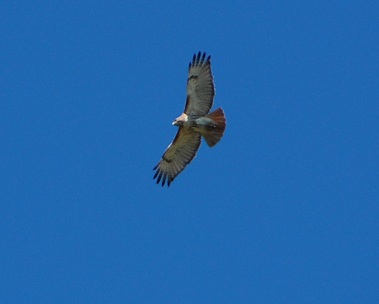
When I retired from the journalism business I wondered what I was going to do to fill the time once spent working. Do what you enjoy, I was told by friends and magazine articles.
Well, that means birding. But what kind of paying job could I get in the birding business? Not many that I would want to do, as it turns out.
 |
| Hitting the road. (RE Berg-Andersson) |
I have great admiration for people who study birds for a living. I don't mean everyday birders like me, I mean those with hard-core knowledge. They know a primary from a secondary (a bird's outer and closer to the body flight feathers), a mantle from a tertial (feathers on a bird's back) and a gape from a gonydeal spot (the fleshy edges at the base of a gull's mouth and the spot, often red, on some large gulls).
All these definitions come from Richard Crossley's field guide to Eastern birds. Crossley is hard-core. So is David Allen Sibley. So was Roger Tory Peterson. They don't just look at birds and identify them, they know their every part. All have written extensive guides.
Other hard-core birders go beyond identification and want to handle the birds in the cause of science. So I looked into becoming a bird bander. It turns out there are rules - a lot of rules.
I found a free, online course in bird banding offered by the U.S. government. Once I registered I looked at the study materials in each module. For instance, there is the 69-page North American Banders Study Guide published by the North American Birding Council. It begins with a Code of Ethics and then goes on to detail such things as the permits needed for banding (migratory birds are protected by federal statute), how to handle a bird, how to open a bird's bill, capturing and extracting birds from mist nets and how to prevent bird injuries and fatalities, among many, many other things.
 |
| Duck banding at Eastern Neck Wildlife Refuge. (Public domain image from the U.S. Fish and Wildlife Service) |
When I started the course I discovered I would not be watching a video of a person talking to me and handling actual birds, but listening to a script as I followed along with notes put up on the screen. I quickly got bored.
OK, says I, I don't want to go through the process of becoming a registered, licensed bird bander. What about volunteering to help out the bird bander?
A contact sent me the link to the Ornithology Exchange listing all kinds of jobs. Most of them require experience as well as advanced science degrees no way covered by my Bachelor of Science degree. The closest hotspots to me for those who monitor, trap and tag migratory birds are on Lake Ontario or Lake Erie.
Here is one such place, in Erie, Pennsylvania. The job would be an assistant to the bander and would pay about $5000 for seven days a week over eight weeks of work starting in September. I would need my own car to get me from the office to the field site. Nothing is mentioned about where I'd be staying for those eight weeks.
Then I read on and found this:
The most successful of candidates will also: Have previous environmental interpretation experience and/or teaching skills. Be comfortable using various social media platforms to relay information regarding EBO’s banding program in a manner consistent with NABC guidelines. Hold NABC certification at the banding assistant level or higher.
Applicants should possess a positive attitude, be comfortable interacting with the general public on a frequent basis, be prepared to work long hours in sometimes adverse conditions (heat and humidity, biting insects), be meticulous in record keeping, and be in good physical condition. Successful candidates will have experience extracting, handling, and banding songbirds. This includes: 1) At least one season at a high-volume station (2,500+ birds/month). Volunteer experience also acceptable and 2) Successful solo extraction of 400 birds minimum. (emphasis added)
So much for that bright idea.
I also considered the Cornell Ornithology Lab's online ornithology course on comprehensive bird biology (for which I'd need another expensive textbook). But I had no interest in that, or even in the Lab's more general online bird-related courses.
 |
| Pete Dunne in 2012 (Margo D. Beller) |
I was an average student, and I went into a field where having a BS (and an ability to cut through the BS) was enough. Everything I learned after that has come from actual experience, the University of the Street. And I remembered that the great Pete Dunne, a man I've met, the author of many books and once the sanctuary director of New Jersey's Cape May Bird Observatory, did not have an advanced degree in ornithology. He was just some guy with a great interest in birds who, according to his "Tales of a Low-Rent Birder", lucked into the job.
The same is true for the writer Kenn Kaufman, who started birding as a young boy and then, as a teen, hitchhiked all over America to see every bird he could find. He wrote about that in "Kingbird Highway," which became a bestseller and led to a career as a bird guide, then as a writer and illustrator and editor of field guides.
 |
| Leg band (Public domain image from the Michigan Department of Natural Resources) |
Do I expect to become a famous birder like these guys and many others, or even a YouTube influencer for fun and profit? No. But I can't see myself trading in the time I've missed by working indoors staring into a computer for time spent indoors following an online course. Life is too short. I'd much rather be outside in the field, scoping out a hotspot or even just walking along a road in my town, learning from life.