Cape May

Cape May
(RE BERG-ANDERSSON)
Showing posts with label Alpha and Beta. Show all posts

Saturday, August 13, 2016

Three Types of Summer's Winged Wonders

Butterflies

This is the time of summer when I go out to the woods and if I see any movement in the trees it is usually a butterfly. The butterflies I see most commonly are tiger swallowtails, dark swallowtails and the occasional monarch butterfly.
Tiger swallowtail (Margo D. Beller)

August into September must be when the caterpillars break out of their cocoons as butterflies. Adult butterflies lay their eggs, the eggs hatch caterpillars, the caterpillars (after eating a lot of leaves, I think) crawl up trees or shrubs to become cocooned pupas and then they hatch as butterflies, which then head south for the winter.

The nice thing about butterflies, besides their many different colors and the way they seem to float in out of nowhere, is they aren't that picky about where they feed. Yes, they have special needs in terms of where they lay eggs, such as the monarch butterfly needing milkweed, but when they need food they will go to any flower, shrub or roadside weed. They will even come to puddles to drink.

I once walked along a road in a strong wind. There was a tiger swallowtail on a Rose of Sharon flower, hanging on for dear life. You would think something so small and delicate would have a problem in wind but this is one strong little creature. 

Butterflies have a lot of fans, which is why you can do a simple search and find all sorts of butterfly clubs to learn more.

Hummingbirds 

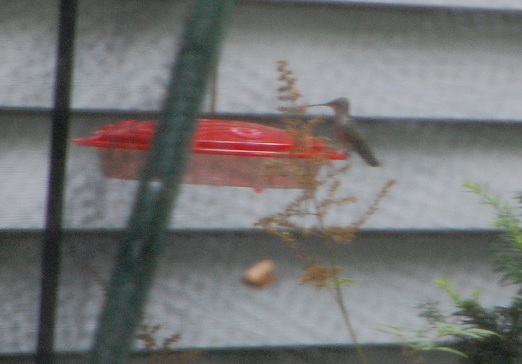
When I last wrote about rubythroated hummingbirds, I mentioned the two that were coming regularly to my feeder. I named them Alpha and Beta. Alpha was the more dominant of the two, hence the name. Beta was rather dusky and very skittish at the feeder, hovering over the portal to drink rather than perch as Alpha did.

Much has happened since then.

First, I realized Alpha might have been a male. We had visited our niece in Connecticut and a male hummer had come to her feeder. The male had a dark head, just like Alpha. The next time Alpha visited I had binoculars with me and did not see a lot of red at the throat, although there was a pink tinge. That was the last time I saw Alpha.
A friend's juvenile hummer (Margo D. Beller)
Beta continued to visit much longer and was soon joined by a smaller, greener individual that was definitely a juvenile male. I named that one Delta. Beta would feed in her skitterish fashion and take off in one direction, Delta would feed and head in another direction.

With the heat and humidity I have not spent time on the enclosed porch, the only way I can see the hummingbird feeder, but it seems to me Beta has moved on and what I call Delta may be Epsilon, Gamma or any of a number of hummingbird visitors. Young are fledging and they have to eat. By now the adult males should've been heading south, and soon the adult females and the young birds will be doing the same.

All I know is, at least once a day a hummingbird comes to feed. I still have plenty of food for as long as they come.

Dragonflies 

One of the things that makes walking with MH so enjoyable is we usually look at different things. I will be looking up in the trees for any bird activity while he will be looking down for snakes, toads and other nonwinged creatures.

But one thing that interests him very much, and is now interesting me, are all the dragonflies.
Green dragonfly blending well into leaf. (RE Berg-Andersson)
You can be in a marsh, in a park, in your backyard and you will have a number of these insects buzzing around, picking off mosquitoes and gnats. If you have clean water, you have dragonflies and the smaller damselflies.

They come in a variety of colors. In the Great Marsh of Concord, Mass., we found a dragonfly that looked like it was red, white and blue. In the Franklin Parker Preserve in southern NJ, in the heart of the Pine Barrens, we found a very large dragonfly that was bright red. We're still trying to identify it.

Usually we find such exotically named creatures as 12-spotted skimmers, white-tailed skimmers, green darners and ebony jewel-wings. There is a state dragonfly association and several Internet sites devoted to field guides and identification. This one even tells you how many different types can be found in each county of New Jersey. In my home county of Morris there are 125!

Like the dragonfly I'm just skimming the surface here. But I am becoming as interested in their colors and diversity as I have been on birds for over a decade. Like the butterflies, these seasonal winged wonders can be easily overlooked, and that is unfortunate.

Sunday, July 3, 2016

The Adventures of Alpha and Beta

When John J. Audubon referred to the ruby-throated hummingbird as "the glittering fragment of the rainbow," he was referring to the male. The male's back and head are bright green, his throat a deep red that can look black in some lights and the breast and belly are white.

Audubon was not referring to the duller females. As with most other birds, the females are not as bright or colorful as the males so as to be inconspicuous on her nest, or getting food for her young.

Attempt at a hummingbird picture (Margo D. Beller)
In late May my New Hampshire brother-in-law hung two feeders and, as usual, two males battled over one of the feeders, leaving the other alone. Hummingbirds will do that - they don't play well with others.

However, one of the males already had a mate and every so often the shier female would come feed, also at the same feeder. She, too, is green but a duller shade and there is no ruby throat.

My brother-in-law, as well as a friend of mine who lives in a hillier part of New Jersey, draw hummingbirds almost from the moment they put a feeder out. I always know the first batch of liquid I make will likely be wasted as I watch for the bird - more insect than bird, wings moving over 50 times a second, able to back up (which no other bird can do) and take off at great speed.

Admittedly, I make it hard on myself. I have the feeder hanging in a shady part of the garden (so as to keep the liquid from going bad quickly in the sun) that I can't see unless I step out on the enclosed porch. I have flowers hummingbirds like in different parts of the garden - azaleas and rhodedendron in the front, for instance, and geraniums and columbine in the back - so the birds are not always where I can see them, unlike the winter where the seed feeders can be seen from the kitchen.

This year I saw a male on June 3, the earliest ever for my yard, and then another one 15 days later. Then nothing.

Until June 30 when the first female showed up.

For some reason, what draws the birds to the feeder are the sprays of tiny pink trumpets thrown up by the coral bells. As I sat on my porch having breakfast, I was aware of movements at the bells and saw the green back. Eventually it flew up and saw the red-topped feeder. It flew over and took a sip. It was very tentative. Its head was so dark I was sure it was a male, but getting my binoculars I saw the white breast and throat.

She came several times that day and has continued coming. This is the typical pattern. At this time of year - June into July - the male hummers have done their genetic duty and go off on their own, sometimes heading south as early as late July into August. That leaves the female with the task of creating a nest, laying eggs, brooding them and then feeding the young, all the while needing food to give her the energy for all that fast flying.

So once she found a reliable food source, she wasn't going to let it alone.

Hummingbird, Higbee Beach, Cape May, NJ (Margo D. Beller)
This is typical. What wasn't typical was when the second hummingbird showed up a couple of days later.

I didn't realize it at first. When the first one - I'll call her Alpha - would stop by, she would feed, then back up and take off to the north, toward a high hedge I keep as privacy from the neighbors. Then I noticed she would fly up to the nearby apple tree, or head east, past my yard and to the next street.

The other morning I took my folding chair outside to drink my coffee and watch the feeder. In came the hummer - and then in came a second one to chase her off. The chaser was Alpha, with the dark head. The one chased off came back about five minutes later. I noticed her head was much lighter green and when she flew off, it was to the apple tree. This one is Beta.

Several times now I have seen Alpha at the feeder and Beta feeding from the coral bells, or Beta at the feeder and Alpha chasing her off, then coming back to feed.

All of this is fun to watch but there are some serious issues under all the feeding and chasing.

These females are making the constant trip to the feeder so they have the energy to sit on their nest or catch food for their young. In my part of suburbia, homeowners leave it to the landscapers to put in their plants and they are usually dull shrubs that do not flower and are cheap to replace. If they have flowers, it is a hanging basket and the flowers are generally not the orange or red trumpets hummingbirds prefer. They don't even have scent, most of the time.

I do have flowers hummingbirds like - bee balm, butterfly bush, salvia, coral bells, columbine - but the deer eat most of them too, and these plants are behind netting as a result. That is the reason for the dull shrubs - easy to replace when eaten by deer and not so lovely as to be missed and thus easily replaced.

My feeder is hanging on that pole in the shade behind netting, too.

When overdevelopment tears up fields of wildflowers and suburban sprawl doesn't replace the lost plants, you don't give a hummingbird a lot of choices. It doesn't have unlimited time and energy to look around.

Hummer drawn by my friend's zinnias (Margo D. Beller)
A feeder, however, is another matter. You buy one at any store. It is usually red either in whole or in part. You boil one-quarter cup of sugar for every cup of water until the sugar is dissolved, wait for it to cool and put it in the feeder. Hang it outside.

There! You've just helped out a hummingbird.

I see many yards with hummingbird feeders, even those with dull shrubs. People like watching hummingbirds. They are fascinating creatures. One second there's a feeder and the next there is a tiny bird sitting and taking long drinks with her very long, thin tongue. Then she rises up and is gone.

They fly backwards. Their wings beat so fast you can hear the blur. Several times I have come face to face with a hummingbird. When it doesn't feel threatened, it wants to check you out. We look at each other, it gives me a small "chip" and takes off. Working in the garden, I've heard an angry squeak and knew I was working in an area where the hummingbird, easily annoyed, was going to check out the nearby plants.

Ruby-throated hummingbirds are not considered to be endangered. More people are putting out feeders and, if global warming continues, hummers might be hanging around beyond late summer when they generally head south to Central America.

I enjoy watching the antics of Alpha and Beta, and if global warming keeps them around longer it might even be worth it. I have lots of sugar.